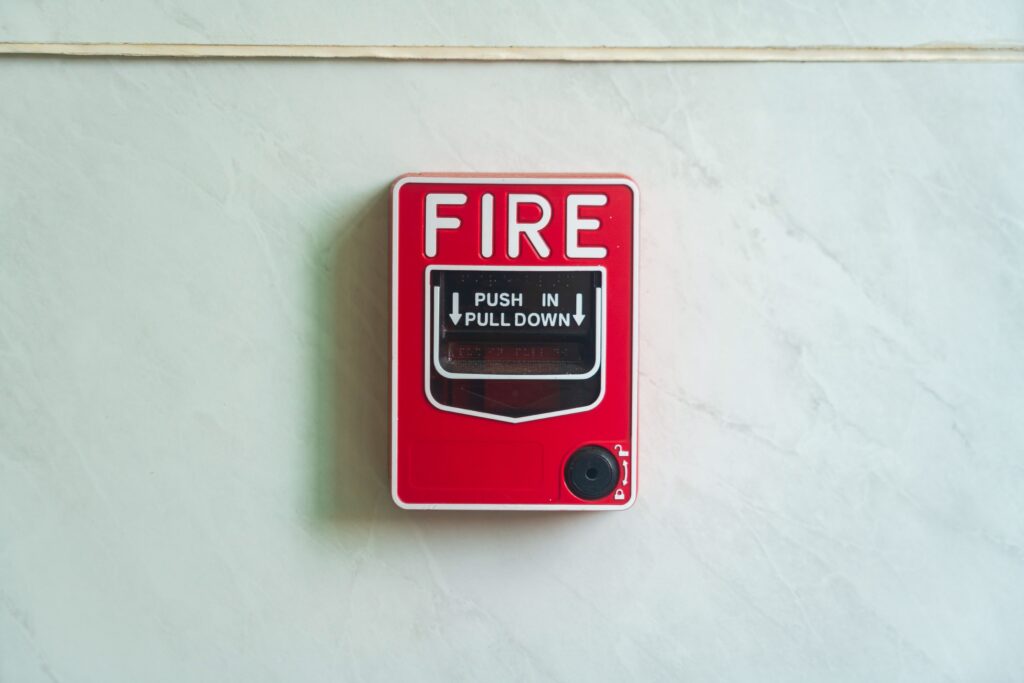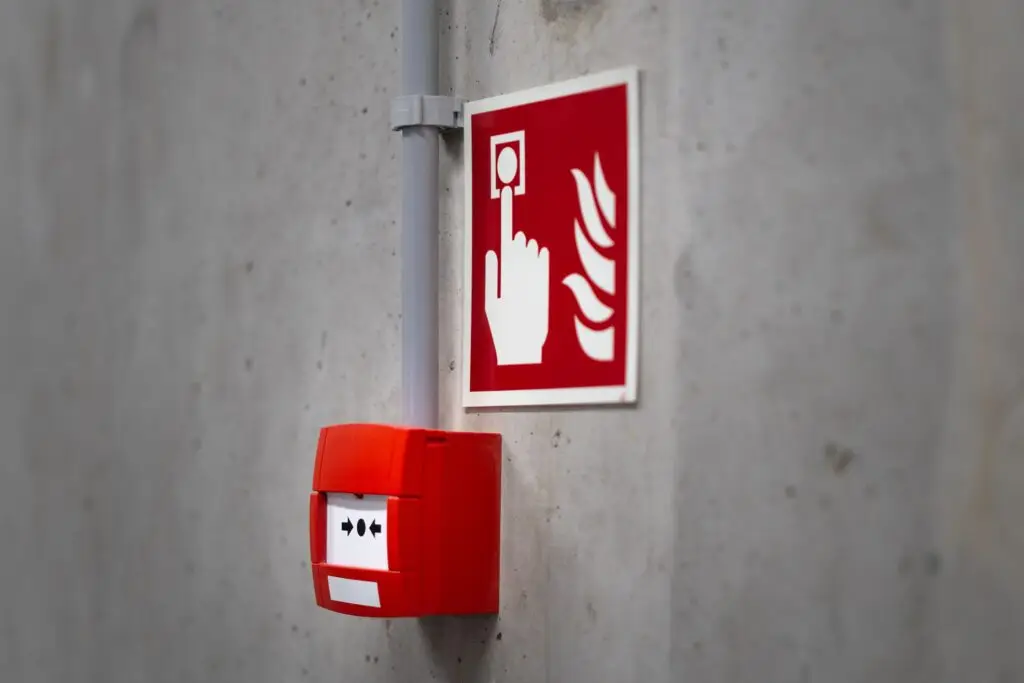
Walk into almost any commercial building and you’ll spot a small red box on the wall near the exit – that’s a manual call point, and it’s one of the most under-appreciated devices in a fire alarm system. While smoke detectors and heat sensors work automatically in the background, an MCP puts the power directly in a person’s hands. Someone spots fire, they break the glass or press the button, and the alarm goes off across the building – often faster than any sensor would react.
This guide covers what a manual call point actually is, how it works, the different types you’ll come across, where it needs to be installed, mounting height as per Indian fire safety standards, and how it should be tested. If you’re a facility manager, contractor, or just trying to understand fire alarm compliance for your building, this should answer most of what you need.
What is a Manual Call Point (MCP)?
A manual call point (MCP) is a device mounted on a wall or column that lets someone manually trigger a fire alarm – usually by breaking a glass panel, pressing a button, or pulling a lever. It’s not automatic. It depends entirely on a person noticing the fire and acting on it.
That’s really the whole idea behind an MCP: give people a fast, obvious way to sound the alarm the moment they see smoke or flames, without waiting for a detector to catch up. You’ll also hear it called a break-glass call point, pull station, or fire alarm call point depending on where you are and which standard the building follows.
A manual call point for fire alarm system installations is mandatory in almost every commercial, industrial, and residential building today – it works alongside smoke and heat detectors, not instead of them, and together they form a complete detection and alarm network.
How Does a Manual Call Point Work?
At its core, an MCP works by closing an electrical circuit the moment it’s activated. Press the button, break the glass, pull the lever – whatever the mechanism, the action trips an internal switch, and that switch sends a signal straight to the fire alarm control panel.
Here’s roughly how it plays out in a real building:
- Someone notices smoke, flames, or an obvious fire hazard.
- They activate the MCP – breaking the glass, pressing the resettable button, or pulling the lever.
- That action closes the internal switch.
- The signal travels to the fire alarm control panel (FACP).
- The panel sets off sirens, hooters, and strobes throughout the building, and in monitored systems, alerts a central station too.
There’s no meaningful delay here. A red manual call point MCP is activated almost the instant it’s touched correctly, which is exactly why it’s treated as the first line of alarm activation in most fire safety plans. A lot of modern units also light up an LED once triggered, so fire wardens can tell at a glance which call point was used and where the alarm originated.
Read More: How Fire Alarm Panels Work – Zones, Detection, Control Explained
Types of Manual Call Points (Indoor, Outdoor/Weatherproof, Conventional, Addressable)
Not every MCP is built the same way, and picking the right one really comes down to where it’s going and what kind of fire alarm system it’s feeding into.
Based on how it’s activated:
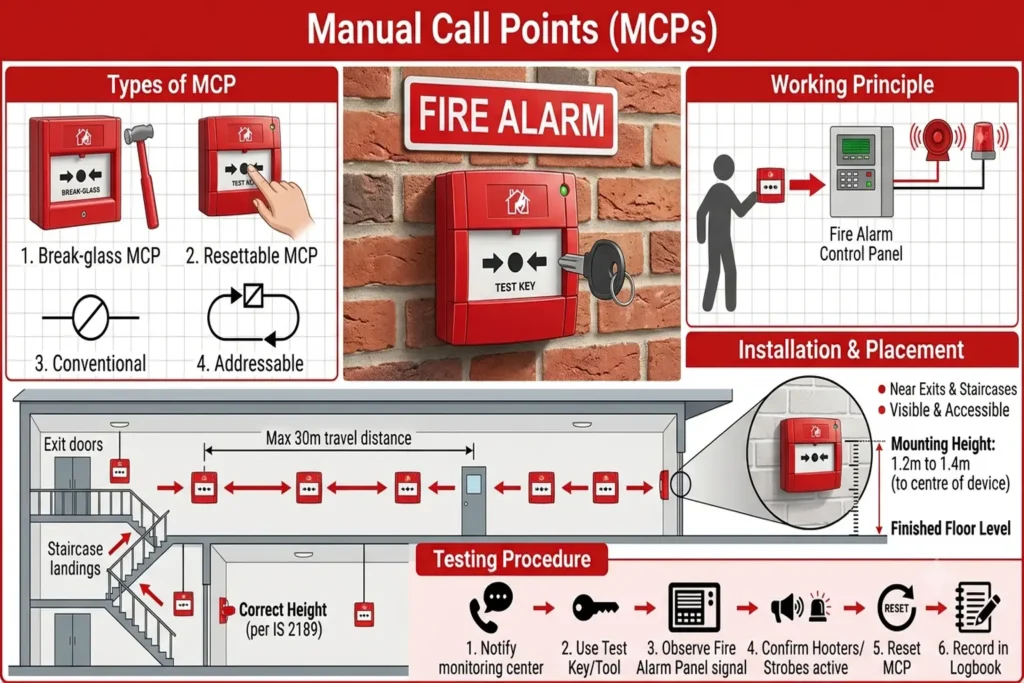
- Break-glass MCP – you break a small glass element to trigger it; the glass is cheap and easy to replace afterward
- Resettable (push-button) MCP – uses a plastic element you press in, then reset with a key, no replacement parts needed
Based on the system architecture:
- Conventional manual call point – wired into zones on a conventional panel, a good fit for smaller sites where budget matters
- Addressable manual call point – each unit has its own unique address, so the panel knows exactly which one was triggered; this is the standard choice for large commercial buildings and high-rises
Based on where it’s installed:
- Indoor manual call point – a standard enclosure, fine for office corridors, lobbies, and similar protected spaces
- Outdoor weatherproof manual call point – IP65/IP66-rated housing built to handle rain, dust, and humidity; you’ll see these in parking areas, industrial yards, and open-air walkways
- Conventional outdoor manual call point – basically a conventional-wired unit housed in a weatherproof shell for outdoor use
If you’re sourcing a fire manual call point in India, don’t assume an indoor-rated unit will hold up outdoors – monsoon humidity and dust exposure will wear it down fast. Match the enclosure rating to the actual environment it’s going into.
Read more: Standalone Fire Alarm Systems – Simple, Reliable Protection
Where Are Manual Call Points Placed? (Placement Rules)
The general rule is simple: MCPs need to sit along escape routes, near exits, and at every staircase landing, close enough that nobody has to go out of their way to reach one during an emergency.
A few things worth keeping in mind:
- Install one at or near every exit and staircase landing
- Space them out along corridors and escape routes at regular intervals
- Keep the maximum travel distance from any point in the building to the nearest MCP within what your applicable fire code allows (commonly around 30 metres, though this can vary by building type and jurisdiction)
- Mount them somewhere visible and well-lit – not tucked into a corner
- Never let furniture, storage, or a half-open door block access to one
Get the placement right, pair it with clear signage, and people can raise the alarm within seconds of spotting a fire. That’s really the whole point of having an MCP in the first place – speed.
Manual Call Point vs Manual Pull Station – What’s the Difference?
Honestly, these two devices do the same job – they’re both manually operated devices for triggering a fire alarm. The difference is mostly regional terminology and which standard governs the installation.
- Common region: Manual call point – UK, Europe, India, Middle East | Pull station – North America
- Activation method: Manual call point – break-glass or push-button | Pull station – pull-down lever/handle
- Governing standard: Manual call point – IS 2189, EN 54-11 | Pull station – NFPA 72, UL 38
- Typical colour: Both are red
- Reset mechanism: Manual call point – key reset or glass replacement | Pull station – key reset
- Common use case: Both are used in conventional and addressable fire alarm systems
So if you’re working on a project in India or Europe, you’ll mostly hear “manual call point.” Cross over to a US-based spec sheet, and it’ll say “pull station” instead. Functionally, though, there’s not much separating the two.
Indoor vs Outdoor (Weatherproof) Manual Call Point – Which One Do You Need?
This one comes down almost entirely to where the device is physically installed. Indoor units are built for controlled environments. Outdoor units are sealed to survive moisture, dust, and temperature swings.
Go with an indoor manual call point if:
- It’s going into office corridors, lobbies, hospitals, schools, or residential buildings
- The space is climate-controlled and shielded from the weather
Go with an outdoor weatherproof manual call point if:
- It’s headed for a parking lot, loading dock, industrial yard, or open walkway
- It’ll face rain, humidity, dust, or direct sun for extended periods
- You specifically need an outdoor waterproof manual call point in India, where monsoon season and humidity are a real concern for electronics left exposed
A proper outdoor weatherproof manual call point should carry at least an IP65 rating, and ideally a UV-stable housing so it doesn’t crack or fade after a couple of summers in direct sunlight.
Manual Call Point Mounting Height & Installation Requirements
The commonly followed fire alarm manual call point mounting height is somewhere between 1.2 and 1.4 metres from finished floor level, measured to the centre of the device – a height most adults, including wheelchair users, can reach comfortably.
A few installation basics worth getting right:
- Mounting height: roughly 1.2m–1.4m from floor level; always double-check the exact figure against IS 2189 and your local fire authority’s requirements
- Wall type: solid, permanent walls or dedicated poles/columns – skip temporary partitions
- Visibility: the unit should be visible from a distance, ideally paired with an illuminated “Fire Alarm” sign
- Wiring: fire-rated cable run through conduit, per applicable electrical and fire codes
- Spacing: positioned so travel distance to the nearest MCP stays within code limits (see the placement section above)
- Accessibility: kept clear of furniture, plants, storage, anything that could get in the way
Getting the manual call point outdoor installation and mounting height right isn’t just a box to tick for an audit – a poorly placed or obstructed MCP can genuinely cost precious seconds in a real fire.
Read More: Reusable Manual Call Point
Selection Criteria for Choosing the Right Manual Call Point
Picking the right MCP really comes down to three things: matching it to your fire alarm system, matching it to the environment it’ll sit in, and making sure it’s actually certified for the job.
A few manual call point requirements worth checking before you buy:
- System compatibility – conventional or addressable, matched to your existing panel
- Environment rating – a standard indoor enclosure vs an IP65/IP66 outdoor weatherproof one
- Activation type – break-glass (single-use element) vs a resettable push-button
- Certification – compliance with IS 2189 (the Indian fire alarm standard) and/or EN 54-11 where relevant
- Build quality – impact-resistant polycarbonate housing, corrosion-resistant internals
- Ease of testing – resettable units let you test without replacing parts every time
- Visibility – LED activation indicators, high-visibility red housing
- Warranty and support – a manufacturer who’ll actually stand behind the product and service it locally
If you’re installing across India, it’s worth confirming IS 2189 compliance up front and matching the enclosure to the actual zone – an air-conditioned office floor and an exposed loading bay have very different requirements, even in the same building.
Read More: Smoke Detector – Trusted Early Fire Warning System
How to Use a Manual Call Point (Step-by-Step)
Using a manual call point is deliberately simple – break the glass or press the button, and the building’s fire alarm goes off almost immediately.
- Find the nearest MCP – usually near an exit, staircase, or corridor, marked with a “Fire Alarm” sign.
- Approach it and lift the protective cover if it has one.
- Activate it: either break the glass element with the small tool provided, or firmly press the resettable button until it clicks in.
- Check for confirmation – an LED indicator, or the building alarm sounding.
- Evacuate immediately, following your building’s fire evacuation plan.
- Don’t go back in until fire wardens or emergency services say it’s clear.
This is the answer to a question people search surprisingly often – how do I press the manual call point – and the short version is: press it firmly, not a light tap. A half-hearted push on a button-type MCP won’t always fully engage the switch.
Read More: Resettable Manual Call Point Eco
Manual Call Point Testing Procedure in Fire Alarm Systems
MCPs need periodic testing, and it should be done using a designated test key or tool that checks the device without setting off a full building evacuation.
A typical manual call point testing procedure in fire alarm systems looks like this:
- Notify the fire safety officer and monitoring station before you start – this avoids an unwanted dispatch of emergency services.
- Use a test key (for addressable systems) or a designated non-destructive test tool where one’s available.
- Activate the MCP and confirm the signal registers correctly at the panel, including the right zone or address.
- Check that the alarm output responds as expected – sirens, strobes, any connected notification devices.
- Reset the device with the manufacturer-approved key or tool.
- Log the test – date, device ID or location, result – in the fire safety maintenance register.
- Rotate through all units so every MCP in the building gets tested within the required cycle, often quarterly depending on site policy and the applicable code.
Skipping this isn’t just a compliance risk – it’s the difference between an MCP working when someone actually needs it, and one that quietly stopped functioning months ago without anyone noticing.
Read more: The Impact of Fire Safety Training on Workplace Safety
Manual Call Point Cover & Accessories
A manual call point cover is a small hinged shield, usually plastic or polycarbonate, that sits over the device to stop accidental knocks, tampering, or casual misuse from setting off a false alarm.
A few accessories worth knowing about:
- Protective covers – stop accidental activation while still allowing fast access in a genuine emergency
- Weatherproof enclosures – extra housing for units mounted outdoors in exposed spots
- Test keys and tools – for safe, non-destructive testing of resettable and addressable MCPs
- Signage – illuminated or photoluminescent “Fire Alarm” signs mounted above or next to the unit
- Mounting boxes – surface or flush-mount, depending on the wall type
A decent manual call point cover for fire alarm setups should lift easily with no tools required in an emergency, but still discourage casual tampering day to day. Most good covers also sound a small alert the moment they’re lifted, which adds a useful extra layer against false alarms.
Read More: Heat Detector – Fast Fire Response System
Why Choose MANXPOWER Manual Call Points
MANXPOWER builds manual call points for both indoor and outdoor fire alarm installations, with an emphasis on rugged construction and compliance with Indian fire safety requirements.
- Conventional and addressable variants available, to fit whatever panel you’re already running
- Indoor and outdoor weatherproof (IP65/IP66) enclosures for any installation environment
- Impact-resistant, UV-stable housing built to last
- Designed with IS 2189 compliance considerations in mind
- Resettable and break-glass options, depending on your testing preferences
- Backed by genuine after-sales support and warranty
Whether you’re fitting out a new commercial site or upgrading an existing fire alarm system, MANXPOWER’s manual call points are built to hold up – and to actually work when it counts.
Read more: Manxpower Standalone Fire Alarm Systems
FAQs
What is a Manual Call Point (MCP)?
A manual call point (MCP) is a wall-mounted device that lets someone manually trigger a fire alarm, usually by breaking glass or pressing a button. It sends a signal straight to the fire alarm control panel, which then sets off the building’s alarm.
How does a Manual Call Point work?
Activating an MCP closes an internal electrical circuit, and that signal goes to the fire alarm control panel. From there, the panel triggers sirens, strobes, and any other notification devices in the building.
How do I press/activate the manual call point?
Lift the cover if there is one, then either break the glass element with the tool provided or firmly press the resettable button until it clicks in. The alarm should sound almost immediately.
What is the maximum distance between manual call points?
MCPs should be spaced so no point in the building is more than a set travel distance from the nearest one – commonly around 30 metres, though the exact figure depends on the fire code that applies to your building.
What is the fire alarm manual call point mounting height?
Typically between 1.2m and 1.4m from finished floor level, measured to the centre of the device, so it’s accessible to most people including wheelchair users.
What is the difference between a manual call point and a manual pull station?
They do the same job. “Manual call point” is the term used in the UK, Europe, and India (under standards like IS 2189), while “pull station” is the term more common in North America under NFPA 72.
How do I install a manual call point?
Mount it on a solid wall or column at the correct height, near exits and along escape routes, wire it with fire-rated cable back to the control panel, and make sure spacing meets your local travel distance requirements.
What is MCP in fire safety?
MCP stands for Manual Call Point – a device that lets a person manually raise a fire alarm, as opposed to automatic detectors like smoke or heat sensors that trigger on their own.
How do I test a manual call point?
Notify the monitoring station first, activate the MCP using a test key or non-destructive method, confirm it registers correctly at the panel, reset it, and log the result in your maintenance records.
Why do I need a manual call point in my building?
Because it gives people an immediate way to raise the alarm the second they spot a fire – often faster than automatic detection – and it’s a mandatory requirement under most fire safety codes for commercial and residential buildings alike.