Reviewed by the Fire Safety Team at MANX IMPEX | Specialists in Fire Protection Equipment & Fire Safety Solutions
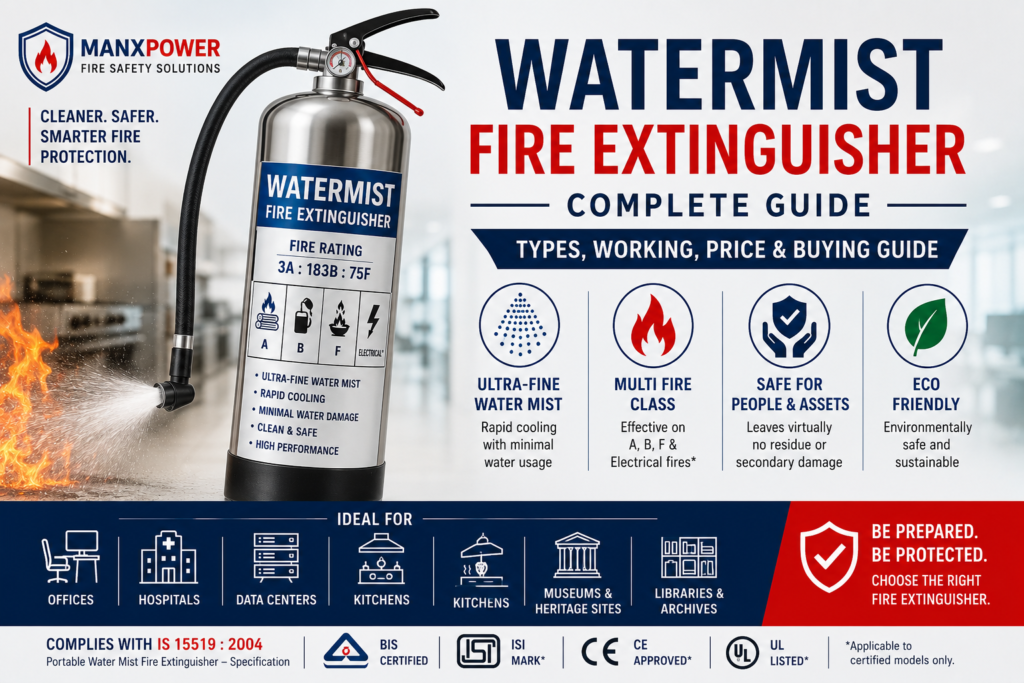
A watermist fire extinguisher is a portable fire extinguisher that uses ultra-fine water droplets to extinguish fires by rapidly cooling the flames, reducing oxygen around the fire, and preventing re-ignition. It is considered one of the cleanest fire suppression solutions available and is widely used in environments where protecting people, sensitive equipment, and valuable assets is a priority.
If you’re wondering what is a watermist fire extinguisher, how it works, where it can be used, or whether it’s better than a water, CO₂, foam, or ABC extinguisher, this guide explains everything you need to know. We’ll also cover its construction, applications, Indian standards, maintenance, and important buying considerations.
Educational Disclaimer: MANXPOWER currently manufactures and supplies Water Based Fire Extinguishers, not Watermist Fire Extinguishers. This guide has been created for educational purposes to help customers understand different fire extinguisher technologies and choose the most suitable solution for their fire risks.
What is a Watermist Fire Extinguisher?
A watermist fire extinguisher is a portable extinguisher that converts water into extremely fine droplets using a specially designed nozzle. Unlike a conventional water extinguisher that releases a continuous stream, a watermist extinguisher creates a dense mist that absorbs heat quickly and suppresses fire using multiple mechanisms.
Many people search for “What is a watermist fire extinguisher?” because it is capable of tackling several fire risks while using much less water than traditional water extinguishers. This helps minimise water damage and makes it suitable for locations containing valuable equipment or sensitive materials.
Watermist fire extinguisher contains
A typical watermist fire extinguisher consists of:
- Clean or demineralised water
- Nitrogen as the propellant gas
- Stainless steel or mild steel pressure cylinder
- High-pressure discharge hose
- Precision watermist nozzle
- Valve assembly
- Pressure gauge
- Safety pin and operating lever
Unlike dry powder extinguishers, watermist extinguishers leave virtually no residue after discharge, making post-fire clean-up much easier.
How Does a Watermist Fire Extinguisher Work?
The water mist fire extinguisher working principle is based on producing microscopic water droplets instead of a solid stream of water.
Because these droplets have a much larger combined surface area, they absorb heat rapidly, convert into steam, and suppress the fire much more efficiently than ordinary water alone.
A watermist extinguisher generally controls fire through three separate actions.
Cooling Effect
The primary method of extinguishment is rapid cooling.
The tiny water droplets absorb a large amount of heat almost immediately after contacting the flames.
This helps to:
- Lower the fire temperature quickly.
- Cool burning materials.
- Prevent the fire from spreading.
- Reduce the risk of re-ignition.
Because the droplets are so small, significantly less water is required compared to conventional water extinguishers.
Oxygen Displacement
As the fine droplets absorb heat, they rapidly convert into steam.
The steam temporarily reduces the oxygen concentration immediately surrounding the fire, making it more difficult for combustion to continue.
This additional effect helps extinguish the fire more efficiently, especially in enclosed spaces.
Blanket / Smothering Effect
The dense cloud of fine mist also creates a temporary barrier around the burning material.
This helps to:
- Reduce heat radiation.
- Slow fire spread.
- Shield nearby combustible materials.
- Improve overall extinguishing performance.
Rather than relying on a single extinguishing mechanism, watermist combines cooling, oxygen reduction, and heat shielding at the same time.
Construction and Materials Used
Although different manufacturers may have slightly different designs, most watermist extinguishers use similar components.
The quality of these components directly affects performance, durability, and reliability during an emergency.
Cylinder Body (Stainless Steel / Mild Steel)
The cylinder stores both the extinguishing medium and the propellant gas under pressure.
Manufacturers generally use:
- Stainless steel
- Mild steel with corrosion-resistant coating
The cylinder is hydrostatically tested during manufacturing to ensure safe operation under pressure.
Nozzle and Hose (EPDM / Braided)
The nozzle is one of the most important parts of a watermist extinguisher.
Unlike conventional water extinguishers, it is specially engineered to atomise water into microscopic droplets.
The discharge hose is commonly manufactured using:
- EPDM rubber
- Braided synthetic hose
- Reinforced rubber materials
These materials provide flexibility while withstanding repeated use and operating pressure.
Propellant (Nitrogen)
Most modern watermist extinguishers use nitrogen as the propellant gas.
Nitrogen is preferred because it is:
- Non-flammable
- Stable under pressure
- Non-toxic
- Environmentally safe
- Highly reliable
Its purpose is simply to pressurise the extinguisher and force the water through the specialised mist nozzle.
Read more: Fire Extinguishing Agents – Powder, Carbon Dioxide, Foam, Clean Agent
Which Fire Classes Can It Handle?
One of the biggest advantages of a watermist extinguisher is that certified models can often tackle multiple classes of fire.
However, the exact fire classes always depend on the manufacturer’s certification and fire rating.
Class A Fires
Suitable for fires involving:
- Wood
- Paper
- Cardboard
- Fabric
- Furniture
- Plastic (where applicable)
These are the most common fires found in offices, schools, hotels, hospitals, and residential buildings.
Class B Fires
Some certified watermist extinguishers can also be used on certain flammable liquid fires involving:
- Petrol
- Diesel
- Paint
- Solvents
- Oils
Always check the manufacturer’s fire rating before use.
Electrical Fires
Many people consider watermist to be among the best fire extinguishers for electrical fires because certain models are dielectric tested.
Certified watermist extinguishers may be suitable for use on energised electrical equipment when operated within the manufacturer’s specified voltage limits.
However, not every watermist extinguisher is approved for live electrical fires, so product certification should always be verified.
Class F Fires
Some watermist extinguishers are also tested for small cooking oil and fat fires.
They are commonly used in:
- Commercial kitchens
- Restaurants
- Hotel kitchens
- Institutional kitchens
Again, suitability depends on the individual product’s certification and fire rating.
Typical Fire Rating
Many quality watermist extinguishers are available with fire ratings such as:
- 3A
- 183B
- 75F
Higher fire ratings indicate greater firefighting capability, although ratings vary between manufacturers and extinguisher sizes.
Common Applications
A watermist fire extinguisher is often considered for locations where clean fire suppression is important, including:
- Offices
- Hospitals
- Schools
- Museums
- Libraries
- Hotels
- Heritage buildings
- Data centres
- Server rooms
- Laboratories
- Commercial kitchens
These environments benefit from an extinguisher that uses minimal water and leaves virtually no residue after use.
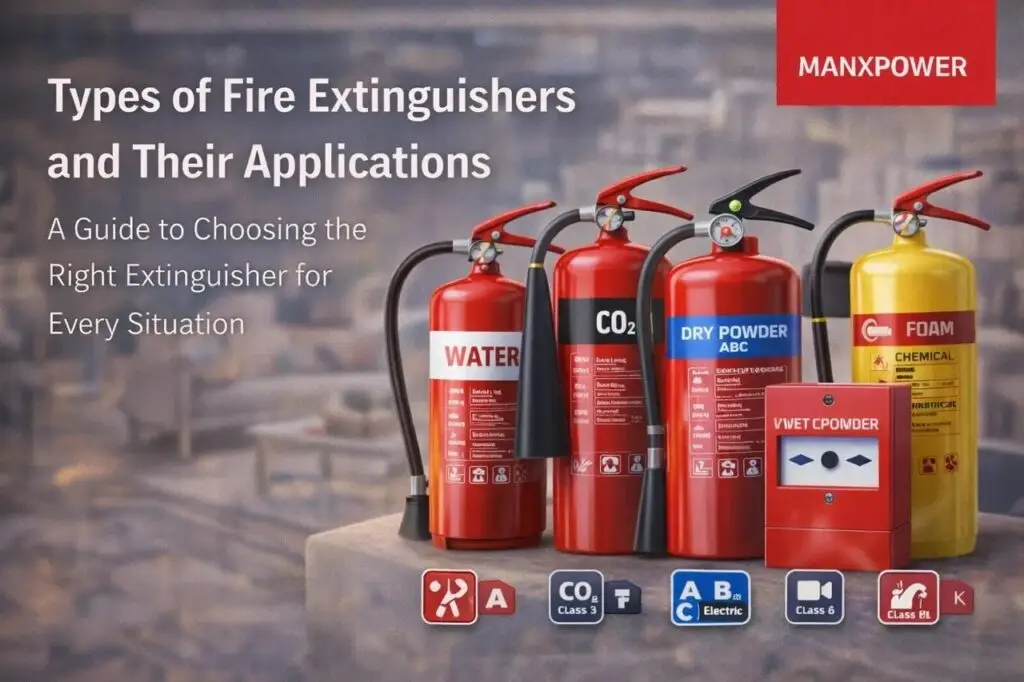
Read more: Types of Fire Extinguishers and Their Applications
Advantages of Watermist Fire Extinguishers
Watermist technology has become increasingly popular because it offers effective fire suppression while using significantly less water than conventional water extinguishers. The fine mist produced during discharge cools the fire quickly and helps minimise damage to the surrounding area.
If you’re researching watermist fire extinguisher advantages and disadvantages, here are some of the key benefits.
Advantages
- Uses ultra-fine water droplets for rapid fire suppression.
- Requires significantly less water than conventional water extinguishers.
- Helps reduce water damage to furniture, equipment, and interiors.
- Leaves virtually no chemical residue after use.
- Provides excellent cooling performance.
- Can suppress multiple fire classes depending on certification.
- Environmentally friendly extinguishing medium.
- Easy to clean after discharge.
- Suitable for sensitive environments where cleanliness is important.
- Lower risk of secondary damage compared to powder extinguishers.
These advantages make watermist extinguishers particularly attractive for locations containing valuable equipment, sensitive electronics, or important documents.
Disadvantages / Limitations
Although watermist extinguishers offer several benefits, they aren’t the right solution for every fire risk.
Understanding their limitations helps ensure the correct extinguisher is selected during a fire risk assessment.
Disadvantages
- More expensive than standard water extinguishers.
- Not every model is approved for live electrical fires.
- Fire performance varies depending on manufacturer certification.
- May not replace specialist extinguishers for every application.
- Requires regular servicing and pressure testing.
- Availability is more limited than conventional extinguishers.
- Larger industrial hazards may require dedicated suppression systems.
Choosing the correct extinguisher should always be based on the specific fire hazards present in the building.
Watermist vs Water Fire Extinguisher
Although both extinguishers use water as the extinguishing medium, they perform very differently.
Watermist Fire Extinguisher
- Produces microscopic water droplets.
- Uses significantly less water.
- Rapidly cools burning materials.
- Helps reduce oxygen around the flames.
- Leaves minimal water damage.
- Suitable for multiple fire classes depending on certification.
Water Based Fire Extinguisher
- Releases a continuous stream of water.
- Primarily designed for Class A fires.
- Uses a greater volume of water.
- Can result in more water damage after firefighting.
- Generally more economical.
- Widely used in commercial buildings for ordinary combustible materials.
Which should you choose?
If your primary concern is protecting paper, wood, textiles, and similar materials, a MANXPOWER Water Based Fire Extinguisher is often a practical and cost-effective choice. Watermist extinguishers are generally selected where reducing water damage is a priority.
Watermist vs CO₂ Fire Extinguisher
Both extinguisher types are commonly installed in commercial buildings but are designed for different fire risks.
Watermist Fire Extinguisher
- Uses ultra-fine water droplets.
- Provides rapid cooling.
- Leaves almost no residue.
- Suitable for multiple fire classes depending on certification.
- Often selected for hospitals, museums, and offices.
CO₂ Fire Extinguisher
- Uses carbon dioxide gas.
- Leaves no residue.
- Excellent for electrical equipment.
- Does not cool burning solid materials effectively.
- Commonly installed near electrical panels and server rooms.
Which should you choose?
For electrical switchboards and electrical panels, CO₂ extinguishers remain one of the preferred options. Watermist extinguishers may be suitable where certified and where multiple fire risks exist.
Watermist vs Foam Fire Extinguisher
Foam and watermist extinguishers both have their place in fire protection, but they are designed for different applications.
Watermist Fire Extinguisher
- Uses clean water in microscopic droplets.
- Minimal water usage.
- Very little residue.
- Easier clean-up after discharge.
- Suitable for sensitive environments.
Foam Fire Extinguisher
- Forms a blanket over burning liquid surfaces.
- Excellent for Class A and Class B fires.
- Leaves foam residue.
- Requires cleaning after discharge.
- Commonly used in fuel storage areas and warehouses.
Which should you choose?
Foam extinguishers are excellent for flammable liquid hazards, while watermist extinguishers are often preferred where cleanliness and reduced water damage are important.
Watermist vs ABC Fire Extinguisher
This is one of the most common comparisons because ABC extinguishers are widely used throughout India.
Watermist Fire Extinguisher
- Uses clean water mist.
- Leaves almost no residue.
- Lower clean-up costs.
- Suitable for sensitive environments.
- Minimal secondary damage.
ABC Dry Powder Fire Extinguisher
- Suitable for Class A, B, and C fires.
- Highly versatile.
- Effective in many industrial applications.
- Leaves a fine powder residue.
- Can damage electronic equipment if not cleaned properly.
Which should you choose?
ABC extinguishers remain one of the most versatile fire extinguishers available. Watermist extinguishers are often selected where protecting valuable equipment and reducing clean-up time are equally important.
Read more: Fire Extinguishing Agents – A Complete Guide
How to Choose the Right Size (2L, 3L, 6L, 9L)
Watermist extinguishers are available in several capacities. The correct size depends on the occupancy, fire risk, and recommendations made during the fire risk assessment.
2 Litre Watermist Fire Extinguisher
Suitable for:
- Small offices
- Retail shops
- Apartments
- Reception areas
3 Litre Watermist Fire Extinguisher
Commonly installed in:
- Clinics
- Schools
- Small commercial premises
- Residential buildings
6 Litre Watermist Fire Extinguisher
Recommended for:
- Medium-sized offices
- Hotels
- Hospitals
- Educational institutions
- Commercial buildings
9 Litre Watermist Fire Extinguisher
The 9 Ltr Watermist Fire Extinguisher is generally selected for locations requiring greater firefighting capacity.
Typical applications include:
- Large office buildings
- Shopping malls
- Manufacturing facilities
- Warehouses
- Hospitals
The correct extinguisher size should always be selected according to the building’s fire risk assessment and applicable fire safety regulations.
Best Applications
Because watermist uses very fine water droplets and leaves almost no residue, it is often considered for environments containing valuable assets or sensitive equipment.
Watermist Fire Extinguisher for Offices
Suitable for:
- Office workstations
- Conference rooms
- Reception areas
- Archive rooms
Watermist Fire Extinguisher for Hospitals
Often considered for:
- Patient wards
- Administrative offices
- Medical facilities
- Healthcare buildings
Watermist Fire Extinguisher for Data Centers
Data centres contain expensive electronic equipment where minimising residue and water damage is particularly important.
Certified watermist extinguishers are sometimes selected for these environments after a suitable fire risk assessment.
Watermist Fire Extinguisher for Kitchens
Some certified watermist extinguishers are suitable for small cooking oil fires and may be installed in:
- Restaurants
- Hotels
- Commercial kitchens
- Institutional catering facilities
Always confirm the fire rating before selecting an extinguisher for cooking oil hazards.
Indian Standards & Certifications
Choosing a certified extinguisher is just as important as choosing the correct extinguisher type.
For portable watermist extinguishers, buyers should look for products that comply with the relevant standards and certifications where applicable.
Common certifications include:
- IS 15683 (Portable Fire Extinguishers)
- BIS Certified Watermist Extinguisher
- ISI Mark (where applicable)
- CE Certified Watermist Extinguisher
- UL Listed Watermist Extinguisher (for international projects)
Before purchasing any extinguisher, always verify:
- Fire rating
- Applicable certification
- Manufacturer details
- Installation recommendations
- Service and maintenance requirements
Educational Note: Although MANXPOWER does not currently manufacture Watermist Fire Extinguishers, we do offer MANXPOWER Water Based Fire Extinguishers for Class A fire risks. For many commercial buildings, schools, offices, and warehouses, a quality water-based extinguisher may be the more practical and economical choice, depending on the results of the fire risk assessment.
What Affects Watermist Fire Extinguisher Price in India?
One of the most common questions buyers ask is about the watermist fire extinguisher price in India. However, there isn’t a single fixed price because several factors influence the overall cost.
The price depends on:
- Extinguisher capacity (2L, 3L, 6L, or 9L)
- Fire rating (such as 3A:183B:75F)
- Manufacturing quality
- Cylinder material (stainless steel or mild steel)
- BIS/ISI certification
- CE or UL certification (where applicable)
- Brand reputation
- Accessories supplied with the extinguisher
- Quantity ordered
For example, the 9 ltr watermist fire extinguisher price will generally be higher than a 2-litre model because of its larger capacity and higher firefighting performance.
Rather than choosing an extinguisher based only on price, it’s important to ensure it is suitable for your fire risks and complies with the relevant standards.
Installation and Mounting Guide
Correct installation is just as important as selecting the right extinguisher. An extinguisher that cannot be located or accessed quickly may delay emergency response.
Best installation practices
- Mount the extinguisher on a wall bracket or approved stand.
- Install it in a clearly visible location.
- Keep it close to emergency escape routes.
- Ensure there are no obstructions in front of the extinguisher.
- Position it where it can be reached quickly during an emergency.
- Install appropriate fire extinguisher signage above the unit.
- Avoid locations exposed to excessive heat, moisture, or corrosive chemicals unless the extinguisher is designed for those conditions.
Regular inspections should be carried out to ensure the extinguisher remains accessible and in good condition.
Watermist Fire Extinguisher Refilling Process
Like every portable fire extinguisher, a watermist extinguisher requires professional servicing after use or whenever maintenance is due.
The watermist fire extinguisher refilling process generally includes:
- Complete inspection of the extinguisher body.
- Internal examination of the cylinder.
- Replacement of damaged seals or O-rings.
- Refilling with the correct extinguishing medium.
- Recharging with nitrogen.
- Pressure testing where required.
- Leak testing.
- Final inspection and labelling.
Refilling should always be carried out by trained technicians using approved equipment and procedures.
Read more: Fire Extinguisher Spares – Why Quality Components Matter
Maintenance and Inspection Checklist
Routine maintenance helps ensure the extinguisher will operate correctly when required.
A simple inspection schedule should include the following checks.
Monthly inspection
- Check the pressure gauge.
- Ensure the safety pin is intact.
- Verify the tamper seal is in place.
- Confirm the extinguisher is easily accessible.
- Inspect the hose and nozzle for damage.
- Check for corrosion or dents.
- Ensure operating instructions remain legible.
Annual servicing
Annual servicing should be carried out by qualified personnel and typically includes:
- Internal inspection.
- Functional testing.
- Replacement of worn components.
- Pressure checks.
- Service labelling.
- Certification where applicable.
Keeping accurate maintenance records also helps demonstrate compliance during safety audits.
Read more: Fire Extinguisher Maintenance Guide
Common Myths About Watermist Fire Extinguishers
Watermist technology is still relatively new to many users, leading to several common misconceptions.
Myth 1: Watermist extinguishers are the same as ordinary water extinguishers.
Fact: Watermist extinguishers atomise water into microscopic droplets, whereas conventional water extinguishers release a continuous stream of water.
Myth 2: Every watermist extinguisher can be used on electrical fires.
Fact: Only extinguishers that have been specifically tested and certified for electrical applications should be used on energised electrical equipment.
Myth 3: Watermist extinguishers replace every other extinguisher.
Fact: No single extinguisher is suitable for every fire risk. Fire extinguisher selection should always be based on a professional fire risk assessment.
Myth 4: Watermist extinguishers require no maintenance.
Fact: Like every portable fire extinguisher, they require periodic inspection, servicing, and testing to ensure reliable performance.
Read more: Manxpower Fire Extinguishers – Essential Protection Every Time
Why Choose MANXPOWER Water Based Fire Extinguishers?
Although MANXPOWER does not currently manufacture Watermist Fire Extinguishers, we understand that many customers researching watermist technology are looking for the most suitable fire extinguisher for their building.
For many commercial and industrial applications, a MANXPOWER Water Based Fire Extinguisher may be the more practical and economical choice, particularly where the primary fire risk involves ordinary combustible materials.
Why choose MANXPOWER?
- Trusted fire safety supplier in India.
- High-quality fire protection products.
- Water Based Fire Extinguishers for Class A fires.
- Complete range of fire extinguishers and hydrant equipment.
- Technical guidance from experienced professionals.
- Support for commercial, industrial, and institutional projects.
- Competitive pricing and bulk supply.
- Reliable after-sales support.
If you’re unsure whether a watermist or water-based extinguisher is appropriate for your premises, our team can help you understand the differences and recommend the most suitable solution.
Final Thoughts
A watermist fire extinguisher is an advanced fire protection solution that combines rapid cooling, reduced water usage, and clean fire suppression. Its ability to tackle multiple fire risks while minimising residue makes it a popular choice for hospitals, offices, museums, kitchens, data centres, and other environments where protecting valuable assets is important.
However, selecting the right extinguisher should always begin with a proper fire risk assessment. Every building has different hazards, and no single extinguisher is suitable for every situation.
Although MANXPOWER does not currently manufacture Watermist Fire Extinguishers, we offer a comprehensive range of Water Based Fire Extinguishers and other fire protection equipment for commercial, industrial, and institutional applications. Our team can help you understand the differences between extinguisher types and recommend the most suitable solution based on your fire safety requirements.
Need expert guidance on choosing the right fire extinguisher? Contact MANXPOWER today for professional advice and dependable fire safety solutions.
Frequently Asked Questions
What is the difference between a water and a watermist fire extinguisher?
A conventional water extinguisher releases a continuous stream of water, while a watermist extinguisher produces microscopic droplets that cool the fire more efficiently using much less water.
Are watermist fire extinguishers any good?
Yes. Certified watermist extinguishers are effective for many applications because they provide rapid cooling, leave minimal residue, and help reduce water damage. However, suitability depends on the specific fire risks and product certification.
Can watermist extinguishers be used in kitchens with hot oil?
Some certified watermist extinguishers are suitable for small cooking oil fires. Always check the extinguisher’s fire rating and manufacturer’s instructions before using it on Class F fires.
Do insurers recognise watermist extinguishers for fire insurance policies?
Insurance requirements vary depending on the property, occupancy, and insurer. Always consult your insurer and ensure the installed extinguishers comply with the applicable fire safety standards and local regulations.
How much does a 9L watermist fire extinguisher cost?
The 9 ltr watermist fire extinguisher price varies depending on the manufacturer, certifications, fire rating, and product quality. Contact suppliers directly for current pricing and availability.
How much does a 50 Litre watermist fire extinguisher cost?
Large-capacity watermist extinguishers are typically used for specialised industrial or commercial applications. Pricing depends on the system design, manufacturer, and project requirements.
Is a watermist fire extinguisher safe for electrical fires?
Some dielectric-tested models are suitable for use on energised electrical equipment. Always verify the manufacturer’s certification before using a watermist extinguisher on electrical fires.
What Indian standard applies to watermist fire extinguishers?
Portable watermist fire extinguishers should comply with IS 15683, along with any other applicable BIS or certification requirements for the specific product.