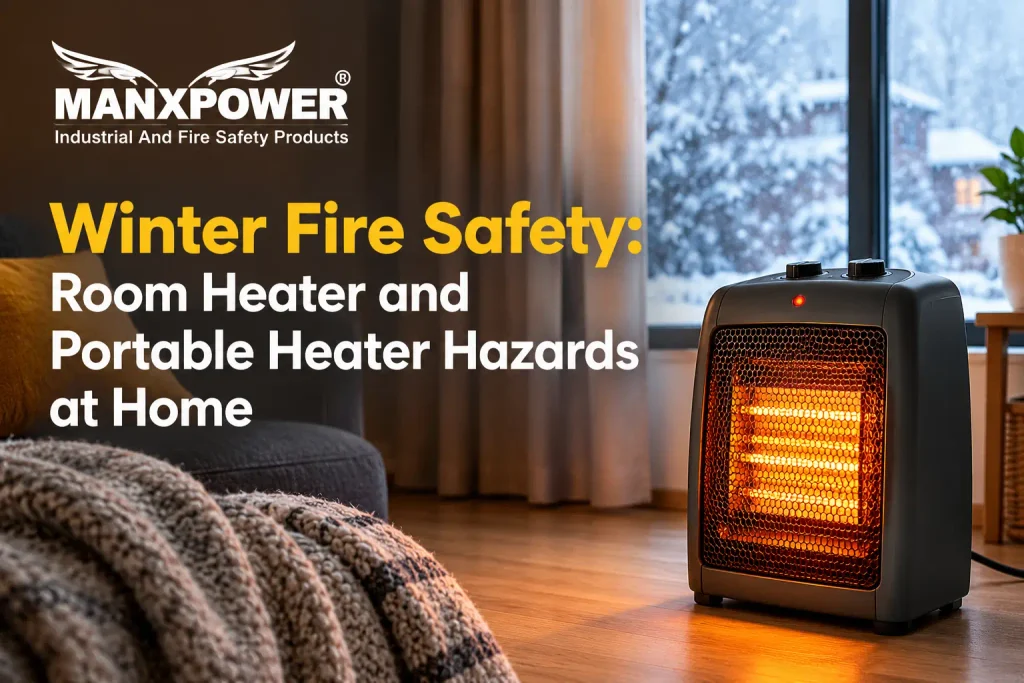
Winter fire safety comes down to five habits: keep heaters at least 1 metre (3 feet) from anything that can burn, plug them into a wall socket (not an extension board), never leave them on while you sleep or go out, switch geysers off after use, and keep a working smoke alarm and extinguisher near your exit. Heater fires usually trace back to the same few mistakes: placement, power supply and leaving the heater unattended.
This winter heating safety guide covers the main winter fire hazards in Indian homes, how to use room heaters and portable heaters safely, a checklist you can finish this week, and what to do if a heater catches fire.
Why do winter fire hazards increase at home?
Winter fire hazards rise because people run high-wattage appliances for longer, in closed rooms, close to bedding and clothes.
- Heaters, blowers and geysers run for hours, often on the same socket or extension board.
- Windows and doors stay shut, so heaters end up close to curtains, quilts and furniture.
- Quilts, blankets, woollens and curtains catch fire quickly once a flame or hot surface touches them.
- Old wiring and loose sockets struggle under a sustained heavy load.
- Coal angithis and charcoal braziers add open embers and fumes to a closed room.
The numbers show why this matters. India recorded 5,971 fire accidents and 5,888 fire deaths in 2024, according to NCRB data compiled by Dataful. Of those fires, 3,585 were in residential buildings, and electrical short circuits caused 17.2% of the deaths. The winter fire safety steps below, along with these cold weather fire safety tips, target each of these risks.
What causes portable heater fires, and which heaters are riskiest?
Portable heater fires usually start in one of four ways: something flammable touches the heater, the plug or cord overheats, the heater tips over or is covered, or the socket is overloaded. Portable heater fire safety starts with knowing which type you own, because each type carries a different portable heater fire hazard.
| Heater type | Main fire risk | Safer practice |
| Blower (fan) heater | Dust in the vents; overheating if the air inlet is blocked | Clean the grille before winter, keep the inlet clear, place it on a hard flat surface |
| Oil-filled radiator | Hot surface can ignite clothes draped over it; plug can overheat on long runs | Never cover it or dry clothes on it, and keep it clear of curtains. It has no glowing element or fan, which lowers (but does not remove) the risk of ignition on contact |
| Halogen or quartz rod heater | Exposed glowing element can ignite nearby fabric | Keep 1 metre clear, never use near bedding, choose a model with a tip-over switch |
| Gas or LPG heater | Gas leak, open flame near fabric, carbon monoxide fumes in a closed room | Use only in a ventilated room, check the hose and regulator, close the cylinder valve when off |
| Coal angithi or charcoal brazier | Sparks, embers and carbon monoxide fumes in a closed room | Never use in a closed room or while sleeping |
Whatever the type, buy a heater with the ISI mark, an overheat cut-off and a tip-over switch. For winter fire safety, the ISI mark matters because room heaters fall under the BIS standard IS 302 (Part 2/Sec 30), which BIS lists under mandatory certification. The standard text tests that a portable heater stays stable when tilted and does not overheat when covered. A heater without these protections gives you no second line of defence if something goes wrong. Even with them, never rely on them while you sleep.
How do you use a room heater safely?
Room heater safety comes down to distance, power supply and switching off. Keep the heater 1 metre clear of anything flammable, plug it into a wall socket, and switch it off whenever you sleep or go out. These portable heater safety tips apply to every type:
- Keep a clear zone. Leave at least 1 metre (3 feet) around the heater, away from curtains, bedding, sofas, clothes and paper. Do not place a heater where a quilt, curtain or clothes can fall or blow onto it.
- Plug into the wall. Avoid extension boards and multi-plugs. Many room heaters draw 1,000 to 2,000 watts or more, which can overheat a light-duty board. If you have no choice, use a heavy-duty ISI-marked board rated well above the heater’s load, and plug nothing else into it.
- Use a stable surface. Place the heater on a flat, hard floor, never on a bed, carpet or sofa.
- Never dry clothes on it. Towels, socks and shoes on or near a heater are a common ignition source.
- Switch off before sleeping or going out. Switch the heater off and unplug it when you go to bed or leave the house. Keep warm another way instead, such as a warmer quilt or a hot-water bottle.
- Check the plug and cord. A warm plug, discoloured pins, a burning smell or crackling means stop using it. Replace damaged cords.
- Keep children and pets away. Use a guard and keep the heater out of reach.
- Keep it dry. Never use a heater near water or on a wet floor.
Hostels and PGs face extra risk, because heaters, chargers and extension boards share one small room. See our page on fire safety for schools, colleges and hostels.
Are geysers a winter fire hazard?
Yes, they can be. Geysers run longer in winter, so small faults show up more often. Switch an electric geyser off once the water is hot, and make sure it is earthed.
Gas geysers need fresh air. A gas geyser in a closed bathroom can release dangerous fumes.
What should be on your winter fire safety checklist?
A winter fire safety checklist covers five areas: heater cords and plugs, clear space, sockets, alarms and extinguishers, and switching off. These fire safety tips for winter double as home heating safety tips, so work through them once before the cold peaks and repeat each winter.
- Inspect every heater cord and plug. Replace any that are frayed, cracked or discoloured.
- Clean dust from the vents and grille of blower heaters.
- Mark a 1-metre clear zone around each heater.
- Plug heaters directly into wall sockets. Avoid extension boards.
- Ask a licensed electrician to check any socket or wiring that feels warm, loose or old.
- Switch geysers off after use and confirm the earthing.
- Test your smoke alarm, and add one outside the bedrooms. See our standalone alarm systems.
- Check your extinguisher gauge and service date, and keep it near an exit. Our home fire extinguisher guide explains the right type and size.
- Keep a fire blanket in the kitchen.
- Make sure everyone knows to switch off the power, get out and call 101 or 112.
- Switch heaters off before you sleep or go out. Never use an angithi or brazier in a closed room or while sleeping.
- If you use a gas heater, fit a CO detector nearby, as its manual advises.
What should you do if a heater catches fire?
A fire at home in winter can start with a heater, so rehearse these steps. Switch off the power, use the right extinguisher on a small fire, and leave at once if it spreads.
- Switch the heater off at the wall socket or MCB, but only if you can do it without reaching across the flames.
- Do not use water. A heater is an electrical appliance, and water can cause a shock.
- For a small fire, use an ABC dry powder extinguisher aimed at the base of the flames, or smother it with a fire blanket.
- If the fire reaches curtains, bedding or the ceiling, or smoke fills the room, leave immediately and, if it is safe, close the door behind you.
- Call 101 for the fire service or 112 for any emergency, and stay outside until responders say it is safe.
Have the wiring and socket checked before you use any appliance there again. For wiring faults and which extinguisher suits electrical fires, read our electrical fire safety guide.
Where can you learn more about winter fire safety at home?
Heater safety in winter comes down to a few habits: a clear zone, a wall socket and switching off. To go further, read how to choose the right home fire extinguisher type and size, learn about electrical fire causes and prevention at home, and see how standalone smoke alarms work.
Have a question about heater safety, smoke alarms or what your home needs? Our team can explain. We are available Monday to Saturday, 10:30 AM to 5:00 PM. Call us on +91 11 4987 2937, email: info@manximpex.com or ask our fire safety team a question.
What customers say about MANXPOWER fire safety products (Google reviews):
“I purchased the MANXPOWER ABC Powder fire extinguisher for my office and I am extremely satisfied with my purchase. It is well-made and easy to use, and I feel much more confident and prepared in case of an emergency.” — Kabir Mehta, February 2023
“The team provided excellent service while installing the fire extinguisher, Fire Alarm Panel, Smoke Detector, Hooter, and MCP. They were highly professional, cooperative, and ensured a smooth installation process. The staff also gave a proper demo, making it easy to understand the system’s functionality.” — BoonBricks, February 2025
“Manxpower provides high-quality Fire Extinguishers and Standalone Fire Alarm Systems with reliable performance. Their installation service is professional, and the team is highly knowledgeable.” — Chandan Srivastava, February 2025
Frequently asked questions
Can I leave a room heater on overnight?
No. Switch it off and unplug it before you sleep or go out. Even heaters with auto shut-off can fail, and a sleeping person cannot react to smoke or a burning smell. Use a warmer quilt or a hot-water bottle instead.
Can I plug a room heater into an extension board?
Avoid it. A room heater draws a heavy load, and a light-duty board can overheat at the plug or cord. Plug it into a wall socket. If you have no choice, use a heavy-duty ISI-marked board rated well above the heater’s load, and plug nothing else into it.
How far should a heater be from the bed or curtains?
Keep at least 1 metre (3 feet) clear on every side. Do not place a heater where a quilt, curtain or clothes can fall or blow onto it.
Is a room heater dangerous?
It can be if it is misused. Fires usually start when something flammable touches the heater, the plug or cord overheats, the heater tips over or is covered, or the socket is overloaded. Keep a 1-metre clear zone, use a wall socket, and switch it off when you sleep or go out.
Is an oil-filled radiator safer than a blower heater?
Neither is risk-free. An oil-filled radiator has no glowing element or fan, so it is less likely to ignite things on contact, but its surface gets hot and it still needs a clear zone. Choose any heater with an ISI mark, an overheat cut-off and a tip-over switch.