Electrical fire safety isn’t something most people think about until a plug sparks or a breaker trips one too many times. But electrical fires behave differently from ordinary fires — they can’t be put out with water, they often start inside walls or panels where you can’t see them coming, and choosing the wrong extinguisher can genuinely make things worse. This guide covers what causes electrical fires, how to prevent them at home and in the workplace, practical steps for electrical fire protection, and — just as important — which fire extinguisher for electrical fires actually works, and why.
Whether you’re trying to fireproof your home, meet workplace compliance requirements, or just figure out what extinguisher to keep near your electrical panel, this covers the full picture, grounded in practical electrical fire safety tips you can actually use.
What is an Electrical Fire?
An electrical fire is a fire caused by faulty wiring, damaged insulation, overloaded circuits, or malfunctioning electrical equipment, rather than an external heat source. It starts when electrical current generates enough heat to ignite nearby insulation, dust, or combustible material.
Unlike a fire that starts from a dropped match or a stove left on, an electrical fire often begins somewhere hidden — inside a wall cavity, behind a switchboard, or within an appliance itself. That’s part of what makes electrical fire safety such a specific concern: by the time you notice smoke or smell burning plastic, the fire may have already been developing for a while. Electrical fires are classified separately from ordinary combustible fires precisely because water and some common extinguishing agents can conduct electricity, turning a fire response into a shock hazard.
Common Causes of Electrical Fires (Home & Workplace)
Causes of electrical fires in homes and workplaces mostly come down to a handful of repeat offenders: faulty wiring, circuit overloads, damaged appliances, and outdated electrical panels that weren’t built for today’s power demands.
A closer look at what typically goes wrong:
- Overloaded circuits — too many high-draw devices plugged into one circuit or extension cord
- Faulty or aging wiring — insulation that’s cracked, frayed, or simply old enough to fail
- Damaged appliances and cords — exposed wires, loose plugs, or appliances used well past their intended lifespan
- Outdated electrical panels — older homes and buildings often have panels not rated for modern electrical loads
- Poor-quality or unlicensed installations — wiring done without proper certification or to code
- Loose electrical connections — connections that work loose over time generate heat through resistance
- Overuse of extension cords and power strips — treated as permanent wiring instead of temporary solutions
In workplaces specifically, electrical fire safety in the workplace risks tend to scale up: heavier machinery, more extensive wiring runs, and higher-load equipment all raise the stakes if any one of the above goes unchecked.
Warning Signs of Faulty Wiring or Electrical Hazards
Faulty wiring rarely fails without warning — flickering lights, warm outlets, a persistent burning smell, or breakers that trip repeatedly are all signs worth acting on immediately, not waiting out.
Watch for:
- Flickering or dimming lights, especially when an appliance turns on
- Outlets or switches that feel warm or discolored
- A persistent burning or “hot plastic” smell with no obvious source
- Frequent circuit breaker trips or blown fuses
- Buzzing or crackling sounds from outlets, switches, or the panel
- Sparking when plugging in or unplugging devices
- Scorch marks around outlets or switch plates
- Extension cords or power strips that feel hot to the touch
If more than one of these shows up at once, it’s worth having a licensed electrician inspect the wiring rather than waiting for something more obvious to happen.
How Long Does It Take for an Electrical Fire to Start?
An electrical fire can develop in a matter of seconds once a fault occurs, but in many cases, the underlying wiring problem builds silently over weeks or months before it actually ignites.
A short circuit or arc fault can produce enough heat to ignite nearby insulation almost instantly. But that’s usually the final moment in a much longer process — a loose connection generating small amounts of heat repeatedly, insulation slowly degrading, or a circuit being overloaded on a regular basis. That’s exactly why electrical fire prevention is less about reacting to the spark and more about catching the slow build-up beforehand, through regular inspection and paying attention to the warning signs above.
Electrical Fire Prevention & Safety Tips (Home)
Electrical fire prevention at home comes down to a few consistent habits: avoiding overloaded circuits, replacing damaged cords promptly, and having wiring inspected periodically rather than only when something obviously breaks. These are essentially the same electrical fire safety precautions at home that most fire safety consultants recommend as a baseline.
Practical electrical fire safety tips at home:
- Don’t overload outlets or extension cords with multiple high-draw devices
- Replace frayed, cracked, or damaged power cords immediately
- Unplug appliances that aren’t in regular use, especially ones that generate heat
- Have your home’s wiring inspected every few years, or sooner in older properties
- Use appliances and cords rated for the load you’re actually putting on them
- Install circuit breakers or RCDs (residual current devices) where appropriate
- Keep flammable materials away from outlets, panels, and heat-generating appliances
- Never run extension cords under carpets or through doorways where they can be damaged
These are basic electrical safety tips, but the fires that do happen are very often traceable to one of these being skipped for a long stretch of time.
Electrical Fire Safety in the Workplace
Electrical fire safety in the workplace requires a more structured approach than at home — regular electrical audits, trained staff, clearly marked panels, and the right class of fire extinguisher stationed near electrical equipment. Following proper electrical fire safety precautions in the workplace isn’t just about compliance, it directly reduces the chance of a small fault turning into a serious incident.
Key workplace practices:
- Schedule regular electrical safety audits and equipment inspections
- Train staff to recognize early warning signs of electrical faults
- Keep server rooms, panels, and machinery areas clear of clutter and flammable storage
- Label electrical panels and circuits clearly for faster response during an incident
- Station appropriate electrical fire safety equipment — extinguishers rated for electrical fires — near high-risk areas
- Avoid daisy-chaining power strips or extension cords on shop floors and office spaces alike
- Assign responsibility for electrical maintenance to a qualified person or team, not ad hoc fixes
As per Indian fire safety regulations, commercial and industrial premises are generally expected to maintain documented fire risk assessments and appropriate extinguisher provisioning — electrical fire safety in the workplace isn’t just good practice, it’s often a compliance requirement too.
Which Fire Extinguisher Is Used for Electrical Fires?
CO2 and dry chemical (ABC-type) fire extinguishers are used for electrical fires, since both are non-conductive and safe to use on live electrical equipment, unlike water-based extinguishers which can cause electric shock.
Fire extinguisher types for electrical fires:
- CO2 fire extinguishers — discharge carbon dioxide gas that smothers the fire without leaving residue, making them ideal for sensitive electronics, server rooms, and control panels
- Dry chemical (ABC) extinguishers — use non-conductive powder effective across multiple fire classes, including electrical fires, though they leave behind a fine residue
- Clean agent extinguishers — use a gaseous agent that leaves no residue, well suited to environments with expensive or sensitive equipment
- Water-based extinguishers — avoid entirely — water conducts electricity and should never be used on a live electrical fire
In India, extinguishers suitable for electrical fires generally fall under Class C classification for gas fires and are also rated safe for use on Class E (electrical) hazards, following IS 15683 and related BIS fire extinguisher standards. Understanding the different electrical safety fire extinguisher types in India helps ensure you’re not relying on the wrong agent for your specific risk. Always check the extinguisher’s rating label before use, since not every extinguisher is safe across every fire class.
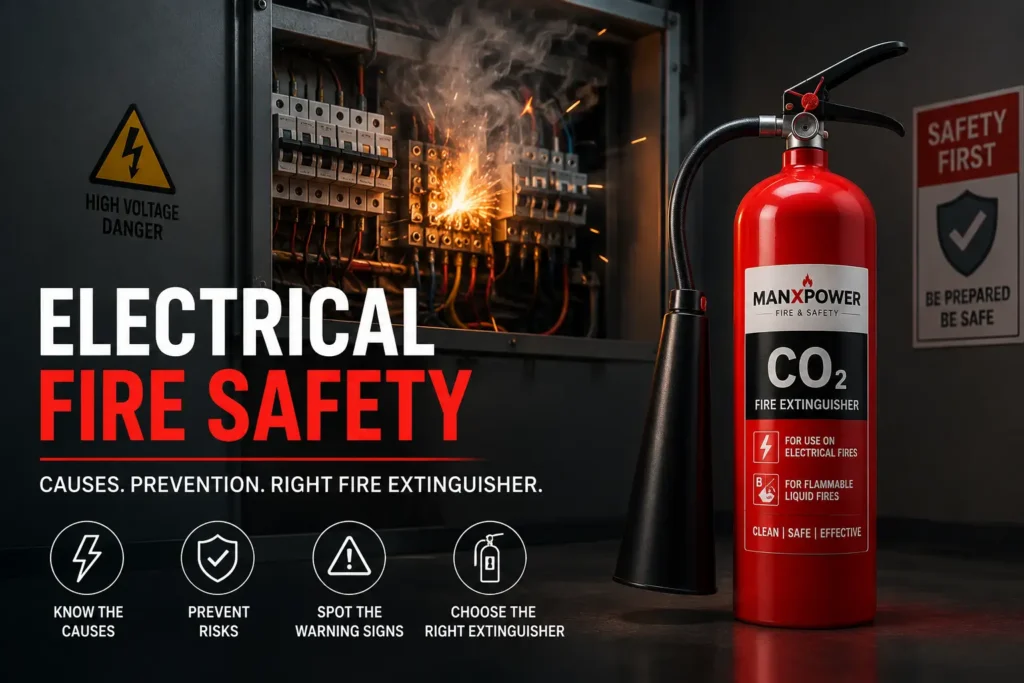
If you’re specifically choosing equipment for offices, server rooms, or electrical panels, MANXPOWER’s CO2 Fire Extinguisher is built for exactly this use case — non-conductive, residue-free, and ISI approved for electrical and Class B fires.
How to Choose the Right Fire Extinguisher for Electrical Fires
Choosing the right fire extinguisher for electrical fires depends mainly on the environment — sensitive electronics call for a clean, residue-free agent, while general workspaces can typically manage well with a dry chemical unit.
A few things to weigh:
- Presence of sensitive equipment — server rooms, labs, and control rooms are better suited to CO2 or clean agent extinguishers, since dry powder can damage delicate electronics
- Size of the space — larger areas may need a higher-capacity extinguisher, or multiple units positioned near different panels
- Frequency of electrical equipment use — high-load equipment used constantly warrants extinguishers stationed closer by, with shorter response distances
- ISI certification — always confirm the extinguisher carries proper Indian Standards certification for the fire class it claims to handle
- Ease of use under stress — staff should be trained on the extinguisher type available, not just have it mounted on a wall
For most commercial electrical panels and office equipment, a CO2 extinguisher is the standard recommendation. For larger installations with a mix of fire risks, a clean agent fire extinguisher is another option worth knowing about — it uses a gaseous agent that leaves no residue, which suits environments with expensive or highly sensitive equipment. MANXPOWER’s CO2 Fire Extinguisher covers most of this same need for electrical and sensitive-equipment fires, without residue concerns.
Read more: Types of Fire Extinguishers and Their Applications
Fire Extinguisher for Electrical Panels — Special Considerations
Electrical panels need extinguishers that won’t conduct current back toward the person using them, and ideally, agents that won’t damage the panel’s internal components either.
- Keep a CO2 or clean agent extinguisher stationed within easy reach of main distribution panels
- Never attempt to use water or foam extinguishers on an electrical panel fire under any circumstances
- Ensure staff know to cut power at the source, if it’s safe to do so, before or while addressing the fire
- Panels in server rooms or data centers benefit particularly from clean agent extinguishers, since dry powder residue can damage sensitive circuitry
- Extinguishers near panels should be inspected and serviced on the same schedule as the rest of your fire safety equipment, not treated as an afterthought
What to Do During an Electrical Fire (Step-by-Step)
- Cut the power at the breaker or main switch if it’s safe and quick to reach.
- Alert others in the building and call for emergency services if the fire is more than small and contained.
- Use a CO2 or dry chemical extinguisher, aiming at the base of the fire, never water.
- Evacuate immediately if the fire grows, spreads to nearby materials, or the extinguisher doesn’t contain it quickly.
- Don’t re-enter the area until it’s confirmed safe by emergency responders or a qualified electrician.
Knowing how to stop an electrical fire quickly, in this order, is often the difference between a contained incident and one that spreads beyond control.
How to Put Out an Electrical Fire Without an Extinguisher
If no extinguisher is available, cutting power at the source and smothering small, contained electrical fires with a fire blanket or non-flammable material can help — but this only works for small fires, and evacuation should always take priority over improvising a response.
- Cut power at the breaker immediately, if it’s safe to reach
- Smother a small, contained fire with a fire blanket or heavy non-flammable cloth, never a flammable one
- Never throw water on the fire, even to try to slow it down
- If the fire grows or you’re unsure of its size, evacuate and call emergency services rather than continuing to attempt to contain it yourself
- Baking soda can help smother very small electrical fires in some cases, but this isn’t a substitute for a proper extinguisher and shouldn’t be relied on as a primary plan
Electrical Safety Checklist for Homes & Offices
- Inspect wiring and panels every 2–3 years, or immediately after any warning signs
- Avoid overloading outlets, extension cords, and power strips
- Replace damaged cords and plugs as soon as they’re noticed
- Keep flammable materials clear of panels, outlets, and heat-producing appliances
- Station the correct class of fire extinguisher near electrical panels and high-risk equipment
- Train household members or staff on basic electrical fire safety tips and emergency response steps
- Schedule professional electrical audits for workplaces, not just reactive repairs
- Test smoke and heat detectors regularly, since early detection buys critical response time
Installation & Safety Tips — MANXPOWER Fire Extinguishers
MANXPOWER extinguishers are built with clear labeling and straightforward operation, so staff and homeowners alike can respond quickly without needing extensive training.
- Mount extinguishers at accessible heights near electrical panels, server rooms, and high-risk equipment
- Choose CO2 extinguishers for sensitive electronics, and ABC or clean agent types for broader coverage
- Service and inspect extinguishers on a regular schedule, not only after use
- Keep extinguishers visible and unobstructed, with clear signage where possible
- Pair extinguishers with basic staff training so equipment doesn’t sit unused during an actual emergency
For a quick reference, here’s a basic electrical fire safety equipment list worth keeping on hand: a CO2 or clean agent extinguisher near panels and server rooms, a fire blanket for small contained fires, clearly labeled circuit breakers, and smoke/heat detectors positioned to catch early warning signs.
Read more: Fire Extinguisher Maintenance Guide
Workplace Fire Extinguisher Regulations (India — as per IS Standards)
As per Indian fire safety regulations, commercial and industrial premises are generally required to maintain fire extinguishers that are ISI marked and appropriate for the fire risks present on-site, following relevant IS standards for portable fire extinguishers.
- Extinguishers should be selected based on the specific fire classes present in each area, including electrical risk zones
- ISI certification (BIS compliance) is typically expected for extinguishers used in commercial and industrial settings
- Extinguishers should be serviced and refilled per manufacturer and regulatory guidelines, generally on an annual basis
- Fire risk assessments are commonly required for workplaces, documenting extinguisher placement and coverage
- Staff training on extinguisher use is often part of broader workplace fire safety compliance requirements
Always confirm current requirements with your local fire department or a certified fire safety consultant, since specific obligations can vary by state, occupancy type, and building classification.
Read more: Fire Safety Compliance in India
Prevent Electrical Fires with MANXPOWER
Electrical fire safety starts with prevention, but having the right equipment on hand is what determines the outcome if something does go wrong. MANXPOWER supplies ISI-approved fire extinguishers built specifically for electrical and Class B fire risks, including CO2 units suited to offices, server rooms, and industrial panels.
- ISI-approved extinguishers built for electrical fire safety equipment needs across homes and workplaces
- CO2 and dry chemical options suited to different environments and equipment sensitivity levels
- Reliable supply for both individual buyers and businesses managing compliance at scale
- A brand focused specifically on fire and life safety equipment, not a general electronics catalogue
Whether you’re setting up fire protection for a new office, upgrading equipment near an electrical panel, or meeting workplace compliance requirements, MANXPOWER’s extinguisher range is built to support consistent, reliable electrical fire protection across every environment.
Frequently Asked Questions
What is an electrical fire?
An electrical fire is a fire caused by faulty wiring, overloaded circuits, or malfunctioning electrical equipment, rather than an external ignition source. It often starts inside walls, panels, or appliances, making early warning signs important to catch before the fire develops.
What causes electrical fires in homes?
Electrical fires in homes are most commonly caused by faulty wiring, overloaded circuits, damaged appliances, and outdated electrical panels. Loose connections, aging insulation, and overuse of extension cords also contribute significantly to household electrical fire risk.
Which fire extinguisher is used for electrical fires?
CO2 and dry chemical (ABC-type) fire extinguishers are used for electrical fires, since both are non-conductive and safe on live electrical equipment. Water-based extinguishers should never be used, as water conducts electricity and creates a serious shock hazard.
What type of fire extinguisher is used for an electrical fire?
A CO2 fire extinguisher is generally the preferred choice for electrical fires involving sensitive equipment, since it leaves no residue. Dry chemical (ABC) extinguishers also work but leave behind powder residue that can affect electronics.
How do I put out an electrical fire without an extinguisher?
Cut power at the breaker immediately, then smother a small, contained fire with a fire blanket or heavy non-flammable material. Never use water. If the fire grows or spreads, evacuate immediately and call emergency services rather than continuing to attempt to contain it.
What are 5 electrical safety tips?
Avoid overloading circuits and extension cords, replace damaged cords immediately, schedule regular wiring inspections, keep flammable materials away from panels and outlets, and station the correct fire extinguisher near electrical equipment and panels.
What are the 7 fire safety rules?
Common fire safety rules include: know your exits, install and test smoke detectors, keep fire extinguishers accessible, avoid overloading electrical circuits, never leave flames or heat sources unattended, keep flammable materials away from ignition sources, and have an evacuation plan everyone understands.
How can I prevent electrical fires in the workplace?
Schedule regular electrical audits, train staff to recognize warning signs, keep panels and machinery areas clear of clutter, station appropriate fire extinguishers near electrical risk zones, and avoid daisy-chaining power strips or extension cords across the workspace.
How long does it take for an electrical fire to start?
An electrical fire can ignite within seconds once a fault occurs, but the underlying wiring issue often develops silently over weeks or months beforehand. Regular inspection and attention to early warning signs are the best way to catch problems before ignition.
How do I stop an electrical fire?
Cut the power at the source immediately if it’s safe to do so, then use a CO2 or dry chemical extinguisher aimed at the base of the fire — never water. If the fire spreads or grows beyond a small, contained size, evacuate immediately and call emergency services rather than continuing to fight it yourself.