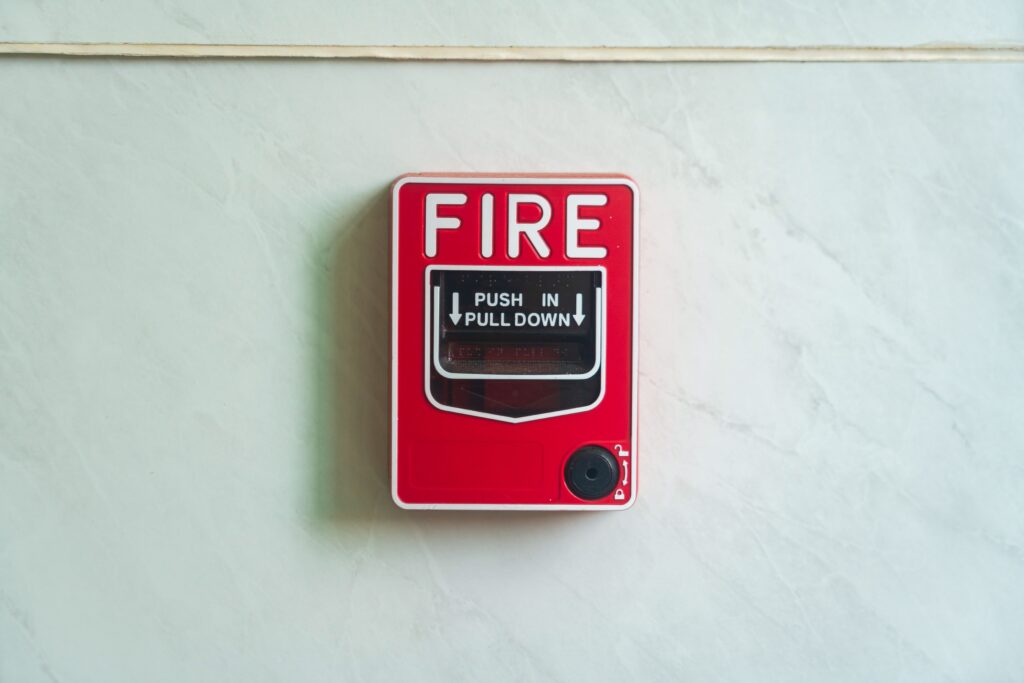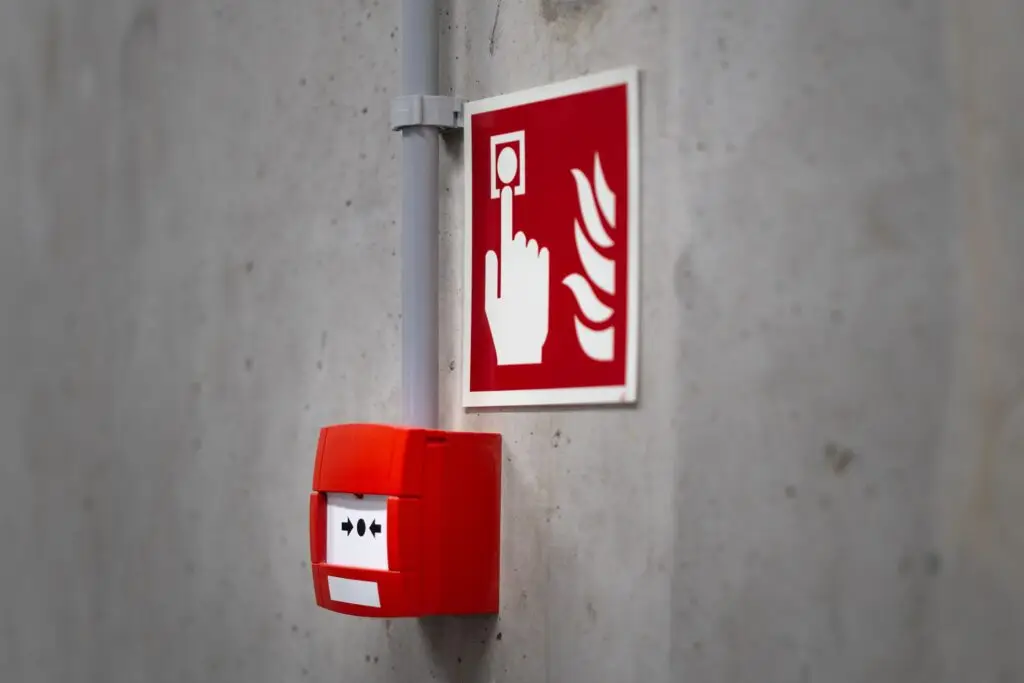
MCP stands for Manual Call Point. It is the small red box near an exit or staircase that lets anyone raise a fire alarm by breaking a glass element or pressing a button. Detectors need time to sense a fire, but a person who sees flames can trigger the alarm at once. Most commercial fire alarm systems therefore include call points alongside detectors.
This guide explains what an MCP is, how it works, its types, the height and travel-distance rules in IS 2189, how to wire, test and reset one, and what it costs. Figures below follow clauses 6.4 and 7.4 of IS 2189:2026. This guide is for understanding. The system should be designed, installed and tested by a competent fire alarm contractor, as your local fire authority requires.
Quick answer
| Question | Answer |
| MCP full form | Manual Call Point (also called a break-glass unit or manual pull station) |
| What it does | Lets a person trigger the fire alarm control panel by hand |
| Mounting height | 1.4 m above the surrounding floor level |
| Maximum travel distance | 30 m inside the premises; 45 m for call points outside the building |
| Product standard | IS/ISO 7240-11 |
| Testing | Visual check every quarter. Inspection every six months and operation once a year, as per the maker’s instructions (confirm in IS 2189:2026 cl. 7.4) |
| Colour | Red for fire alarm |
What is a manual call point (MCP)?
IS 2189 defines it as “A manually operated device used to initiate an alarm signal.” It sits in a red housing behind a breakable glass element, a plastic resettable element, or a hinged flap over a button.
The name changes by region. Manual call point is the term used in India, Europe and Australia. Manual pull station is the term used in the US and Canada.
An MCP does not replace detectors. Detectors catch fires nobody has seen yet, while the MCP covers the fire a person sees first. IS 2189 treats both as activation devices, and it says a system may also include manual call points. Whether your building must have call points is set by the National Building Code and your local fire authority.
| Feature | Manual call point | Smoke detector |
| Operation | Activated by a person | Detects smoke automatically |
| Main purpose | Raises the alarm when someone sees a fire | Detects smoke without human action |
| Installation | Near exits, staircases and escape routes | Positions set by the fire system design |
Read more in How Fire Alarm Panels Work, Smoke Detector and Heat Detector.
How does a manual call point work?
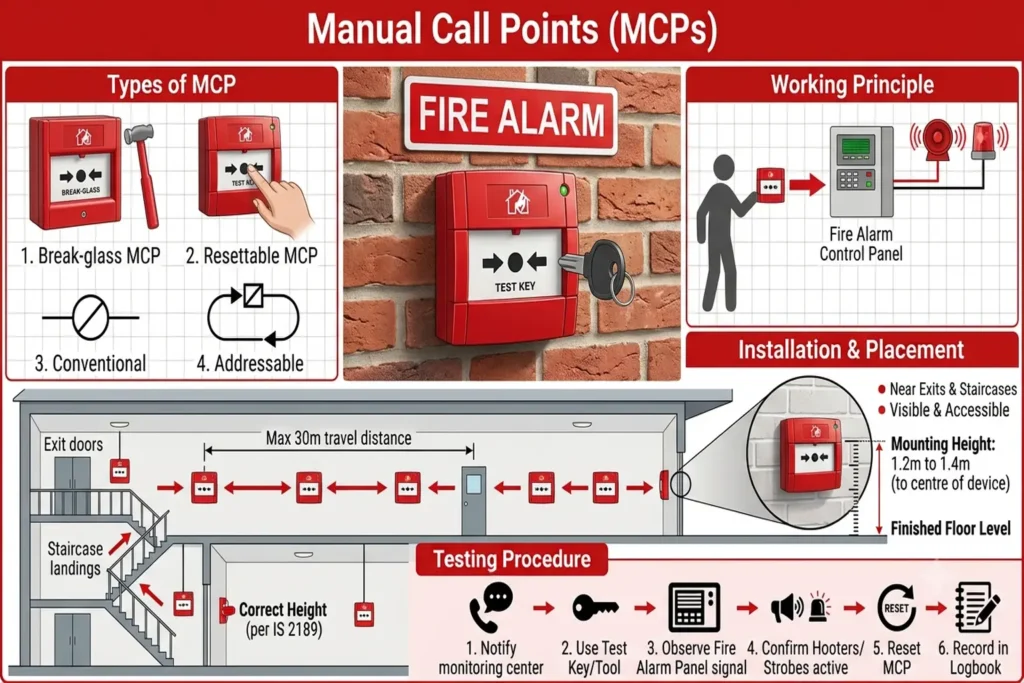
- A person sees smoke or flames and operates the nearest MCP: breaks the glass, presses the resettable element, or lifts the flap and presses the button.
- A switch inside, held open by the element, is released. In one common design, a micro-switch is held off by the glass and released when the glass breaks.
- On a conventional system the panel shows that zone in alarm. On an addressable system the device reports its own address, so the panel shows the exact call point.
- The panel starts the sounders and strobes. IS 2189 says the alarm sounds on the floor and at the control equipment, a light glows, and the alarm stays on even if the button is pressed again.
- Whether the fire brigade is called automatically, or smoke control and sprinklers start, depends on how the building’s system is set up, not on the MCP itself.
- After the incident, the unit is reset with the maker’s key or tool, and then the panel is reset.
What are the types of manual call points?
| Basis | Type | What sets it apart | Typical use |
| Operation | Break-glass | Glass is broken to release the switch; glass is replaced after every use or test | Sites that want a visible, tamper-evident unit |
| Operation | Resettable | Plastic or flexible element, reset with a key, no spare glass | Buildings that test often |
| Action | Single action | One movement triggers the alarm (EN 54-11 Type A, direct operation) | Most commercial buildings |
| Action | Double action | Two movements, such as lift then push (EN 54-11 Type B, indirect operation) | Places with frequent accidental alarms |
| System | Conventional | Reports only the zone it is wired to | Small and mid-size sites |
| System | Addressable | Has its own address, so the panel names the exact device | Large buildings and high-rises |
| Location | Indoor | Standard enclosure for controlled spaces | Offices, malls, hospitals, schools |
| Location | Outdoor / weatherproof | Sealed housing against rain, dust and humidity | Parking, yards, open walkways |
| Location | Flameproof / intrinsically safe | Built for explosive atmospheres | Oil, gas, chemical and paint areas |
| Location | Wireless | Battery-powered radio unit | Temporary sites such as construction |
Colour shows the function. Red is for fire alarm. Other colours serve other functions in some systems, so read the label and signage before pressing. See also Standalone Fire Alarm Systems.
What is the difference between a manual call point and a manual pull station?
Both do the same job: a person triggers the fire alarm by hand. The difference is regional and in the standards followed.
| Feature | Manual call point (MCP) | Manual pull station |
| Where used | India, Europe, Australia, Middle East | USA and Canada |
| Operation | Break glass or press a resettable element, sometimes under a hinged cover | Pull a handle or lever down; many are double action |
| System standard | IS 2189 (India) | NFPA 72 |
| Device standard | IS/ISO 7240-11, EN 54-11 | UL 38 |
| Mounting height | 1.4 m under IS 2189 | 42 to 48 in. (1.07 to 1.22 m) under NFPA 72 |
| Reset | Key or tool, or replace the glass | Key or tool |
If a US spec sheet asks for a manual pull station, do not copy its height or spacing into an Indian project. Follow IS 2189 and the National Building Code, and confirm with your fire consultant or local fire authority.
Where should a manual call point be placed? Height, spacing and travel distance
| Rule | IS 2189:2026 (India) | NFPA 72 (USA) |
| Mounting height | 1.4 m above the surrounding floor level | 42 to 48 in. (1.07 to 1.22 m) |
| Maximum travel distance | 30 m; 45 m for external call points | Not compared here |
Check which edition your project is bound by before quoting a figure in a tender or audit report.
Placement checklist:
- Preferably near staircase entries at various levels.
- Along escape routes and near exits, so the travel distance limit is met. The 30 m limit may need to be reduced where access is difficult or the risk is potentially dangerous.
- In accessible, well-lit, conspicuous positions free of obstructions. If a call point is not visible from the front, as in a long corridor, mount it surface or semi-recessed with a side profile of at least 15 mm.
- Never behind a door that swings open, or blocked by furniture, stock or plants.
- On a solid wall or column, with a “Fire Alarm” sign above or beside it.
If a wheelchair user needs to reach the device, discuss a lower height with your fire consultant and record it as a variation.
Indoor, outdoor and flameproof manual call points
| Where it will be fitted | Choose | What to check on the datasheet |
| Offices, malls, hospitals, schools, residences | Indoor MCP | Enclosure rating |
| Parking, loading docks, yards, open walkways | Outdoor / weatherproof MCP | An IP rating suited to rain and dust |
| Oil, gas, chemical, paint or dust-handling areas (Zone 1, 21, 22) | Flameproof or intrinsically safe MCP | Hazardous-area certificate for the exact zone |
| Temporary sites such as construction | Wireless MCP | Battery life, radio range and the base unit |
IS 2189 asks for a dust-proof and moisture-proof enclosure, properly sealed with rubber lining. Hazardous-area call points are not ordinary MCPs in a tougher box. ISO 7240-11 does not cover intrinsically safe units or units for hazardous conditions, which need additional requirements. Before you buy one, get the zone classification from the plant’s safety officer and ask the supplier for the certificate that matches that zone.
How are manual call points wired and installed?
Conventional: wired to a zone circuit. IS 2189 strongly recommends separate circuits for detectors and call points, and advises showing call points separately from detectors on the control equipment. The panel sees the zone, not the exact device.
Addressable: wired on the loop with its own address. IS 2189 asks for Class A wiring on addressable loops.
Installation steps:
- Mark the position at 1.4 m on a solid wall or column, near an exit route or staircase entry.
- Fix the back box, surface or flush.
- Terminate the cables as per the maker’s wiring diagram.
- Fit the device, check the element and cover, and fit the “Fire Alarm” sign.
- Test it at the panel: right zone or address, sounders operate, device resets.
- Record the device ID, location and result in the maintenance register.
To use one in an emergency: go to the nearest call point, lift the cover, break the glass or press the element firmly until it clicks, leave by the nearest exit, and call the fire brigade on 101 or 112 once you are safe. Do not go back in until you are told it is clear. Training helps: see The Impact of Fire Safety Training on Workplace Safety.
How often should a manual call point be tested?
| Interval | What to do |
| Every quarter | Check visually that building or occupancy changes have not affected where call points are needed, and that each unit is clear and visible |
| Every six months | Have your maintenance contractor inspect the call points |
| Every year | Operate each call point as per the manufacturer’s published instructions |
Confirm the exact schedule in clause 7.4 of IS 2189:2026. Your fire consultant or insurer may set a stricter schedule.
Testing procedure:
- Tell the fire safety officer and the monitoring station, if there is one.
- Operate the unit with the maker’s test key or tool.
- Check that the panel shows the right zone or address, and that sounders and strobes respond.
- Reset the device, then clear the panel.
- Log the date, device ID or location, and result.
- Replace any unit that fails to register, sticks, or has a cracked housing or faded label.
Never run an uncontrolled test that could cause an unnecessary fire brigade call or alarm disruption.
After an activation, break-glass units need a new glass element and resettable units need the key or reset switch. On the MANXPOWER MCP Eco, pressing the reset switch turns the red LED off and the green LED resumes blinking.
Covers, spare glass, signage and accessories
- Protective cover: a hinged clear cover stops accidental knocks while still lifting easily in an emergency.
- Spare glass: IS 2189 asks for a glass surface of at least 30 cm² and a thickness of not more than 2 mm. Use the element made for your model.
- Test and reset key: needed for testing and resetting. Keys are usually maker-specific, so keep spares with the fire officer.
- Mounting box: surface or flush, depending on the wall.
- Combined MCP and hooter units: some suppliers offer a call point and hooter in one body. See Fire Alarm Hooter vs Siren vs Strobe.
- Signage: fit a “Fire Alarm” sign above or beside each unit. Photoluminescent or illuminated signs stay visible in a power cut or smoke.
What is the price of a manual call point in India?
Prices below are online listing prices seen in November 2026, per piece. They show the spread only and are not a quote.
| Category | Price seen (₹) |
| Basic conventional | About 150 to 700 |
| Branded conventional | About 1,000 to 2,750 |
| Addressable | About 1,800 to 4,000; some listings are higher |
| Wireless, flameproof, covers | Vary widely by brand and certification; ask for a quote |
| MANXPOWER Resettable MCP / MCP Eco | ₹1,100 / ₹900 on our site (21 November 2026) |
Price depends on addressable electronics, enclosure rating, hazardous-area certification, brand, and what comes in the box (back box, key, spare glass). For GST, fire alarm devices generally fall under HSN heading 8531. Confirm the exact 8-digit code and current GST rate with your accountant or on the supplier’s invoice.
Checklist before you buy: system match (conventional or addressable, and your panel model); environment; element type; a test report to IS/ISO 7240-11; impact-resistant housing and a clear activation indicator; and local supply of spare elements, keys and covers. How to Choose the Right Fire Alarm System helps with panel choice.
MANXPOWER manual call points
Manx Impex is an ISO 9001:2015 certified company founded in 2015 in New Delhi. Its MANXPOWER brand offers resettable manual call points for conventional fire alarm panels, including these two models.
| Resettable MCP (MP-FA-505) | MCP Eco | |
| Best for | Offices, shopping complexes, hospitals, schools, hotels, industrial sites | Malls, offices, restaurants, residences (indoor) |
| Compatible with | Conventional fire alarm panels | Conventional fire alarm panels |
| Housing | Red, transparent protective cover | Red ABS, factory-fitted back box |
| Mounting | Wall-mounted | Surface or semi-flush |
| Indication | Activation indicator | Bi-colour LED: green blink every 14 seconds when healthy, steady red in alarm |
| Reset | Key or reset tool | Separate reset switch |
| Extra features | One-way and two-way configurations | Dual switch design; tamper protection raises a system fault |
| Operating temperature | −10 °C to +65 °C | 0 °C to +60 °C |
| Operating humidity | 10–90% RH | 5–95% RH, non-condensing |
| Supply | 24 V DC | 24 V DC; 150 µA normal, 60 mA in alarm |
| Size | 86 × 89 × 56 mm | Not stated |
| Weight | Not stated | 80 g |
| Price on site (21 Nov 2026) | ₹1,100 | ₹900 |
To compare models, check panel compatibility or get a quote, use Get a Quote or message the team on WhatsApp at +91 11 4987 2937. Panel pairing: Conventional Fire Alarm Panel.
Manual Call Point FAQs:
What is the full form of MCP in fire alarm?
MCP stands for Manual Call Point. It is also called a break-glass unit or, in North America, a manual pull station.
Manual call point kya hota hai?
Manual call point ek lal rang ka box hota hai jo exit ya staircase ke paas lagta hai. Aag dikhne par glass todne ya button dabane se fire alarm baj jaata hai aur control panel ko signal milta hai.
What happens when a manual call point is activated?
Its switch changes state and the fire alarm control panel registers an alarm for that zone or address. The panel then starts the sounders and strobes. Whether the fire brigade is called automatically depends on how the system is set up.
What is the mounting height of a manual call point?
IS 2189 says call points should be fixed 1.4 m above the surrounding floor level. NFPA 72 in the US uses 42 to 48 inches (1.07 to 1.22 m). Check the current edition of the standard that applies to your project.
What is the maximum distance between manual call points?
IS 2189 sets a travel distance, not a fixed spacing: no person should have to travel more than 30 m to reach a call point, or 45 m for call points outside the building. The distance may need to be shorter where the risk is potentially dangerous.
What is the difference between a manual call point and a manual pull station?
They do the same job. Manual call point is the term used in India, Europe and Australia, and manual pull station is the term used in the US and Canada. The two follow different standards and mounting heights.
How often should a manual call point be tested?
Check each call point visually every quarter, and have your maintenance contractor inspect it every six months and operate it once a year as per the manufacturer’s instructions. Confirm the exact schedule in clause 7.4 of IS 2189:2026. Your fire consultant or insurer may set a stricter schedule.
How do I test and reset a manual call point?
Tell the fire safety officer and the monitoring station, if there is one. Operate the unit with the maker’s test key or tool, confirm the panel shows the right zone or address, reset the device, then clear the panel and log the result.
What is a flameproof manual call point?
A flameproof call point is built for areas where flammable gas or dust may be present, such as Zone 1, 21 or 22. It must be certified for the zone, because the ISO 7240-11 product standard does not cover hazardous-area units.
What is the price of a manual call point in India?
Online listings in November 2026 range from about ₹150 for basic conventional units to several thousand rupees for addressable units. See the price table above.
What is the HSN code for a manual call point?
Fire alarm devices generally fall under HSN heading 8531. Confirm the exact 8-digit code and the current GST rate with your accountant or on the supplier’s invoice.
Do I need manual call points if I already have smoke detectors?
Usually yes, because detectors work on their own but a call point lets a person raise the alarm the moment they see a fire. Whether your building must have one is set by the National Building Code and your local fire authority.