Imagine a fire breaking out on the 18th floor of a commercial building. Firefighters arrive within minutes, but carrying water all the way to the upper floors isn’t practical. Instead, they connect their fire engine to a fitting located outside the building, pump water into the building’s fire protection system, and immediately begin firefighting operations inside.
That fitting is called a fire brigade inlet connection.
Although it doesn’t receive the same attention as fire extinguishers or sprinkler systems, a fire brigade inlet connection is one of the most critical components of a building’s fire hydrant system. It allows the Fire Department to supply water directly into the building’s riser or sprinkler network whenever the internal water supply is insufficient or unavailable.
Whether you’re constructing a commercial complex, factory, warehouse, hospital, hotel, or high-rise residential building, understanding how a fire brigade inlet connection works can help you design a safer and more compliant fire protection system.
In this guide, we’ll explain its purpose, working principle, different types, installation requirements, technical specifications, maintenance practices, and how to choose the right solution for your project.
What is a Fire Brigade Inlet Connection?
A fire brigade inlet connection, also known as a Fire Brigade Breeching Inlet, is an external connection installed on a building’s fire hydrant or sprinkler system. It allows firefighters to pump water from a fire engine into the building during an emergency.
Think of it as a backup water entry point.
Under normal conditions, the building’s fire pumps and underground water tanks supply water to hydrant systems, landing valves, hose reels, and sprinklers. But if the fire lasts longer than expected or the internal water supply becomes inadequate, the Fire Department can use the fire brigade inlet connection to keep water flowing throughout the system.
This simple arrangement can make a significant difference during large fires, especially in high-rise buildings where maintaining adequate water pressure is essential.
Because of its role in emergency response, the fire brigade inlet connection use is recognised in fire protection systems designed in accordance with the National Building Code (NBC) of India and other applicable standards.
How Does a Fire Brigade Inlet Connection Work?
At first glance, the fitting appears simple, but it performs an important function.
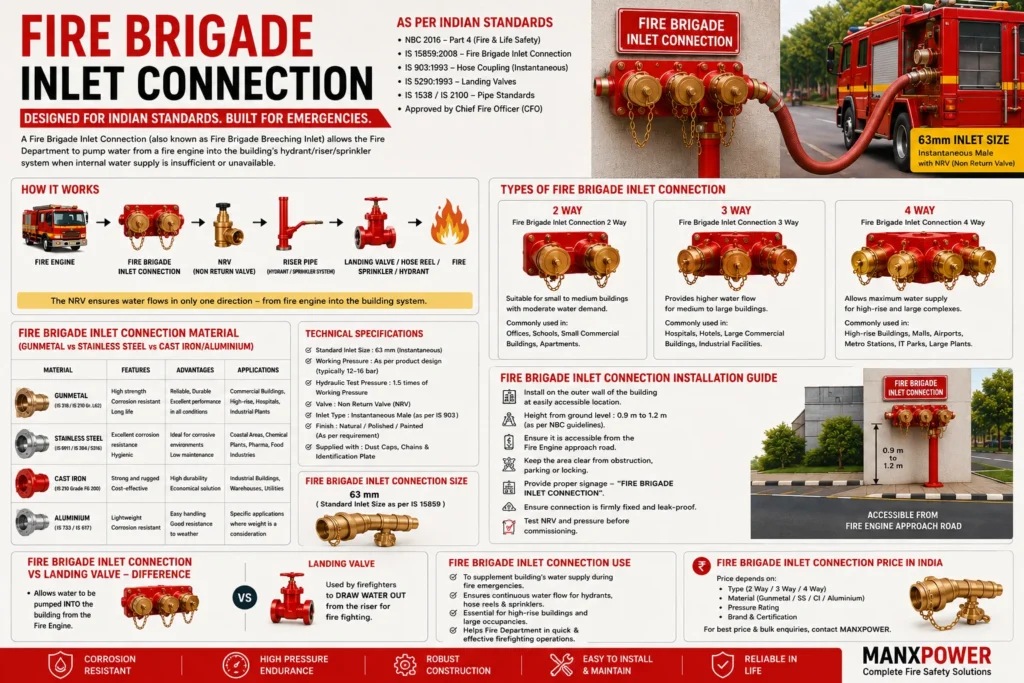
When firefighters arrive, they connect hoses from the fire engine to the inlet connection located outside the building.
Once connected, the fire engine pumps water through the inlet into the building’s vertical riser or sprinkler pipeline. This additional water supply supplements or replaces the building’s own fire pumps if required.
The water then travels through the fire protection system and reaches components such as:
- Landing Valves
- Fire Hose Reels
- Sprinkler Systems
- Internal Hydrant Networks
This enables firefighters to continue firefighting operations even if the building’s water storage has been exhausted.
Fire Brigade Inlet Connection with NRV (Non Return Valve)
One of the most important components of the system is the Fire Brigade Inlet Connection with NRV (Non Return Valve).
The NRV allows water to flow in only one direction—from the fire engine into the building.
Without this valve, water from the building’s hydrant system could flow backwards through the inlet connection, reducing efficiency and potentially creating operational issues during firefighting.
In simple terms, the NRV acts like a one-way gate. It ensures that the water pumped by the Fire Department reaches the building without flowing back toward the fire engine.
This is why most quality fire brigade inlet connections supplied today are designed with a non-return valve as an integral safety feature.
Read more: Landing Valves – A Critical Component of Fire Hydrant Systems
Types of Fire Brigade Inlet Connections
Not every building requires the same type of inlet connection.
The number of inlets depends on factors such as building height, occupancy, water demand, and fire protection system design.
Let’s look at the most common configurations.
Fire Brigade Inlet Connection 2 Way
A fire brigade inlet connection 2 way consists of two inlet ports that allow firefighters to connect two hoses simultaneously.
These are commonly installed in:
- Small commercial buildings
- Office buildings
- Educational institutions
- Medium-sized warehouses
- Apartment complexes
For buildings with moderate water demand, a two-way inlet often provides sufficient flow during emergency operations.
Fire Brigade Inlet Connection 3 Way
A fire brigade inlet connection 3 way provides three separate inlet connections, allowing additional water to be supplied when larger firefighting operations are required.
This type is commonly found in:
- Hospitals
- Hotels
- Large commercial buildings
- Industrial facilities
- Multi-storey office complexes
Adding an extra inlet increases the amount of water that can be pumped into the building’s fire protection system, improving firefighting capability.
Fire Brigade Inlet Connection 4 Way
Among the most commonly specified options for larger projects is the fire brigade inlet connection 4 way.
As the name suggests, it provides four separate hose connections, enabling multiple fire engines or multiple delivery hoses to supply water simultaneously.
These are generally installed in:
- High-rise commercial buildings
- Shopping malls
- Airports
- Metro stations
- Large manufacturing plants
- IT parks
- High-capacity warehouses
Because larger buildings require greater water flow during emergencies, a four-way inlet helps firefighters maintain adequate pressure throughout the fire hydrant system.
Read more: Manxpower Landing Valve – Essential Fire Hydrant Outlet
Fire Brigade Inlet Connection for High Rise Buildings
High-rise buildings present unique firefighting challenges.
Unlike a ground-floor fire, water has to travel several floors upward while maintaining sufficient pressure for effective firefighting.
This is why a fire brigade inlet connection for high-rise buildings becomes particularly important.
If the building’s pumps fail or stored water becomes insufficient, firefighters can connect directly to the inlet connection and continue supplying water to:
- Fire Hydrant Risers
- Landing Valves
- Fire Hose Reels
- Automatic Sprinkler Systems
Without this external connection, firefighting operations could become significantly more difficult during prolonged emergencies.
For this reason, fire brigade inlet connections are considered an essential part of many high-rise fire protection systems designed in accordance with applicable fire safety regulations and the National Building Code.
Fire Brigade Inlet Connection Material: Gunmetal vs Stainless Steel vs Cast Iron vs Aluminium
Choosing the right fire brigade inlet connection material is just as important as choosing the right type. Since the inlet connection is installed outdoors and exposed to changing weather conditions, it must be able to withstand corrosion, high water pressure, and years of continuous use.
The most commonly used materials are gunmetal, stainless steel, cast iron, and aluminium. Each has its own advantages depending on the application and budget.
Gunmetal Fire Brigade Inlet Connection
Gunmetal has been one of the most trusted materials for fire protection equipment for decades. It offers excellent corrosion resistance, performs well under pressure, and has a long service life, making it a preferred choice for commercial and industrial buildings.
It’s commonly used in:
- Office buildings
- Hospitals
- Hotels
- Shopping malls
- Industrial plants
- High-rise buildings
Because of its durability and reliability, many engineers continue to specify gunmetal for critical fire protection systems.
Stainless Steel Fire Brigade Inlet Connection
Stainless steel is an excellent choice for environments where corrosion is a concern.
Buildings located near coastal areas, chemical plants, food processing facilities, or pharmaceutical units often prefer stainless steel because it offers excellent resistance to rust and requires minimal maintenance.
Although it generally costs more than other materials, its long lifespan can make it a worthwhile investment.
Cast Iron Fire Brigade Inlet Connection
Cast iron has traditionally been used in many fire protection systems because it provides good strength at a relatively economical price.
However, compared to gunmetal or stainless steel, cast iron is more susceptible to corrosion if protective coatings are damaged. Regular inspections and maintenance are therefore particularly important.
Aluminium Fire Brigade Inlet Connection
Aluminium is lightweight and naturally resistant to corrosion, making it suitable for certain applications.
While it offers easier handling and installation, it may not always be the preferred choice for heavy-duty industrial environments where long-term durability under demanding conditions is a priority.
Ultimately, the right material depends on factors such as building type, environmental conditions, project specifications, and local fire safety requirements.
Read more: Manxpower Fire Hose Couplings & Branch Pipes
Fire Brigade Inlet Connection Working Pressure and Test Pressure
A fire brigade inlet connection working pressure and test pressure are important technical specifications that engineers should always verify before selecting a product.
The working pressure refers to the pressure at which the inlet connection is designed to operate safely during normal firefighting conditions.
The hydraulic test pressure is the higher pressure applied during manufacturing or testing to ensure the product can withstand demanding operating conditions without leakage or structural failure.
The exact pressure ratings vary depending on the manufacturer, product design, and applicable standards. For this reason, it’s always advisable to review the product’s technical data sheet before installation rather than relying on a single standard value.
When purchasing fire protection equipment, choosing products that have been tested in accordance with recognised industry standards provides additional confidence in their performance during an emergency.
Fire Brigade Inlet Connection Size
Another common question from consultants and contractors relates to the fire brigade inlet connection size.
In India, the most widely used inlet size is 63 mm, which is compatible with standard fire brigade delivery hoses used by many Fire Departments.
Depending on the system design, a fire brigade inlet connection may also include:
- Instantaneous male or female couplings
- Non Return Valve (NRV)
- Drain arrangement
- Blank caps
- Safety chains
- Identification plate
These accessories help protect the connection from dust, debris, and accidental damage while ensuring it remains ready for use during an emergency.
Before purchasing any equipment, always confirm that the connection size and coupling type are compatible with your building’s fire protection system and local Fire Department requirements.
Fire Brigade Inlet Connection vs Landing Valve: What’s the Difference?
It’s common for people to confuse a fire brigade inlet connection with a landing valve because both are part of a building’s fire hydrant system.
However, they perform completely different functions.
A fire brigade inlet connection allows firefighters to pump water into the building from an external source, usually a fire engine.
A landing valve, on the other hand, is an outlet located on each floor of a building. Firefighters connect their hose pipes to the landing valve to draw water from the building’s riser system and direct it towards the fire.
Think of it like this:
- Fire Brigade Inlet Connection = Water enters the building.
- Landing Valve = Water exits the building’s firefighting system to fight the fire.
Both components are essential, and one cannot replace the other.
For a complete hydrant system, buildings often require both properly installed and maintained.
MANXPOWER supplies both Fire Brigade Inlet Connections and Landing Valves designed for commercial, industrial, and institutional fire protection systems.
Read more: Manxpower Fire Hose Reel Drum – Rapid Response, Reliable Safety
Fire Brigade Inlet Connection Installation Guide
Proper installation is just as important as selecting the right equipment.
Even a high-quality inlet connection may not perform as intended if it’s installed in the wrong location or connected incorrectly.
Here are some widely accepted best practices that form the basis of a good fire brigade inlet connection installation guide.
Install It Where Firefighters Can Reach It Quickly
The inlet connection should be installed in a location that’s clearly visible and easily accessible from the fire service access road.
During an emergency, firefighters shouldn’t have to search for the connection or move obstacles before connecting their hoses.
Avoid installing it:
- Behind parked vehicles.
- Inside locked compounds.
- Behind landscaping or decorative features.
- In areas with restricted access.
Protect It from Damage
Although the inlet connection should remain accessible, it also needs protection from accidental impact.
Where there’s a risk of vehicles striking the equipment, protective bollards or barriers may be installed without obstructing access.
Clearly Identify the Connection
Good identification saves valuable time during emergencies.
The inlet connection should be properly labelled so firefighters can immediately identify its purpose, especially where multiple service connections exist.
Ensure Correct System Integration
The inlet connection should be connected to the building’s fire hydrant or sprinkler system exactly as specified in the approved fire protection design.
Improper installation may reduce water flow or affect overall system performance during firefighting operations.
Inspect Before Handover
Before the building is handed over or presented for Fire Department inspection, verify that:
- The NRV is functioning correctly.
- Couplings are free from damage.
- Blank caps are installed securely.
- Safety chains are intact.
- Identification markings are clearly visible.
- The connection is free from dirt and debris.
A few minutes spent checking these details can prevent delays during Fire NOC inspections.
Is an ISI or UL Certified Fire Brigade Inlet Connection Worth It?
When selecting critical fire protection equipment, quality should never be an afterthought.
An ISI/UL certified fire brigade inlet connection provides greater confidence that the product has been manufactured and tested in accordance with recognised quality standards where applicable.
Certification can also offer reassurance to consultants, contractors, building owners, and facility managers who want dependable equipment for long-term service.
At MANXPOWER, we understand that fire safety products are expected to perform only when they’re needed most. That’s why we focus on supplying reliable fire protection equipment designed for commercial buildings, factories, warehouses, hospitals, hotels, educational institutions, and industrial facilities across India.
Fire Brigade Inlet Connection Maintenance Tips
Installing a fire brigade inlet connection is only the first step. Like every other component in a fire protection system, it needs regular inspection and maintenance to ensure it works when it’s needed most.
A fire emergency is not the time to discover that an inlet connection is blocked, corroded, or damaged. Regular maintenance helps prevent unexpected failures and keeps your building ready for Fire Department inspections.
Here are a few simple maintenance practices every facility manager should follow:
Inspect Dust Caps and Safety Chains
Dust caps protect the inlet from dirt, insects, and moisture. Check that they are fitted securely and that safety chains are intact. Missing caps can allow debris to enter the system, affecting performance during an emergency.
Check for Corrosion or Physical Damage
Look for signs of rust, cracks, dents, or mechanical damage. If the inlet connection is installed in an exposed location, inspect it more frequently, especially after the monsoon season.
Test the Non Return Valve (NRV)
The Fire Brigade Inlet Connection with NRV (Non Return Valve) should operate smoothly and prevent reverse water flow. Periodic testing helps ensure the valve remains functional.
Verify Couplings and Threads
Inspect the hose couplings and threaded connections for wear or damage. They should allow firefighters to connect hoses quickly without leakage.
Keep the Area Accessible
One of the most common issues during inspections is poor accessibility.
Avoid storing materials, installing signboards, or parking vehicles in front of the inlet connection. Firefighters should be able to locate and connect to it immediately during an emergency.
Include It in Routine Fire Safety Inspections
Many organizations already inspect fire extinguishers, alarms, and hydrant systems on a scheduled basis. The fire brigade inlet connection should be included in the same maintenance program.
Regular inspections not only improve reliability but also help identify small issues before they become expensive repairs.
Read more: Maintenance Guide – How to Extend the Life of Your Manxpower Hose
Fire Brigade Inlet Connection Price in India
One of the most common online searches is “Fire brigade inlet connection price in India.”
While price is an important consideration, it should never be the only deciding factor.
The cost of a fire brigade inlet connection depends on several factors, including:
- Whether it’s a fire brigade inlet connection 2 way, 3 way, or 4 way.
- The material used (gunmetal, stainless steel, cast iron, or aluminium).
- Pressure rating.
- Size and coupling type.
- Presence of a Non Return Valve (NRV).
- Manufacturing quality and certifications.
- Brand and warranty.
Rather than choosing the lowest-priced option, it’s better to invest in a product that offers long-term reliability and complies with the project specifications.
A well-manufactured inlet connection can remain in service for many years with proper maintenance, making it a cost-effective investment over the life of the building.
If you’re unsure which model is suitable for your project, consulting an experienced supplier can help you avoid selecting equipment that doesn’t match your fire protection system.
Read more: Protecting Lives and Property with Manxpower
Why Choose MANXPOWER Fire Brigade Inlet Connections?
Fire protection equipment is expected to perform without hesitation during an emergency. That’s why choosing a reliable manufacturer matters.
At MANXPOWER, we supply fire protection equipment designed for commercial buildings, factories, warehouses, hospitals, hotels, educational institutions, and industrial facilities across India.
Our fire brigade inlet connections are manufactured with a focus on quality, durability, and dependable performance.
In addition to Fire Brigade Inlet Connections, MANXPOWER also offers:
- Landing Valves
- Fire Hose Reels
- Fire Hose Pipes
- Branch Pipes
- Hydrant Valves
- Fire Hose Cabinets
- Fire Extinguishers
- Smoke Detectors
- Heat Detectors
- Fire Alarm Panels
- Sprinkler System Components
- Manual Call Points
- Hooters and Strobes
Whether you’re working on a new construction project or upgrading an existing fire hydrant system, our team can help you choose products that suit your application and comply with relevant project specifications.
Choose Reliable Fire Protection with MANXPOWER
A fire brigade inlet connection may not be the most visible component of a fire protection system, but during a major emergency, it can become one of the most important.
By allowing firefighters to supply water directly into a building’s hydrant or sprinkler network, it supports faster firefighting operations and helps maintain water flow when internal supplies are insufficient. Combined with properly installed landing valves, fire hose reels, fire alarm systems, and other fire protection equipment, it forms an essential part of a well-designed fire safety system.
If you’re planning a new project, upgrading an existing hydrant network, or looking for dependable fire protection products, MANXPOWER is here to help.
Our team can assist you in selecting the right fire brigade inlet connection based on your building type, system design, and project requirements. With a complete range of fire hydrant and fire safety products, MANXPOWER is committed to helping businesses, consultants, contractors, and facility managers build safer and more reliable fire protection systems.
Need help choosing the right Fire Brigade Inlet Connection? Contact MANXPOWER today for product guidance, technical support, and a competitive quotation.
Frequently Asked Questions
What is a fire brigade inlet connection?
A fire brigade inlet connection is an external fitting installed on a building’s fire hydrant or sprinkler system. It allows the Fire Department to pump water from a fire engine into the building during an emergency, ensuring a continuous water supply for firefighting operations.
What is the 4 way fire brigade inlet connection?
A fire brigade inlet connection 4 way has four inlet ports, allowing multiple hoses to be connected simultaneously. It is commonly used in high-rise buildings, shopping malls, large commercial complexes, airports, and industrial facilities where higher water flow may be required.
What is the difference between 2 way, 3 way, and 4 way inlet connections?
The main difference is the number of hose inlets available.u003cbru003eFire brigade inlet connection 2 way – Two hose connections, suitable for smaller buildings.u003cbru003eFire brigade inlet connection 3 way – Three hose connections for medium to large facilities.u003cbru003eFire brigade inlet connection 4 way – Four hose connections for larger buildings with higher firefighting water demand.u003cbru003eThe selection depends on the building’s fire protection system design and project requirements.
What is the difference between a fire brigade inlet connection and a landing valve?
A fire brigade inlet connection allows water to be pumped into the building from a fire engine.u003cbru003eA landing valve allows firefighters to draw water out of the building’s hydrant riser and connect their hoses to fight the fire.u003cbru003eBoth components serve different purposes and are essential parts of a complete fire hydrant system.
Which material is best: gunmetal, cast iron, or stainless steel?
Each material has its advantages.u003cbru003eGunmetal offers excellent corrosion resistance and long service life.u003cbru003eStainless steel performs well in corrosive environments such as coastal or chemical industries.u003cbru003eCast iron provides strength at a lower cost but requires proper maintenance to prevent corrosion.u003cbru003eAluminium is lightweight and suitable for certain applications where reduced weight is beneficial.u003cbru003eThe right choice depends on the environment, project specifications, and maintenance requirements.
What is the working pressure of a fire brigade inlet connection?
The fire brigade inlet connection working pressure and test pressure vary depending on the manufacturer and product specifications. Always refer to the technical data sheet and ensure the selected product meets the requirements of your fire protection system and applicable standards.
Is a fire brigade inlet connection mandatory for high-rise buildings?
Many high-rise buildings require a fire brigade inlet connection as part of their fire protection system in accordance with the National Building Code (NBC) of India and applicable local fire safety regulations. The exact requirement depends on the building’s height, occupancy, and the rules enforced by the relevant Fire Department.