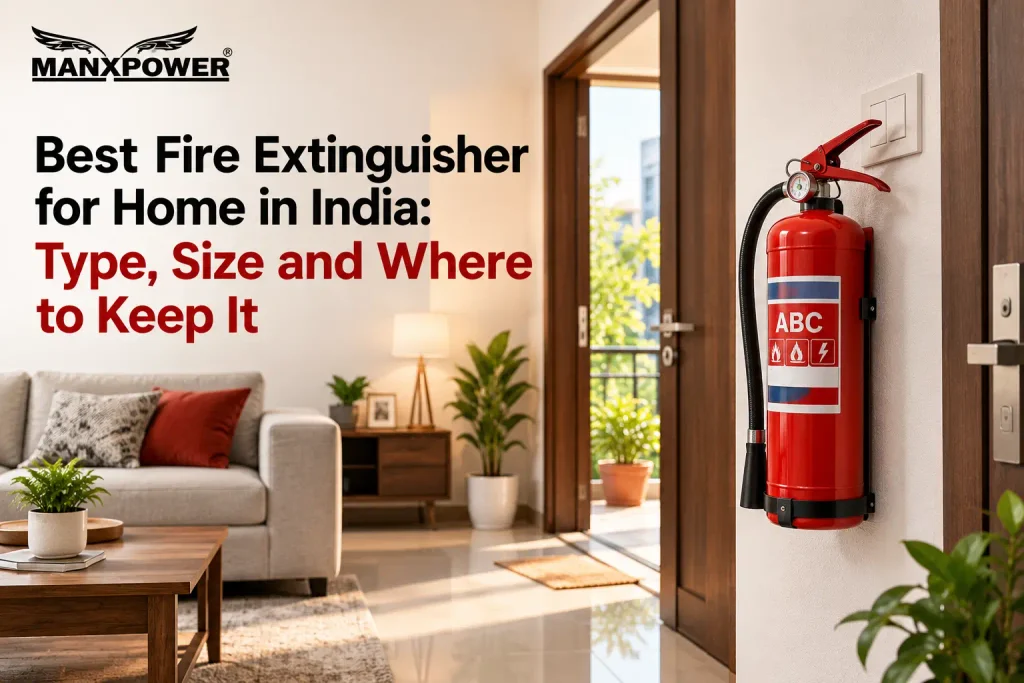
The best fire extinguisher for most Indian homes is an ISI-marked ABC dry powder extinguisher. A 2 kg unit suits a flat, a 4 kg unit per floor suits a house or villa, and a 1 kg unit suits a small kitchen or a car. Mount it on a wall near an exit, away from the stove. ABC powder works on the fires most likely to start at home: solids such as wood, cloth and paper (Class A), flammable liquids such as petrol and paint thinner (Class B) and gas fires such as LPG (Class C). Check the pressure gauge every month and learn how to use it before you need it.
Homes are where most fire accidents happen. NCRB’s ADSI 2024 report records 5,971 fire accidents and 5,888 deaths in India, and 3,585 of those accidents were in residential buildings. Cooking-related causes account for 23.6% of the deaths (NCRB ADSI 2024, as summarised by Dataful).
In short:
- Type: ABC dry powder is the best all-round choice for a home. Add a CO₂ unit only for a home office or electrical room.
- Size: 2 kg for a flat, 4 kg per floor for a house or villa, 1 kg for a small kitchen or a car.
- Place: Near an exit, away from the stove, on a wall bracket at an easy-to-reach height.
- Check: ISI mark, IS 15683 on the label, gauge in the green, and a quick look every month.
Which fire extinguisher is best for a home?
ABC dry powder is the best choice for most homes because one extinguisher covers wood and cloth fires, liquid fires and LPG fires. The trade-off is the powder itself. It reduces visibility when sprayed and leaves a residue that must be cleaned up.
| Type | Works on | Verdict for a home |
| ABC dry powder | Class A, B and C, and small electrical fires (switch off the power first) | Best all-rounder. Start here. |
| CO₂ | Class B and live electrical equipment | Good second unit for a home office or electrical room. No residue, but not suitable for cloth and wood fires. |
| Water mist | Class A, and some models B and electrical | Useful where powder residue is a concern. Check the label for the classes it is rated for. |
| Water or foam | Class A (water), A and B (foam) | Not ideal for homes. Never use water on oil or live electrical fires. |
| Fire blanket | Small kitchen fires, clothing fires | Not an extinguisher, but the best tool for a cooking-oil pan fire. |
CO₂ works by displacing oxygen, so in a small closed room, discharge it and leave. Hold the handle, not the horn, because the horn becomes extremely cold during use.
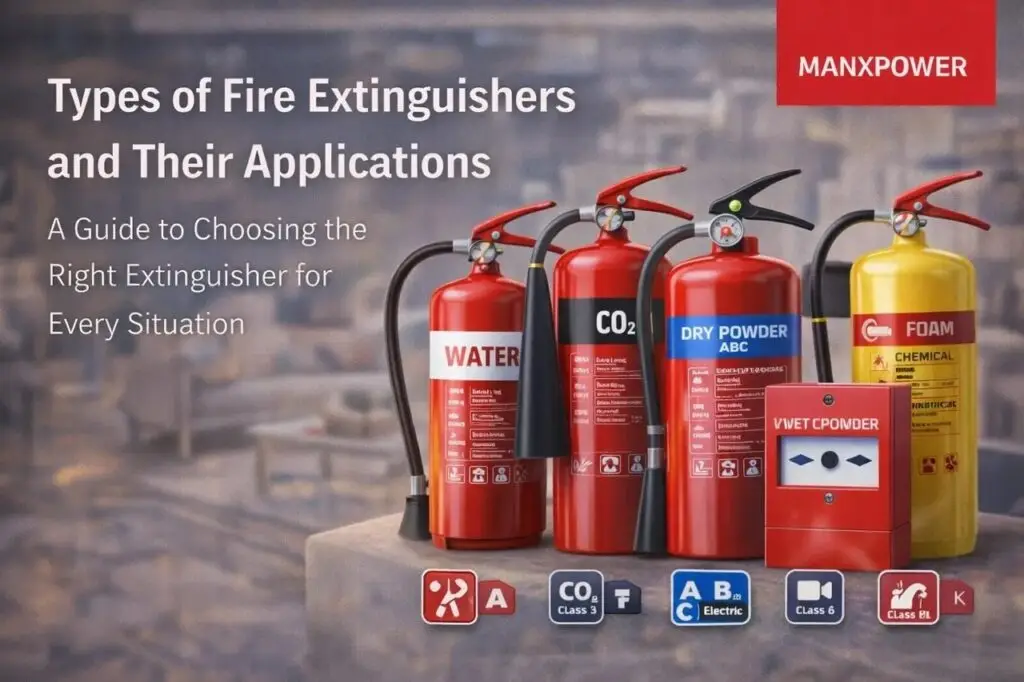
For the full comparison, read our guides on types of fire extinguishers and their applications, ABC vs CO₂ fire extinguishers and water mist extinguishers.
What size fire extinguisher do I need at home?
For most flats, a 2 kg ABC extinguisher is the practical size. It holds enough powder for a small fire and is light enough for anyone in the family to lift. A 1 kg unit has less agent and runs out sooner, so it suits a kitchen shelf or a car better than serving as the main unit. For a car, a compact unit such as our 500 g ABC extinguisher also works. Small extinguishers can empty in well under 30 seconds, so the first aim has to count.
This table is practical guidance, not a legal requirement or a substitute for a fire-risk assessment.
| Your home | Suggested extinguisher | Where to keep it |
| 1 or 2 BHK flat | One 2 kg ABC | Near the main door or kitchen exit |
| 3 BHK or larger flat | One 2 kg ABC, plus a 1 kg ABC in the kitchen | Main door and kitchen |
| Independent house or villa | One 4 kg ABC on each floor | Landing or passage near the stairs |
| Garage or parking | One 2 kg ABC | Just inside the entrance |
| Home office or electrical room | One 2 kg CO₂ (optional) | Near the equipment, not above it |
Usually, no law requires the owner of an individual flat or low-rise house to keep an extinguisher, but rules differ by state and building type. High-rise and group housing buildings must have fire safety systems under the National Building Code and state fire rules. Check with your local fire department. Keeping an extinguisher is strongly recommended either way.
Bigger is not always better. A 6 kg or 9 kg unit is heavy, and a person who cannot lift it quickly will not use it. Our ABC fire extinguishers come in 1, 2, 4, 6 and 9 kg, so you can match the size to your home.
Not sure which size suits your home? Tell us your home type (flat, house or villa) and the number of floors, and our team will explain the right size and number of units.
Call: +91 11 4987 2937 · WhatsApp: Message us · Contact form: Ask a question
Where should you keep a fire extinguisher at home?
Keep it where you can reach it while still having a clear way out: near an exit, on a wall bracket, in plain sight.
- Kitchen: next to the kitchen door, not above or beside the stove. If the fire blocks the stove, you must still be able to reach the extinguisher.
- Near the main door: so you can grab it on the way in or out.
- Each floor or landing: in a house or villa, so nobody has to run up or down stairs to fetch one.
- Near the electrical panel, inverter or UPS: close enough to reach, but not directly beside it, where a fire could cut you off.
- Garage or parking: close to the entrance.
Mount it on a wall bracket with the handle roughly 1 to 1.5 metres from the floor, or as the maker’s label says. Do not hide it in a cupboard, behind a door or under the sink. Keep it away from heat sources and direct sun. See our mounting brackets and spares.
How to check you are buying a genuine ISI extinguisher
Portable extinguishers in India are covered by IS 15683:2018, the BIS standard for performance and construction. Check these before you pay:
- ISI mark with a BIS licence number on the body (it usually starts with CM/L). Verify the licence on the BIS website.
- IS 15683 on the label, along with the capacity in kg, the fire classes (for example A B C), the maker’s name and the date of manufacture.
- Powder grade: ABC units come in MAP 50% and MAP 90%. MAP 90% has a higher monoammonium phosphate content and suits higher-risk areas. MAP 50% is common for general home use. Either way, the label should state the grade and the fire ratings.
- Pressure gauge in the green zone. A needle in the red means the unit has lost pressure.
- Complete unit: metal cylinder, valve, hose and wall bracket.
- Tax invoice and warranty from the seller.
Be careful with very cheap, unbranded cylinders and small aerosol “fire stop” cans sold online. They are not a substitute for an ISI-marked extinguisher unless the label shows the BIS licence and the IS standard.
Want help reading a label or specification? Share the details printed on the extinguisher (standard, capacity, fire classes and powder grade) and our team will explain what each one means.
Call: +91 11 4987 2937 · WhatsApp: Message us · Contact form: Send your question
How do you use a fire extinguisher? The PASS method
Use the PASS method only on a small fire that has not spread, and only if you have a clear exit behind you.
- Pull the safety pin.
- Aim the nozzle at the base of the flames, not the top.
- Squeeze the handle.
- Sweep from side to side, standing about 2 metres back and moving closer only as the flames die down.
Leave instead of fighting the fire if it is bigger than a waste bin, is spreading to curtains or the ceiling, or if smoke is filling the room. Close the door behind you if it is safe to do so, get everyone out and call 101 (fire) or 112 (national emergency number). Your first job is to get out safely. Your second is to protect property.
ABC powder can irritate the eyes, nose and throat. After using one indoors, leave the room, ventilate it, keep children and pets away and clean up the residue as the manufacturer advises. See a doctor if you have trouble breathing.
What to do in common home fire situations
| Situation | What to do | What to avoid |
| Cooking oil in a pan | Turn off the burner if safe, cover with a lid or fire blanket and leave it covered until cool. | Water. Carrying the pan. Spraying an extinguisher into the pan at close range. |
| LPG leak or burning regulator | If you can reach it safely, switch off the regulator and close the valve. A small flame can then be tackled with ABC powder from a distance. | Putting out a gas flame while the leak continues. Switching electrical items on or off near a leak. If the fire is growing, evacuate and call 101. |
| Electrical appliance, AC or wiring | Switch off at the MCB or mains if you can reach it safely, then use ABC (or CO₂) on a small fire. | Water. Touching a live or damaged appliance. |
| Sofa, bed or curtain fire | Use ABC at the base of the fire while you stand between the fire and the exit. | Staying if the fire has reached the ceiling. |
| E-scooter or lithium battery | Move away, get out and call 101. See our guide on lithium-ion battery fires. | Handling or moving a burning battery. Charging overnight in a passage or near the exit. |
| Car in the garage | If the fire is small and you have a clear exit, use ABC from a distance. Otherwise get out and call 101. See vehicle fire prevention. | Opening the bonnet fully on an engine fire. |
In Indian classification, “C” means flammable gases. Electricity is only the ignition source, so an electrical fire takes the class of whatever is burning (wiring insulation, plastic, oil). Isolate the power first, or the fire can restart.
For air conditioner and wiring risks, also read our guides on AC fire safety and electrical fire safety.
How do you maintain a home fire extinguisher?
An extinguisher that has lost pressure looks the same as a good one, so check it on a schedule.
- Every month: gauge in the green, safety pin and seal intact, hose and nozzle clear and uncracked, no dents, rust or leakage, unit still on its bracket and not blocked.
- CO₂ units: these usually have no pressure gauge. Follow the maker’s instructions, which typically involve checking the weight against the full weight on the label.
- Every year: have it inspected and serviced by a qualified technician, or as the manufacturer’s label states.
- After any use: get it recharged even if you only sprayed for a second, because you cannot know how much agent or pressure is left.
- Replace it if the body is rusted, dented or leaking, if the gauge stays in the red, or if it is past its service date.
Do not turn the unit upside down or shake it unless the manufacturer’s label tells you to. Note the date of each check on the tag. Our fire extinguisher maintenance guide covers the full routine, and spare gauges, valves and hoses and extinguishing agent refills are available if a part wears out.
Why an extinguisher is not enough on its own
An extinguisher is a last line of defence, not the first. It only helps in the first minute or two of a fire, and only if someone is awake and nearby. A smoke alarm gives early warning, including at night, and is the first thing to add if you do not have one. Fit one in the passage outside the bedrooms and one in the living area. See our standalone alarm systems and our guide to smoke vs heat detectors to choose the right one for a kitchen and a bedroom.
If you live in a housing society, the common-area fire systems are managed by the society. They do not replace an extinguisher inside your own flat, where a fire starts. Societies planning equipment for shared spaces can see our page for residential societies.
Home fire extinguisher buying checklist
- ABC dry powder, 2 kg for a flat (4 kg per floor for a house)
- ISI mark, BIS licence number and IS 15683 on the label
- Powder grade (MAP 50% or MAP 90%) and fire ratings stated on the label
- Gauge in the green
- Wall bracket included
- Mounted near an exit at an easy-to-reach height
- A fire blanket in the kitchen
- A smoke alarm outside the bedrooms and in the living area
- Everyone in the house knows PASS and the number 101
Get the right extinguisher for your home
Choosing a home extinguisher comes down to four things: the right type (ABC), the right size (2 kg for a flat), a genuine ISI mark and a spot near the exit. Manx Impex has supplied fire safety equipment under the MANXPOWER brand since 2015 and is ISO 9001:2015 certified, with pan-India dispatch from New Delhi. View our fire extinguishers to see the range.
Have a question about your home’s fire safety setup? Our team can explain the right type, size, placement and servicing for your home. We are available Monday to Saturday, 10:30 AM to 5:00 PM.
Call: +91 11 4987 2937 · WhatsApp: Message us · Contact form: Get in touch
Frequently Asked Questions:
Is a fire extinguisher mandatory at home in India?
Usually not for an individual flat or low-rise house, but rules differ by state and building type. High-rise and group housing buildings must have fire safety systems under the National Building Code and state fire rules, and these are usually managed by the society. Check with your local fire department. Keeping an extinguisher is strongly recommended even where it is not required.
Which fire extinguisher is best for a kitchen at home?
A 1 kg or 2 kg ABC dry powder extinguisher kept near the kitchen door, plus a fire blanket. Use a lid or the blanket for a cooking-oil fire. Use the extinguisher for a small LPG flame (after switching off the regulator, if it is safe) or a fire in cloth or wood. Never use water on burning oil, and leave if the fire spreads.
Is a 1 kg fire extinguisher enough for a home?
A 1 kg unit is fine for a small kitchen or a car, but it has less agent and runs out sooner. For a flat, a 2 kg extinguisher gives more margin. For a house or villa, use a 4 kg unit on each floor.
What should I do if an appliance or wiring catches fire at home?
Switch off the power at the MCB or mains if you can reach it safely, because the fire can restart if the power stays on. For a small fire, an ABC extinguisher can be used, but its powder leaves a residue that can damage electronics. CO₂ is better for a home office or electrical room. Never use water. If the fire spreads or you cannot reach the switch safely, leave and call 101. In India, electrical equipment has no fire class of its own. The fire takes the class of whatever is burning.
Where should I place a fire extinguisher at home?
Near an exit, on a wall bracket in plain sight, and not above or beside the stove. In a house or villa, keep one on each floor. Mount it with the handle roughly 1 to 1.5 metres from the floor, or as the maker’s label says. Do not hide it in a cupboard or under the sink.
How often should a home fire extinguisher be serviced?
Check the condition every month and have it serviced once a year, or as the manufacturer’s label states. Recharge it after any use, and replace it if it is corroded, dented, leaking or past its service date.
Is ABC powder harmful if I breathe it in?
It can irritate the eyes, nose and throat. After discharging an extinguisher indoors, leave the room, ventilate it, keep children and pets away and clean up the residue as the manufacturer advises. See a doctor if you have trouble breathing.
Where can I buy an ISI-marked fire extinguisher for my home?
MANXPOWER supplies ISI-marked ABC extinguishers from 1 kg to 9 kg, with MAP 50% and MAP 90% options, from New Delhi with pan-India dispatch. See the fire extinguisher range or request a quote.