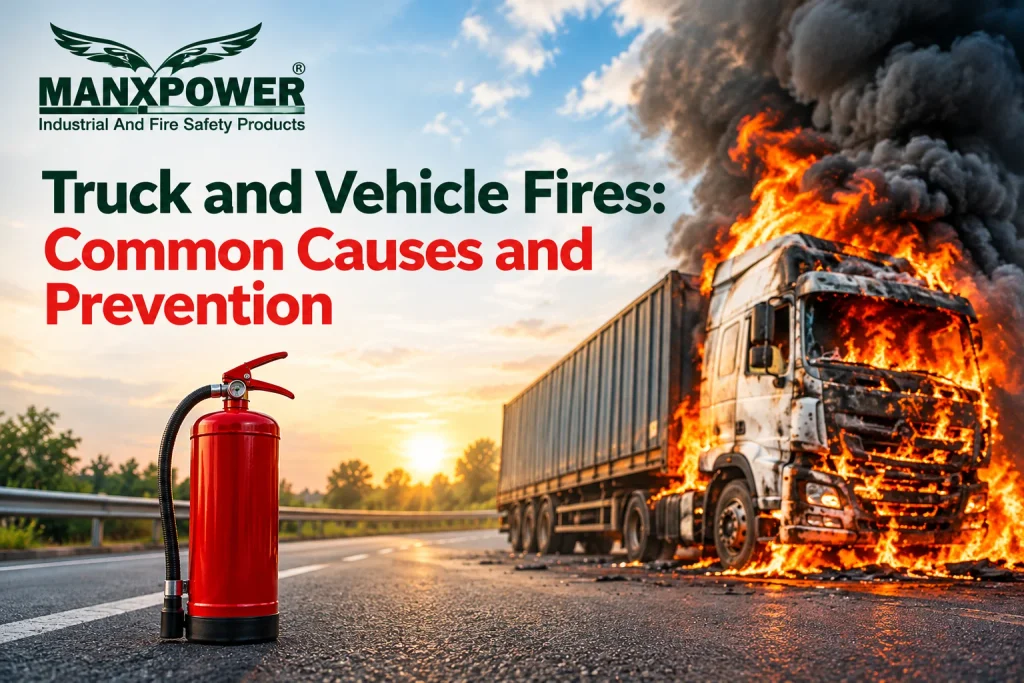
A truck fire rarely starts with a dramatic event. It starts with a wire rubbing on a bracket, a wheel bearing running hot, or a fuel line weeping onto a turbo. Most trace back to maintenance failures, especially electrical faults, not accidents.
That is the useful part, because these fires give warning. Here is where they begin, what a driver can notice, and what Indian rules actually require. If you run electric vehicles, also read our guide to lithium-ion battery fires.
The Most Common Causes
Electrical Faults and Chafed Wiring
This is the most common starting point. A wire that passes over a sharp edge or is clipped loosely gradually loses its insulation. Once bare copper touches the chassis, you get a short circuit, heat and often an arc, right next to grease, dust and plastic. Loose or corroded battery terminals and unfused cables are the other hotspots.
Wheel Ends
A dragging brake, seized bearing or under-inflated tyre builds friction heat. While moving, airflow carries some of it away. When the driver stops, that cooling stops too, and the tyre or hub grease can ignite minutes later. This is why many truck fires begin at a dhaba or weighbridge, not on the road.
Turbocharger, Exhaust and Leaks
A turbo runs extremely hot and is fed pressurised oil. Any diesel, engine oil or hydraulic fluid leaking onto it or the exhaust can ignite. A small stain under a parked vehicle should be traced, not topped up.
Aftermarket Accessories
In India, extra lights, inverters, fridges and music systems are commonly added after purchase. The risk is how they are wired: direct to the battery without a fuse, taped joints, or cable too thin for the load. A thin wire carrying too much current heats along its whole length, often hidden inside a loom.
The Load Itself
Chemicals, gas cylinders, textiles and paper can all fuel a fire. For depot and yard risks, see fire hazards in industrial facilities.
Not sure how well your fleet is protected? Tell us your vehicle types and our team will help you choose the right extinguisher for each. Call +91 11 4987 2937 or use the contact form.
Warning Signs a Driver Can Catch
Watch for a burning plastic smell that does not match the load, lights flickering, and fuses that keep blowing. Never replace a blown fuse with a higher-rated one, because that is how a fault becomes a fire. Also check for a wheel hotter than the others at a stop (use the back of your hand near the hub), fresh stains under the vehicle, and any smoke that is not from the exhaust.
What Indian Law Actually Requires
A widely repeated claim says a fire extinguisher is mandatory in all vehicles under the CMVR. As a blanket statement, that is not accurate. The general equipment requirement centres on a first-aid box, warning triangles and a tool kit.
Category-specific rules do exist. LPG vehicles must carry extinguishers, buses have separate fire detection and suppression standards, school buses must carry one under safety guidelines, and hazardous goods vehicles have their own firefighting requirements. Check what applies to your vehicle category and state.
More importantly, the legal question is the wrong one for a fleet operator. A fire destroys the vehicle, the load and puts the driver at risk. Carry an extinguisher regardless.
Which Extinguisher Belongs in a Vehicle, and Where
A vehicle fire involves wiring, plastics, upholstery and fuel together, so ABC dry powder is the practical choice. For most cabs, a car ABC fire extinguisher or a 500 g unit works well.
One exception: on electric vehicles, ABC powder is for the fires around the battery, not the pack itself. A pack in thermal runaway is a job for the fire service.
Mounting matters more than capacity. Keep the unit in a bracket within the driver’s reach, never loose in the cab or buried in the boot, and make sure it releases one-handed.
A small extinguisher is for a fire caught early. Once an engine bay, fuel or tyres are burning, get people clear and let it burn.
Need help choosing the right size for your trucks and buses? Send us your vehicle categories and we will recommend the capacity and quantity. Call +91 11 4987 2937 or use the contact form.
If a Fire Starts While You Are Driving
Stop somewhere safe, away from other vehicles and buildings. Switch off the engine and isolate the battery if you can. Get everyone out and move upwind, away from the tank and tyres. Call 101 or 112 and say what the vehicle carries. Do not fully open the bonnet, because the rush of air feeds the fire. Never go back for belongings.
Fitting out a fleet? We supply MANXPOWER ABC extinguishers in vehicle-suitable capacities. Call +91 11 4987 2937 or see the full extinguisher range.
Frequently asked questions
What is the most common cause of truck fires?
Electrical faults, especially wiring chafed by vibration, are a leading cause. Wheel-end problems and fluid leaks onto hot surfaces follow.
Why do trucks catch fire after they stop?
Heat from a dragging brake or under-inflated tyre builds while driving. When the vehicle stops, cooling airflow stops and the tyre or hub grease can ignite minutes later.
Is a fire extinguisher compulsory in all vehicles in India?
Not as a blanket rule. Specific requirements apply to LPG vehicles, buses, school buses and hazardous goods carriers. Check your vehicle category and state.
Which fire extinguisher is best for a truck or car?
An ABC dry powder unit, mounted in a bracket within the driver’s reach.
Can aftermarket accessories cause a vehicle fire?
Yes. Unfused connections, taped joints and undersized cable are common causes in India.
Should I open the bonnet if the engine is on fire?
No. Fresh air feeds the fire. If the fire is small and you have a clear exit, discharge through a gap.