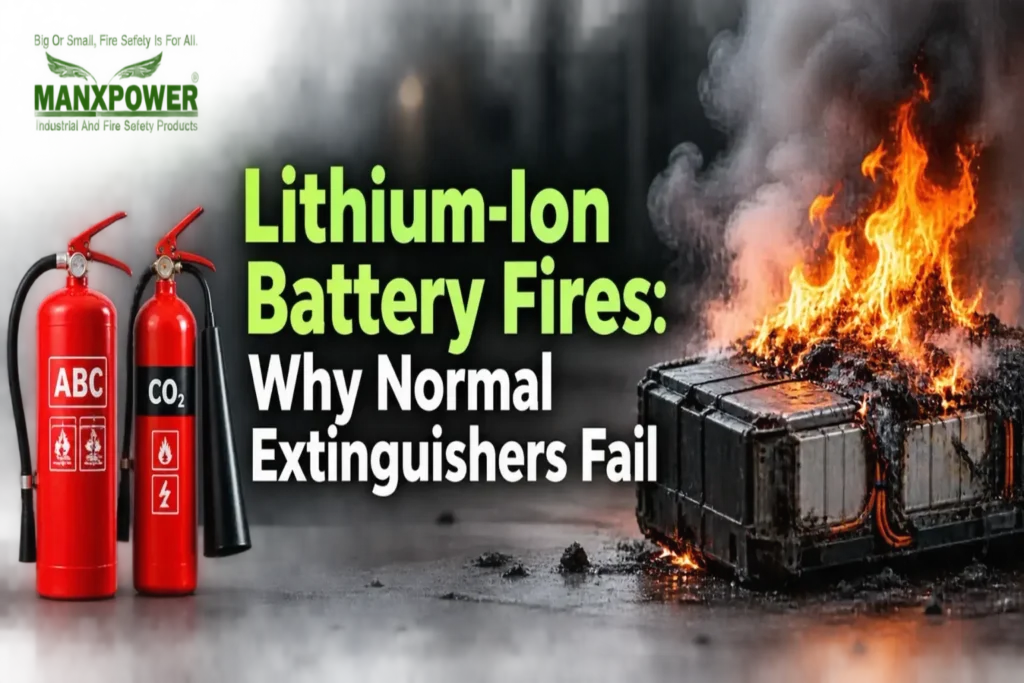
A lithium-ion battery fire does not behave like the fires that extinguishers were designed for. It does not need the surrounding air to keep going in the same way, it can restart hours after it appears to be out, and the extinguisher on your office wall will not reliably stop it.
That is not a reason to panic about every phone and power bank. It is a reason to understand what is actually happening inside the cell, because the response that works for a paper fire is close to useless here.
A Lithium Fire Is Not a Normal Fire
Most fires need three things in balance: fuel, heat and oxygen from the surrounding air. Remove any one and the fire stops. That is the principle behind almost every extinguisher ever made. Smother the fire, starve it of oxygen, or cool it below the temperature at which it sustains itself.
A lithium-ion cell in failure breaks that model. The reaction happens inside a sealed cell, it produces its own heat faster than the heat can escape, and the materials involved release gases as they break down. You cannot smother something that is not relying on the air around it in the first place.
What Thermal Runaway Actually Does
The term for this failure is thermal runaway. It is a self-feeding cycle, and it follows a fairly predictable sequence.
Something causes a cell to heat up — a manufacturing defect, physical damage, overcharging, a short circuit, or simply being operated in high ambient heat. As the cell warms, chemical reactions inside it begin to break down its materials. Those reactions generate more heat. The extra heat accelerates the reactions further. Beyond a certain point the cycle sustains itself and nothing external is driving it any more.
The cell then vents. Pressure builds until the casing gives way and a mix of hot, flammable gases escapes, often with considerable force. This is why lithium fires are frequently described as jetting or exploding rather than simply burning.
In a battery pack, the problem compounds. A single cell in runaway heats the cells packed around it, and those cells enter runaway in turn. The failure propagates through the pack, which is why an e-scooter battery can go from a faint smell to a serious fire in a short time.
Why ABC Powder and CO2 Fall Short
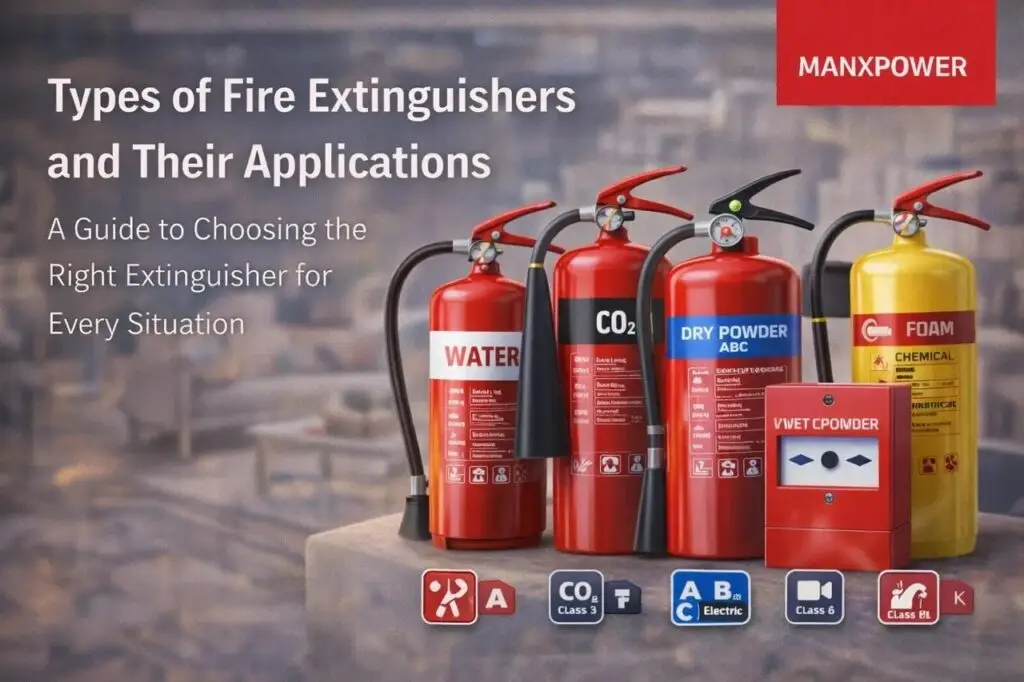
Both of the extinguishers most commonly found in Indian buildings work primarily by interrupting the fire rather than cooling the fuel.
An ABC dry powder extinguisher breaks the combustion chain reaction and blankets the burning surface. It can knock down flames coming off a battery pack, which looks like success. But the powder does almost nothing to lower the temperature inside the cells, and that internal reaction is what is driving the event. The pack keeps heating, keeps venting, and re-ignites.
A CO2 extinguisher has the same problem in a more pronounced form. It works by displacing oxygen, has limited cooling effect, and disperses quickly. Against a reaction that generates its own heat and gas inside a sealed pack, it offers very little.
Neither is useless in the vicinity. Both can deal with secondary fires — the furniture, packaging, plastics or fittings that the battery has set alight. That is worth something. But on the pack itself, they suppress the symptom rather than the cause.
Not sure what your building currently has installed, or whether it’s rated for what you actually need? A quick check can tell you where the gaps are. Call +91 11 4987 2937 or use the contact form.
Why Water Works, and Why the Fire Can Come Back
The one thing that addresses thermal runaway directly is cooling, and the practical way to move that much heat is a large volume of water.
Water does not stop the chemistry inside a cell. What it does is pull heat out of the pack fast enough that neighbouring cells stay below the temperature at which they would enter runaway themselves. That interrupts the propagation. It takes a lot of water and it takes sustained application — this is fire service work, not a hand-held extinguisher’s job.
Which leads to the most important safety point in this article, and the one Indian coverage almost always leaves out. A lithium battery that appears to be out can re-ignite hours later, and international fire service guidance treats a window of roughly 24 to 72 hours as the period of concern. Cells that were damaged but did not fail immediately can go into runaway well after the visible fire has stopped.
In practice that means a battery involved in a fire should not be brought back indoors, put in a vehicle, or stored next to anything that matters. It should be isolated outside, away from structures and other combustibles, and left alone.
What Happened in India in 2022
India’s public reckoning with this hazard came in the summer of 2022, when a series of electric two-wheeler fires drew national attention. Incidents involved scooters from several manufacturers, including Ola Electric, Okinawa Autotech and Pure EV. One incident involving an Okinawa scooter was reported to have caused deaths in Tamil Nadu.
The Ministry of Road Transport and Highways ordered an investigation, tasking the Defence Research and Development Organisation’s Centre for Fire, Explosive and Environment Safety (CFEES) with examining the failures. Reporting on the findings pointed to defects in battery cells, packs and modules, with cost-driven material choices identified as a contributing factor. Several manufacturers issued recalls, together covering thousands of vehicles.
The deadliest single incident came months later. A fire broke out in the basement of a Secunderabad hotel that housed an electric-scooter showroom with around two dozen vehicles. It killed eight people and injured eleven, most of them hotel guests overcome by smoke, and remains the deadliest EV-related fire reported in India. The exact ignition point was not confirmed, but it happened in the same cluster of 2022 incidents that triggered the CFEES probe.
Fires involving these battery packs have not stopped since. Isolated incidents, including e-scooters catching fire while in motion, continue to be reported years after the 2022 recalls — a reminder that this is an ongoing risk category, not a problem that was fully closed out by one round of regulation.
The reason this matters beyond the news cycle is what it revealed about the failure mode. These were not fires caused by crashes. They were packs failing during normal use and, in several reported cases, while parked or charging.
The Rules That Followed
The regulatory response tightened battery safety requirements for electric vehicles in India. Amendments to the automotive standards governing EV batteries were notified in 2022 and phased in, adding requirements around cell testing, thermal propagation, battery management system monitoring and warning to the rider when a thermal event is detected.
Separately, portable lithium cells and batteries of the kind used in power banks and consumer electronics fall under Bureau of Indian Standards requirements through the Compulsory Registration Scheme.
For a buyer, the practical takeaway is simple. Buy vehicles, batteries and chargers that meet the applicable Indian standards from manufacturers who will honour a recall, and be wary of unbranded replacement batteries and chargers sold purely on price. A cheap replacement pack for an e-scooter is the single highest-risk purchase in this category.
How These Fires Start
In practice, most incidents trace back to a short list of causes:
- Manufacturing defects inside the cells, which is what the 2022 investigation focused on. Nothing the owner does causes or prevents these.
- Physical damage. A dropped battery, a scooter that has been through a pothole hard, or a pack crushed in an accident. Damage can take days or weeks to turn into a failure.
- Overcharging or the wrong charger. A mismatched or poor-quality charger can push a pack beyond safe voltage.
- Heat. Charging a hot battery, or leaving a pack in direct sun or a closed vehicle in Indian summer conditions, adds to the thermal load the cell has to manage.
- Water ingress into a pack that is not sealed for it, including riding through flooded roads.
Charging an E-Scooter or Battery Safely
Most of the risk sits in the charging window, and most of it is controllable:
- Use the charger that came with the vehicle. Not a generic one, not a higher-rated one, not a repaired one.
- Let the battery cool before charging. A pack that has just finished a long ride is already warm.
- Do not charge overnight or unattended where you cannot notice a problem. If it must charge overnight, it should not be inside living space.
- Charge away from your exit route. A battery charging in a narrow corridor or at the bottom of a staircase can cut off the way out of a home. This is the detail that turns a property fire into a fatal one.
- Keep it clear of soft furnishings. Not on a bed, sofa, carpet or stacked cardboard.
- Charge in a ventilated space, not a sealed cupboard or a closed store room.
- Stop using any battery that has swollen, smells odd, gets unusually hot, or has been damaged. Swelling is a clear warning sign, not a cosmetic issue.
The same logic applies to power banks and laptop batteries, in proportion. A swollen power bank charging on a bed at night is a small version of the same hazard.
What to Do If a Battery Starts Venting or Burning
The warning signs are usually audible and visible before there is open flame: popping or hissing, a sharp chemical smell, visible smoke or vapour coming from the pack, and rapid heating.
If you see them, the priority is distance, not firefighting:
- Get people away. The gases released are toxic as well as flammable, so leave the area and close the door if you can do it without delay.
- Do not try to carry the battery or the vehicle outside once it is venting. A pack can jet flame with force and without warning.
- Call the fire service on 101, or 112. Tell them it is a lithium battery, because it changes how they approach it and how much water they will need.
- Use an extinguisher only on surrounding material, and only if you can do so safely with a clear exit behind you. Do not stand over the pack trying to put it out.
- Keep people away afterwards. A pack that has been involved in a fire should stay isolated outdoors, not brought back inside.
It is worth saying plainly: no portable extinguisher commonly found in Indian homes and offices, including the ones we supply, is a reliable answer to a battery pack in full thermal runaway. Standard extinguishers are for the fires around it. The battery itself is a job for the fire service.
Planning a dedicated charging or battery-storage area and want to know what to put where? We can walk you through detection and standard fire-protection options for the space. Call +91 11 4987 2937 or use the contact form.
What This Means for Buildings and Offices
The building-level risk has shifted quickly, because charging has moved indoors. Delivery fleets charge in basements. Staff charge scooters in parking areas. Offices have battery and UPS rooms.
The Secunderabad fire is the clearest illustration of why this matters at the building level: two dozen scooters stored together in a basement, under a hotel full of people, with no separation from the rest of the structure.
Three things make a practical difference:
Designate where charging happens. A ventilated area away from exits, stairwells and stored combustibles, rather than wherever a socket happens to be. A basement full of charging two-wheelers under the only staircase is a serious arrangement to inspect.
Put detection where charging happens. These fires produce smoke and heat before they become obvious, and early warning is worth far more here than extra extinguishers. Conventional fire alarm systems with appropriate detectors in charging and battery areas give people the one thing that matters most in this scenario, which is time to leave. For a small standalone area, a standalone alarm is better than nothing at all.
Keep normal fire protection in good order. Extinguishers and blankets still matter for the secondary fires a battery starts, and those secondary fires are what usually spread through a building. That is a real and useful role — just not the pack itself.
Reviewing detection or extinguisher coverage around a charging or battery area? Our team can help you work out what to place where. Call +91 11 4987 2937 or use the contact form. Please note we supply conventional fire detection and standard portable extinguishers — we do not supply lithium-specific suppression systems, and no portable extinguisher should be relied on against a battery pack in thermal runaway.
FAQs
Why can’t a normal fire extinguisher put out a lithium-ion battery fire?
Because thermal runaway generates heat inside the cells and does not depend on surrounding air the way an ordinary fire does. ABC powder and CO2 interrupt flames but do not cool the pack, so it keeps heating and re-ignites.
Does water put out a lithium-ion battery fire?
Water is the practical response, but it works by cooling rather than by extinguishing the internal reaction. It takes a large, sustained volume to bring the pack temperature down, which makes it a fire service task rather than something a hand-held unit can achieve.
What is thermal runaway?
A self-feeding cycle inside a lithium cell where heat triggers chemical reactions that generate more heat. Once it passes a certain point it sustains itself, the cell vents flammable gas, and the failure can spread to neighbouring cells in the pack.
Can a lithium battery catch fire again after it has been put out?
Yes. Re-ignition hours after apparent extinguishment is well documented, with international fire service guidance treating roughly 24 to 72 hours as the window of concern. A battery involved in a fire should be isolated outdoors and not brought back inside.
What are the warning signs before a battery fire?
Swelling of the battery or casing, unusual heat, a sharp chemical smell, hissing or popping sounds, and visible smoke or vapour. Stop using and stop charging any battery showing these signs.
Is it safe to charge an electric scooter overnight at home?
It is safer not to. Charging unattended means nobody is there to notice the early warning signs. If overnight charging is unavoidable, it should be outside living space, in a ventilated area, away from exits and soft furnishings.
Why did electric scooters catch fire in India in 2022?
A series of incidents in 2022 led the Ministry of Road Transport and Highways to order an investigation by DRDO’s CFEES. Reporting on the findings pointed to defects in battery cells, packs and modules, and several manufacturers issued recalls.
What should I do if a battery starts smoking indoors?
Get everyone away from the area and close the door if you can do so without delay, since the gases are toxic as well as flammable. Do not attempt to carry the battery outside. Call the fire service on 101 or 112 and tell them it is a lithium battery.