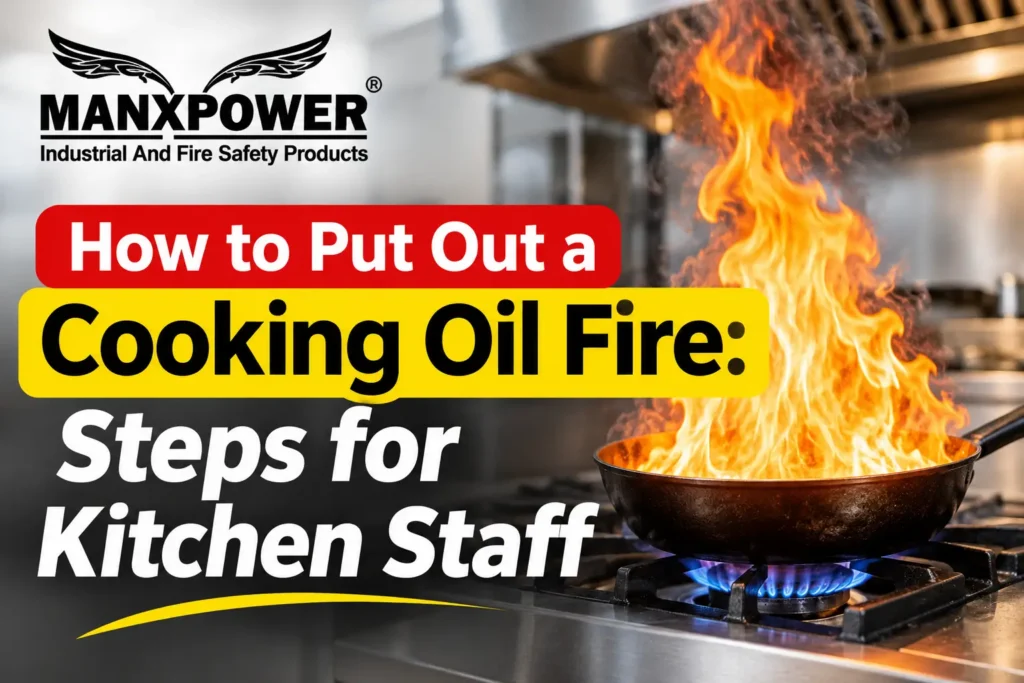
How to put out a cooking oil fire: turn off the heat if it is safe to do so, then cover the pan with a metal lid or a fire blanket. Do not use water and do not move the pan. Leave the cover in place until the pan has cooled completely. Call 101 or 112 if the fire spreads beyond the pan or you are unsure.
That is the short answer on how to put out a cooking oil fire. This guide explains why cooking oil fires behave differently, gives the full steps for kitchen staff, and lists the oil fire mistakes that cause the most damage. It is written for restaurants, cafes, canteens and cloud kitchens, but the steps work in any kitchen. Staff often ask how to put out oil fire in kitchen conditions with gas, hoods and fryers, so each step below is written for a real shift.
What Is a Class F Fire?
A Class F fire is a fire involving cooking oils and fats, such as the oil in a deep fat fryer, a frying pan or a tawa. Fires are grouped into classes by what is burning, and under IS 2190:2024, a Class F fire covers fires in cooking media, which may also be called a kitchen fire. Some people say type F fire, but Class F fire is the term used in the Indian standard. Our page on fire safety equipment for restaurants explains where each item belongs in a kitchen.
These class F fire examples all start the same way, with oil that gets hotter than it should: a deep fat fryer left on too long, a kadhai of oil that starts to smoke, a tawa with ghee that catches, or a pan of oil left alone on a gas stove. Each of these is a Class F fire, and a type F fire needs the same response as any other.
Cooking oil fires are different from ordinary fires for three reasons:
• The oil is extremely hot. Hot oil stays hot for a long time, so a fire can start again after the flames disappear.
• Oil floats on water. Water cannot smother it.
• Some extinguishing methods fail. Water turns to steam and throws burning oil outwards. Some extinguishers that work on other fires are not made for cooking oil.
To see all fire classes, read our guide to types of fire extinguishers and their applications.
Grease Fire in Kitchen: Why Water Makes It Worse
Water makes a grease fire worse because it sinks below the oil and turns to steam instantly. The steam throws burning oil outwards.
A grease fire in kitchen areas is the same thing as a cooking oil fire. Many people reach for water because it works on most fires. In a kitchen, this is the most dangerous instinct. The steam throws burning drops onto walls, hoods and staff, and a pan fire can become a kitchen fire in seconds. Every cook, helper and cleaner should know one rule first: never put water on burning oil.
A grease fire in kitchen spaces spreads through hoods and ducts, so staff must act in the first seconds. Treat every grease fire in kitchen work areas as dangerous, even when the flames look small.
What to Do in Case of a Grease Fire (Step by Step)
Turn off the heat, cover the pan with a metal lid or a fire blanket, do not move it, and call 101 or 112 if the fire spreads beyond the pan or you are unsure. Follow these steps in order.
Stay calm and call out. Shout “fire” so the team knows. Do not deal with it alone.
Turn off the heat. Switch off the burner or fryer if you can reach it without leaning over the flames. Close the LPG regulator or gas valve if it is within safe reach.
Cover the pan. If the fire is still in the pan and you can reach it safely, slide a metal lid over it from the side, or lower a fire blanket over it. This cuts off the oxygen.
Do not move the pan. Carrying a burning pan splashes oil and spreads the fire to your clothes and the floor.
Leave it covered. Keep the lid or blanket on until the pan has cooled completely. This can take a long time. Oil can catch fire again if you lift the cover too early.
Call for help. Call 101 or 112 if the fire spreads beyond the pan or you are unsure. Get everyone out first if the flames are growing. It is always better to call early.
Never put yourself or a team member at risk to save equipment or stock.
How to put out a grease fire on stove: switch off the burner, then slide a metal lid over the pan from the side. If there is no lid, use a fire blanket. Keep it covered until the pan is cool.
How to put out a deep fat fryer fire: switch off the fryer, then lower the fryer lid or a fire blanket over the oil. Do not lift the basket and do not use water. If your kitchen has a Class F extinguisher for the fryer, a trained person may use it.
How to put out oil fire in kitchen areas with more than one burner: cover the burning pan first, then switch off the other burners and close the gas valve if it is safe.
How to Use a Fire Blanket on an Oil Fire
To use a fire blanket, switch off the heat if it is safe, pull the tapes, hold the top corners behind the edge, and lower it gently over the pan.
A fire blanket is a safe first response to a small pan fire. Follow the maker’s instructions on the blanket. Switch off the heat first if it is safe. Pull the tapes to release the blanket. Hold it by the top corners with your hands behind the edge, so your hands and wrists are covered. Lower it gently over the pan, starting from the side nearest you. Do not throw it. Leave it in place until the pan is cool.
A 1 m × 2 m fire blanket fixed on the wall near the cooking line is within reach when you need it.
What Not to Do on an Oil Fire
What not to do on an oil fire: do not use water, flour, sugar or a dripping-wet cloth, and do not move the burning pan.
| What people use | Safe on an oil fire? | Why |
| Metal lid | Yes | Cuts off the oxygen |
| Fire blanket | Yes | Smothers the flames |
| Wet chemical extinguisher (Class F) | Yes, if your kitchen has one | Made for cooking oil |
| ABC powder extinguisher | Not recommended | Not designed for cooking oil |
| Water | No | Steam throws burning oil outwards |
| Flour or sugar | No | Can burn and make the fire worse |
Avoid these oil fire mistakes:
• Do not throw water. It spreads the fire and causes steam burns.
• Do not carry or move the pan. Even a short walk to the sink is dangerous.
• Do not use flour, sugar or a dripping-wet cloth.
• Do not fan the flames. A towel or a gust of air feeds the fire.
• Do not walk away when the flames go out. Hot oil can catch fire again.
Most oil fire mistakes happen when staff panic. Teach what not to do on an oil fire as clearly as the steps, because oil fire mistakes cause the worst burns.
Oil Fire in Kitchen: How to Stop It Before It Starts
To stop an oil fire in kitchen areas before it starts, never leave hot oil unattended, do not overfill pans or fryers, watch the oil temperature, and keep stoves, hoods and ducts free of grease.
• Never leave hot oil unattended, even for a minute.
• Do not overfill pans or fryers.
• Dry food before it goes into hot oil.
• Watch the oil temperature. Switch off the heat if the oil starts to smoke.
• Change oil on schedule. Old oil ignites more easily.
• Clean grease from stoves, hoods and ducts regularly.
Most cooking oil fires start from one of these habits, and each oil fire in kitchen teams face is easier to prevent than to fight. For checks across the whole kitchen, use our restaurant kitchen fire safety checklist.
Kitchen Staff Fire Response: A 10-Minute Team Drill
Good kitchen staff fire response starts with practice. Run a 10-minute drill with every new hire and repeat it every few months. Knowing the steps on paper is not enough, because under stress people freeze unless they have practised. Every cook should know how to put out a cooking oil fire before the shift starts.
1. Show where the fire blanket, lids, gas shut-off and exits are.
2. Ask each person to say the six steps in their own words.
3. Let each person practise with a spare blanket. Replace any blanket after real use.
4. Agree who calls the fire service and who leads everyone out.
5. Write the date and names in a drill record. Inspectors may ask for it.
Which Equipment Does an Oil Fire Need?
A kitchen that cooks with oil should have a fire blanket at every cooking line and lids that fit every pan. It also needs an extinguisher that suits the risk. For cooking oil, the most common type made for the job is a wet chemical extinguisher (Class F). Ask your local fire authority or fire safety consultant which one your kitchen needs, especially if you run commercial fryers.
We list what to place in each kitchen area on our page for fire safety equipment for restaurants.
Not sure what your kitchen needs? Message us on WhatsApp or call +91 11 4987 2937.
Need Help Equipping Your Kitchen?
MANXPOWER, the fire safety brand of Manx Impex, supplies fire safety equipment for restaurants, cafes and cloud kitchens, with delivery across India. Share your kitchen size and what you already have installed. Our team will suggest what to add and send you an itemised quote.
• Call: +91 11 4987 2937
• WhatsApp: Message us on WhatsApp
• Email: info@manximpex.com
• Quote form: Get a kitchen safety quote
• Address: Manx Impex, 3963/9, Ground Floor, City Market, Ajmeri Gate, New Delhi 110006
• Hours: Monday to Saturday, 10:30 AM to 5:00 PM. Sunday closed.
This guide is general safety information. It does not replace a site assessment or the advice of your local fire authority. Rules differ by state and city, so confirm what your fire authority expects.
Frequently Asked Questions:
Can I put out a cooking oil fire with water?
No. Water sinks below the oil and turns to steam instantly. The steam throws burning oil outwards and spreads the fire. Cover the pan with a metal lid or a fire blanket instead.
What should I put on a grease fire?
Put a metal lid or a fire blanket over the pan. Both cut off the oxygen. Do not use water, flour, sugar or a dripping-wet cloth.
How to put out a grease fire on stove?
Switch off the burner, then slide a metal lid over the pan from the side. If there is no lid, use a fire blanket. Keep it covered until the pan is cool.
How to put out a deep fat fryer fire?
Switch off the fryer, then lower the fryer lid or a fire blanket over the oil. Do not lift the basket and do not use water. If your kitchen has a Class F extinguisher for the fryer, a trained person may use it.
How long should I leave the lid or blanket on?
Leave it in place until the pan has cooled completely. This can take a long time. Oil can catch fire again if you lift the cover too early.
When should I call the fire service?
Call 101 or 112 if the fire spreads beyond the pan or you are unsure. Get everyone out first if the flames are growing. It is always better to call early.
How do I train kitchen staff to handle an oil fire?
Run a 10-minute drill with every new hire and repeat it every few months. Show where the fire blanket, lids, gas shut-off and exits are. Ask each person to say the six steps. Let them practise with a spare blanket. Agree who calls the fire service and who leads everyone out. Keep a dated drill record.