Most buildings in India end up with ABC extinguishers by default, because they cover the widest range of fires. That is usually the right call, but not always. Put an ABC unit in a server room and a small fire can end with a replaced rack. Put a CO2 unit in a storeroom full of cartons and it may not put the fire out at all.
This ABC vs CO2 Fire Extinguisher guide is not about every type of extinguisher, and it does not repeat the product specifications. It answers one question: between ABC and CO2, which one belongs in which space, and why?
The short answer
Use an ABC extinguisher for general and mixed risks: offices, homes, shops, corridors and vehicles. Use a CO2 extinguisher where residue would ruin what you are trying to protect: server rooms, UPS rooms, electrical panels, labs and workshops with sensitive equipment. Most commercial premises need both, placed according to the risk in each area rather than spread evenly across the floor.
ABC in One Paragraph
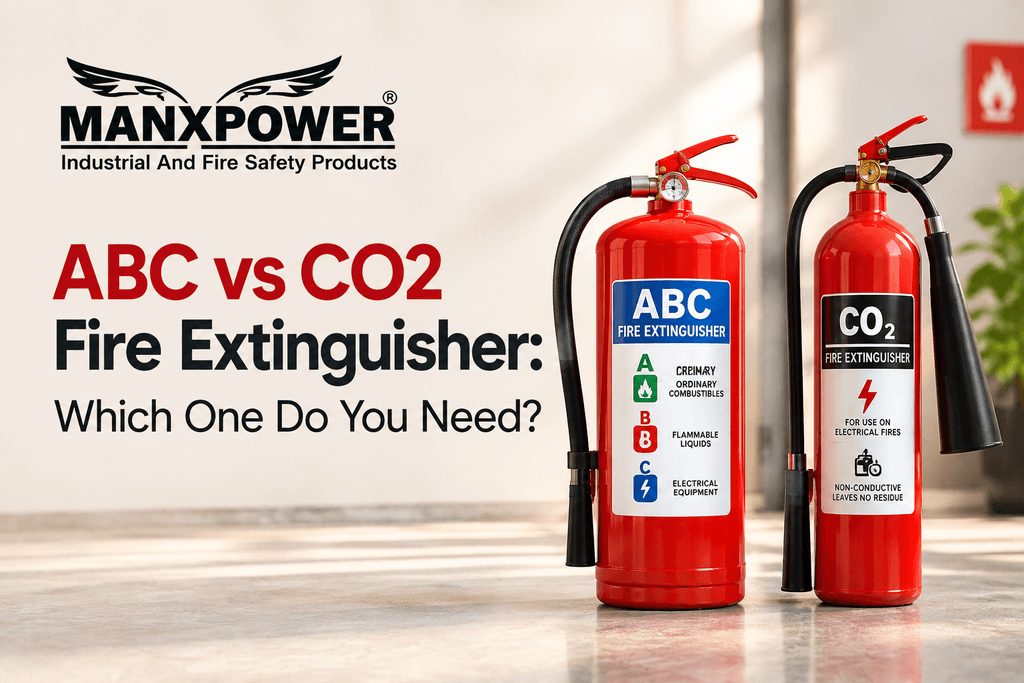
An ABC unit discharges a dry chemical powder that breaks the combustion chain reaction and settles as a layer over the burning surface. It is rated for Class A (solids like wood, paper, plastics), Class B (flammable liquids) and Class C, which in Indian classification means flammable gases. That breadth is why it is the default for mixed-risk spaces. The powder grades, capacities and fire ratings are covered on the page explaining how an ABC fire extinguisher works, and the difference between grades on how MAP percentage changes ABC powder performance.
CO2 in One Paragraph
A CO2 unit discharges carbon dioxide gas that displaces oxygen around the fuel, with some cooling as the gas expands. Its defining quality is that it leaves nothing behind, which is why it became the standard choice around electronics and energised equipment. You can recognise it by the flared discharge horn and, usually, the absence of a pressure gauge, because the charge is checked by weight. Construction and capacities are explained under how a CO2 fire extinguisher works.
ABC vs CO2 Fire Extinguisher: Comparison Table
| ABC dry powder | CO2 | |
| Agent | Monoammonium phosphate powder | Carbon dioxide gas |
| How it works | Breaks the combustion chain reaction and blankets the fuel | Displaces oxygen, with some cooling |
| Fire classes | A, B and C | B, and suitable around energised electrical equipment |
| On Class A fires | Effective, including deep-seated material | Poor, because it cannot soak in and the fire re-ignites |
| Residue | Corrosive powder, needs cleanup | None |
| Best for | Offices, homes, shops, storage, vehicles | Server rooms, UPS rooms, panels, labs |
| Main limitation | Damages electronics and machinery | Oxygen depletion in small closed rooms; freeze burn from the horn |
| Pressure gauge | Fitted | Usually none, charge checked by weight |
| Indian standard | IS 15683:2018 | IS 15683:2018 |
The Difference that Decides Most Purchases: Residue
ABC powder is corrosive, and it travels. A discharge does not stay neatly on the fire. Fine powder settles across the room, works into vents, keyboards, connectors and circuit boards, and attracts moisture from the air. Cleaning it out of a server rack or a control panel is often not worth attempting, and the equipment gets written off.
That is the real arithmetic behind the choice. A small fire inside a rack might destroy one power supply. The wrong extinguisher used on it can take out the whole rack. In a warehouse full of cartons, residue costs nothing worth worrying about, so ABC is the sensible option. In a room full of servers, residue is the expensive part.
CO2 sidesteps the problem completely. It is also why you will see CO2 units mounted beside electrical panels and inside IT rooms in buildings where every other extinguisher on the floor is ABC.
Unsure which rooms in your building need residue-free protection? Describe what each area contains and our team will explain which type fits where. Call +91 11 4987 2937.
Where CO2 Becomes a Risk to People
CO2 works by removing oxygen, and it cannot tell the difference between a fire and a person. In a large or ventilated area this is not a practical concern. In a small, closed room it is.
UK guidance applying HSE risk-assessment principles treats rooms below roughly 30 cubic metres as needing alternative measures where a 5 kg CO2 unit is in use, and BS 5306-8:2023 cautions against both CO2 and dry powder in confined spaces unless the risk has been assessed. India has no equivalent published figure, so treat this as good practice rather than a code requirement. The practical rule is simple: if the room is small and poorly ventilated, discharge and get out. Never treat a CO2 unit as something to keep using while standing inside a sealed space. Room size and ventilation are exactly what a proper assessment should record, as set out in how to conduct a fire risk assessment for your property.
There is a second hazard that is more immediate and far more common. The discharge horn drops to around −78 °C in use. Holding the horn instead of the handle causes freeze burns. Anyone who might have to use one should be shown this once, because it takes ten seconds to explain and it is the injury most often associated with these units.
Which one for your space?
Home
An ABC unit covers the realistic risks: kitchen appliances, wiring, furnishings and plastics. A small unit near the kitchen and another near the main electrical point is a reasonable starting point. For pan fires specifically, an extinguisher is often the wrong first move, and it helps to understand how a fire blanket works on small pan fires.
Office floors and reception areas
ABC for general coverage. What actually burns in an office is paper, furniture, plastics and packaging, and CO2 handles those poorly. Keep CO2 for the rooms that need it rather than scattering it across open floor space.
Server rooms, UPS rooms and electrical panels
CO2. This is the clearest case in the whole comparison. Being residue-free matters more here than raw extinguishing power, because the equipment is the thing you are protecting. Keep the room size in mind for the ventilation point above, and make sure staff know to leave after discharging.
Shops, godowns and storage
ABC. Stock, cartons, packing material and shelving are Class A risks, and CO2 will not hold them down once the gas disperses. Storage areas carry hazards well beyond extinguisher choice, which are covered in warehouse fire safety explained.
Cars, trucks and delivery vehicles
A compact ABC unit, mounted where the driver can reach it from the seat rather than locked in the boot. A vehicle fire usually involves wiring, upholstery and fuel at the same time, which is exactly what ABC covers. CO2 disperses too quickly in open air around a vehicle to work as a first response. Sizes and mounting positions are covered under what a car ABC fire extinguisher is designed to handle.
Working out the right mix for an office, godown or vehicle fleet? We can talk you through it room by room. Call +91 11 4987 2937 or use the contact form.
The “Class C” Confusion
This is where most Indian guidance gets muddled, so it is worth being precise.
Under Indian Standards, energised electrical equipment has no fire class of its own. Electricity is an ignition source rather than a fuel. What burns is the insulation, the plastic, the paper or the oil around it, and the fire takes the class of that material. The “C” in an Indian ABC rating refers to flammable gases, not electrical equipment. That differs from the American NFPA system, where Class C does mean energised electrical, and the mix-up gets repeated on a lot of Indian websites.
What this means for the ABC vs CO2 choice: both can be used where electrical equipment is involved, but CO2 is preferred around sensitive electronics because nothing is left behind, and ABC will damage whatever it touches. Either way, isolate the supply first if it is safe to do so, or the fire restarts once the agent disperses. The causes, warning signs and prevention of these fires are a separate topic, covered in electrical fire safety: causes and prevention.
Where Neither One Belongs
Two situations where reaching for either of these is the wrong move:
- Cooking oil and fat fires. These are Class F fires and need a wet chemical agent, which reacts with the hot oil to form a sealing layer. Powder can disturb the oil surface, and water is outright dangerous. For a small pan fire, a fire blanket is the safer response. Commercial kitchens have a longer list to work through, set out in the fire safety checklist for restaurants and commercial kitchens.
- Lithium-ion battery fires. A cell in thermal runaway generates its own heat and gas. Smothering agents like CO2 and ABC powder do not cool the cells, so the fire continues or restarts minutes later. This is a containment and evacuation situation rather than an extinguisher one.
Knowing the limits of your equipment is part of using it properly. An extinguisher that is wrong for the fire can make the situation worse, not just fail to help.
Reading The Label Before You Decide
Whatever type you settle on, read the label rather than the product name. It should carry the IS 15683:2018 reference and the ISI mark, the capacity, and the fire rating. That rating is a number-and-letter code such as 21A or 113B, and it tells you the size of test fire the unit actually handled. Two extinguishers of the same weight can carry different ratings depending on the grade of agent inside, which is why the rating matters more than the kilogram figure.
Placement and checks are a topic of their own. Mounting height, visibility and the monthly gauge-or-weight check are set out in the fire extinguisher maintenance guide, and the rules behind placement in fire safety compliance in India.
Still not sure what belongs where in your building? Tell us what each area contains and our team will help you work out the right mix of ABC and CO2 units. Call +91 11 4987 2937 or use the contact form.
FAQs about ABC vs CO2 Fire Extinguisher:
What is the difference between an ABC vs CO2 fire extinguisher?
ABC discharges a dry chemical powder that covers Class A, B and C fires but leaves a corrosive residue. CO2 discharges carbon dioxide gas, leaves no residue, and suits electronics and energised equipment, but it performs poorly on solid combustibles.
Can a CO2 extinguisher be used on a Class A fire?
It is not suitable. CO2 cannot penetrate deep-seated material such as wood, paper or fabric, so the fire commonly re-ignites once the gas disperses. Use an ABC or water-based extinguisher for Class A risks.
Which fire extinguisher is best for a server room?
CO2, because it leaves no residue. ABC powder settles into equipment, is corrosive, and usually causes more damage than the fire itself. Keep the room’s size and ventilation in mind, since CO2 displaces oxygen.
Can an ABC extinguisher be used on an electrical fire?
It can be, but it will damage the equipment it covers. Where sensitive electronics are involved, CO2 is preferred. Isolate the power supply first if it is safe to do so, otherwise the fire will restart.
Why does a CO2 fire extinguisher have no pressure gauge?
Its charge is checked by weighing the cylinder rather than reading a dial, because the contents are a liquefied gas. Periodic weighing therefore becomes part of routine maintenance.
Is a CO2 extinguisher dangerous in a closed room?
It can be. CO2 works by displacing oxygen, so in a small, poorly ventilated room it can reduce oxygen to unsafe levels. Discharge and leave the area rather than remaining inside.
Which extinguisher should I keep in my car or truck?
A compact ABC unit, mounted within reach of the driver. Vehicle fires typically involve wiring, upholstery and fuel together, which ABC covers, while CO2 disperses too quickly in open air.
Do ABC and CO2 extinguishers work on kitchen oil fires?
No. Cooking oil and fat fires are Class F and need a wet chemical agent. For a small pan fire, a fire blanket is the safer first response.