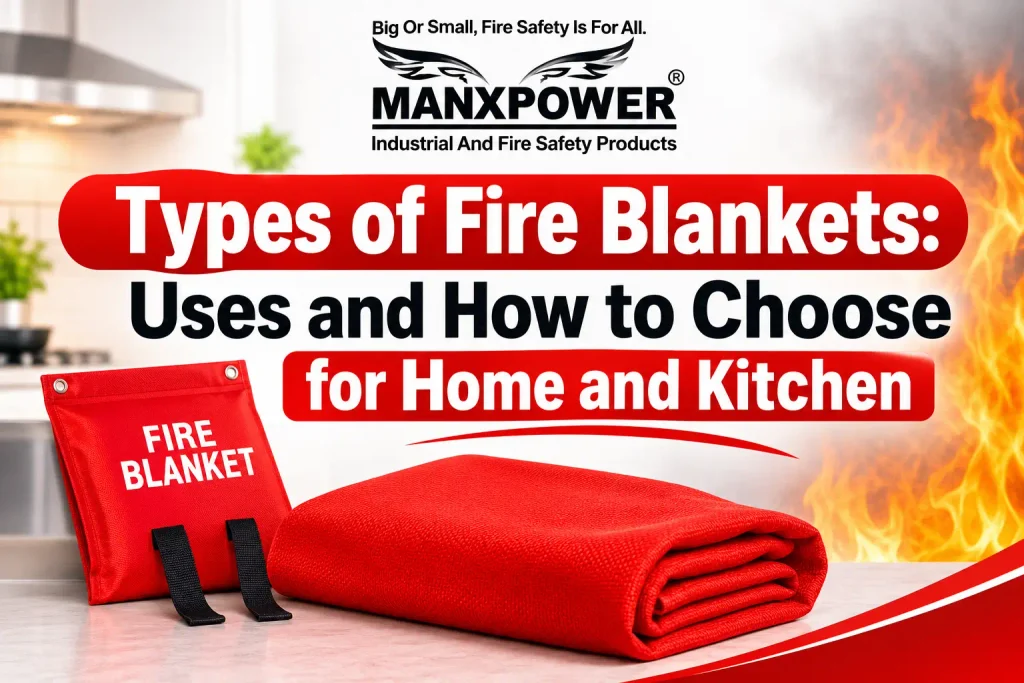
A fire blanket, also called a fire safety blanket, is a sheet of fire-resistant fabric that puts out a small fire by cutting off its oxygen. The main types are fiberglass (home and kitchen), silicone-coated fiberglass (workshops), treated wool (camping), aramid (specialist) and large EV blankets. A fire blanket needs very little training, no refilling and no power, so it belongs near the stove in every home and commercial kitchen.
Not every blanket suits every job, so a kitchen blanket and an electric-vehicle blanket are not interchangeable. This guide explains how a fire blanket works, the main types and materials, what fires it can be used on, and how to choose the right one.
How does a fire blanket work?
A fire blanket works by removing oxygen. Every fire needs fuel, heat and oxygen, and a blanket laid over a small fire stops air reaching the flames, so the fire dies out. The fabric also resists heat, which lets you shield your hands and body as you approach.
Most household blankets are woven fiberglass folded into a wall-mounted pouch. Pull tapes or release tabs hang from the pouch: pull them down and the blanket drops free, ready to open.
Types of fire blankets
Fire blankets are grouped by the material they are made from and by the job they are made for. Check both when you compare blankets.
Fire blanket materials: what are fire blankets made of?
| Material | What it is | Best for |
| Fiberglass (also spelled fibreglass) | Woven glass fibers, the most common fire blanket material in homes and kitchens | Kitchens, homes, small workshops |
| Silicone-coated fiberglass | Fiberglass with a coating that resists hot sparks and sheds fewer fibers | Workshops, industrial use |
| Treated wool | Wool treated to resist flame, often called a wool fire blanket | Camping, outdoor and personal use |
| Aramid fabrics (such as Kevlar and Nomex) | Heavy fabrics for very high temperatures | Industrial and specialist use |
Types of fire blankets by use
| Type | Typical use | Notes |
| Kitchen and domestic (household) | Pan and cooking-oil fires, small bin or appliance fires | Common sizes run from 1 m x 1 m to 1.2 m x 1.8 m |
| Industrial and commercial | Canteens, workshops, labs, factories | Often larger than household sizes, such as 1 m x 2 m or 1.8 m x 1.8 m |
| EV and lithium battery fire blanket | Covers a whole car during a battery fire | Very large, specialist product (see the EV section below) |
For a home or a restaurant kitchen, a fiberglass fire blanket in a quick-release pouch is the standard choice. The Manxpower fire blanket is a 1 m x 2 m fire-retardant fiberglass blanket in a wall-mountable pouch with pull-down release tabs.
What fires can a fire blanket be used on?
A fire blanket is made for small, contained fires that you can cover completely. Use this table to check before you act.
| Fire | Use a fire blanket? |
| Cooking oil or fat in a pan (Class F) | Yes, if the fire is still in the pan |
| Small fire in a bin, or in paper, cloth or wood (Class A) | Yes, if it is small and contained |
| Small flammable liquid fire in a pan or tray (Class B) | Yes, if it is small and contained |
| Small appliance fire, such as a toaster or kettle | Yes, only after the power is off |
| Live electrical equipment | No |
| Gas fire, such as a burning LPG regulator | No. A blanket cannot stop the leak. Close the regulator only if it is safe, then leave and call 101 (fire) or 112 |
| Large or spreading fire | No. Leave and call 101 (fire) or 112 |
| EV or lithium battery fire | No (see the EV section below) |
Fire blanket safety: when to use it and when to leave
Use a fire blanket only on a small, contained fire such as a pan, a bin or a small appliance. If the fire is spreading across a room, leave, close the door and call 101 (fire) or 112 (national emergency number).
- Keep your exit behind you, and never lean over the flames.
- Shield your hands behind the top edge of the blanket.
- Do not throw the blanket. Lay it gently over the fire.
- Do not lift it early. Hot oil can catch fire again.
- If the fire is bigger than the blanket, leave.
Can a fire blanket be used on a person? A blanket can smother flames on clothing if it is big enough to cover the person. Wrap it around them, then call 112 and get medical help. A 1 m x 1 m blanket is too small for an adult.
Fire blanket for the kitchen
A fire blanket in the kitchen is one of the safest tools for a pan fire, because water makes burning oil flare up and spread, and a blanket does not. Most kitchen fires start with hot oil or a pan left on the heat, so hang the blanket on the wall within a short step of the stove, where you can grab it without reaching over the heat.
How to use a fire blanket in the kitchen: switch off the heat if it is safe, pull the tabs to release the blanket, shield your hands behind its top edge, lower it over the pan away from your body, and leave it in place until the pan is completely cool. Never carry a burning pan and never throw water on it. For the full steps, read our guide on how to put out a cooking oil fire. Commercial kitchens should also follow our fire safety checklist for restaurants and commercial kitchens.
Fire blanket for the home
A household (domestic) fire blanket gives a home a low-effort first response to small fires. Keep one in the kitchen, near the exit path, so you can reach it and still leave quickly if the fire grows.
A 1 m x 1 m blanket covers a standard pan, and a larger blanket gives you more margin for a wide pan or a tray. Mount the pouch on the wall, away from direct heat and splashes, and make sure everyone in the house knows where it is.
A blanket is only one layer of protection. Pair it with an extinguisher, as described in our guide to the best fire extinguisher for home in India. ABC dry powder suits general home fires, while deep-fat fryers and commercial kitchen oil fires need a wet chemical (Class F) extinguisher.
Can you use a fire blanket on an electrical fire?
Only after the power is off. A fire blanket should never go over live electrical equipment, because the blanket does not cut the power or stop the fault. If you can cut the supply at the switch, MCB or mains without risk, a blanket can then smother a small fire in an appliance such as a toaster or kettle.
If you cannot switch the power off, leave the area and call 101 (fire) or 112 (national emergency number). For electrical risks, an ABC or CO2 extinguisher is the usual tool once the power is off, and CO2 leaves no powder residue. Our comparison of ABC vs CO2 fire extinguishers explains when to choose each, and our guide to electrical fire safety covers prevention.
EV fire blankets and lithium battery fires
A household fire blanket is not designed for an electric car or a large lithium-ion battery fire. These fires burn hot, can reignite after they look out and need the fire service, not a 1 m x 2 m blanket.
Special EV fire blankets exist for electric cars. They are very large, made to cover the whole vehicle, and they are meant to slow the spread of the fire while professionals respond, not to put it out. If you are comparing products, check the size and the use stated by the maker before you rely on any blanket for an electric vehicle.
For safe practice with batteries, read our guides on lithium-ion battery fires and truck and vehicle fires.
Fire blanket vs fire extinguisher: do you need both?
Keep both, because they cover different situations. A blanket is best for a small pan or appliance fire, while an extinguisher handles a wider range of fires and can be used from a distance.
| Fire blanket | Fire extinguisher | |
| Best for | Small pan, oil and appliance fires | Different fire classes, depending on type |
| Training needed | Very little | Basic training (the PASS method) |
| Distance from fire | Close, behind the blanket | Can be used from a safer distance |
| After use | Replace the blanket | Recharge or replace the extinguisher |
| Limits | Small, contained fires only | Must match the fire class |
For a kitchen, a fire blanket and an extinguisher together give the best cover. See our ABC fire extinguisher range for the extinguisher side.
Fire blanket shelf life: how long does it last?
Some makers print a replacement period on the label, so check it first. If yours does not, inspect the blanket at least once a year, and replace it after any use. A blanket that has smothered a fire may be damaged or contaminated, even if it looks fine.
Replace it if you find any of these:
- Tears, burns, holes or frayed edges
- Oil, grease or chemical stains
- Pull tapes or tabs that are missing or stuck
- A pouch that is damaged, wet or no longer holds the blanket securely
Keep the pouch dry and clean, away from direct heat, and do not store other items on top of it.
How to choose a fire blanket
Choose by size, material, standard and ease of release. Use this checklist when you compare blankets.
- Size: See the size table below.
- Material: Fiberglass suits kitchens and homes. Pick a silicone-coated or heavier fabric for workshops.
- Standard: Look for a recognised fire blanket standard, such as EN 1869, or a test certificate from the maker.
- Fast release: The pouch should open with pull tapes or tabs, with clear instructions printed on it.
- Mounting: The pouch should be wall-mountable and easy to reach from the stove.
- Fit for the risk: Confirm the maker states the blanket is for kitchen or general use, not only for an EV.
Fire blanket size for the kitchen
| Size | Typical use |
| 1 m x 1 m | Home kitchen, standard pan |
| 1.2 m x 1.2 m | Small kitchen or small commercial kitchen |
| 1 m x 2 m or 1.2 m x 1.8 m | Wide pans, trays, bigger cooktops, labs and restaurants |
| 1.8 m x 1.8 m or 2 m x 2 m | Large commercial kitchens, workshops, industrial use |
Quick summary: choosing and using a fire blanket
A fire blanket is a first response for small, contained fires, mainly pan and small appliance fires. Match the type to the risk: fiberglass for homes and kitchens, heavier or coated fabrics for workshops, and a very large specialist blanket for EVs. Keep it within a short step of the stove, make sure everyone knows where it is, and replace it after any use. If a fire grows, leave and call 101 (fire) or 112. For the size and features of a 1 m x 2 m fiberglass blanket, see our fire blanket page.
Fire blanket FAQ
What is a fire blanket used for?
A fire blanket is used to smother small fires, mainly cooking-oil and pan fires, small appliance fires and small contained fires in workshops.
What types of fire can a fire blanket be used on?
A fire blanket can be used on small, contained fires: cooking oil or fat in a pan, small flammable liquid fires, and small fires in paper, cloth or wood. It should not be used on live electrical equipment, gas fires, large spreading fires or EV battery fires.
How does a fire blanket work?
A fire blanket works by removing oxygen. Laid over a small fire, it stops air reaching the flames, so the fire dies out. The fabric also resists heat, which lets you shield your hands as you approach.
Can a fire blanket be used on a person?
A fire blanket can smother flames on clothing if it is big enough to cover the person. Wrap it around them, then call 112 and get medical help. A 1 m x 1 m blanket is too small for an adult.
Is a fire blanket reusable?
Treat it as single use. Replace it after you use it on a fire, and replace it if it is torn, burned or stained.
What size fire blanket do I need for my kitchen?
A 1 m x 1 m blanket covers a standard pan. Choose a larger blanket for wide pans, trays or a commercial kitchen.
Do I need both a fire blanket and a fire extinguisher?
Yes. The blanket handles small pan and appliance fires up close, while the extinguisher covers more fire types from a distance.
Can a fire blanket put out an EV fire?
A household blanket cannot. EV battery fires need the fire service and, if used at all, a very large EV-specific blanket.