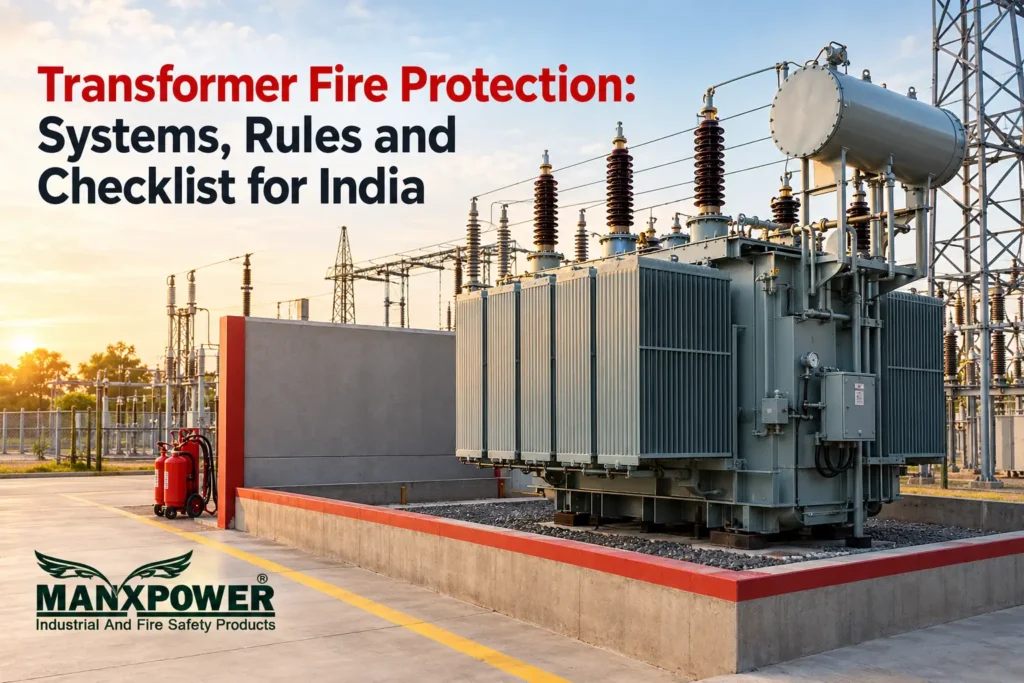
Transformer fire protection is the set of measures that stop a transformer from catching fire and stop a fire from spreading if it does. It comes down to four things:
- Prevent the electrical faults that start fires: overload, loose connections, old oil and failing insulation.
- Contain the oil with a pit large enough to hold all of it plus fire-fighting water, and a fire wall where the transformer is close to a building or another transformer.
- Keep CO2 and ABC dry powder extinguishers nearby. Never use water or foam on live equipment.
- Fit an automatic system on large transformers. In India, this is mandatory for transformers of 10 MVA and above.
An oil-filled transformer can hold hundreds or thousands of litres of mineral oil. Once that oil catches, the fire is hard to stop and can spread to cables, meter rooms and nearby buildings.
Manx Impex is a New Delhi-based, ISO 9001:2015 certified supplier of fire extinguishers and fire alarm equipment, serving customers across India since 2015. Our work in Delhi includes supplying fire safety equipment for transformer and substation rooms.
This guide is for housing societies, factories, hospitals, schools and commercial buildings in India that have their own transformer or substation room. It is general information, not engineering advice. Fixed systems must be designed and checked by a qualified electrical and fire engineer.
Why Do Transformers Catch Fire?
Most transformer fires start with an electrical fault. The heat or arc from the fault ignites the insulating oil. Common causes are:
- Overloading. In summer, air conditioning pushes loads up, and an overloaded transformer runs hot.
- Loose or corroded connections. A poor joint at a bushing or cable lug heats up and can arc.
- Old or contaminated oil. Moisture and sludge reduce the oil’s insulating strength.
- Insulation failure. Winding insulation weakens with age and heat. A breakdown causes an internal arc, which can split the tank.
- Oil leaks. Leaked oil on the ground or on cables is fuel waiting for a spark.
- Lightning and surges. A surge without proper protection can damage the windings.
- Rubbish around the unit. Dry leaves, paper and plastic near the transformer catch easily from a spark.
An internal arc can rupture the tank and spray burning oil. That is why distance, fire walls and oil containment matter as much as extinguishers.
What Is the Indian Standard for Transformer Fire Protection?
The main Indian standard is IS 3034:1993, the Bureau of Indian Standards code of practice for fire safety of electrical generating and distributing stations. It is listed on the Bureau of Indian Standards website, with a 2005 amendment. It is written for power stations and substations, so for a society or small factory transformer, treat it as a good-practice guide. Its main transformer fire protection requirements are:
| Requirement | What IS 3034 says |
| Fire wall near buildings | An outdoor transformer needs a fire barrier wall (fire wall) of at least 2 hours’ fire resistance where a clear distance of 15 metres from nearby buildings is not available |
| Fire protection wall between transformers | Needed between oil-filled transformers holding more than 2,000 litres of oil where the required clearance between them is not kept, and between transformers less than 15 metres apart |
| Oil containment | For large transformers: drainage and a pit large enough to hold at least the total volume of oil, plus fire-fighting water, with flame arresters on drain pipes |
| Fixed water spray | Not required below 10 MVA, or for transformers holding 2,000 litres of oil or less. Larger transformers need an automatic high-velocity water spray system |
| Protection devices | Transformers with conservators need a Buchholz relay. All need oil temperature alarms or overcurrent protection |
| Maintenance | Keep bushings, insulators and tap-changer contacts clean, and check oil level and dielectric strength regularly |
| Portable extinguishers | First-aid extinguishers at fire-risk areas, as per IS 2190 |
The second rule is the CEA (Measures relating to Safety and Electric Supply) Regulations, 2023 from the Central Electricity Authority. As of October 2026, they make an automatic fire-fighting system mandatory for every transformer of 10 MVA or higher, and every reactor of 10 MVAr or higher, in installations above 650 V. CEA amends these regulations from time to time, so check the latest version on its website.
Most housing society and small factory transformers are well below 10 MVA. They do not need an automatic system under these rules. As good practice, they should still have a fire wall or safe distance, oil containment, protection relays, regular maintenance and first-aid extinguishers. Your local fire service or electrical inspector may add conditions when it issues a fire NOC.
Types of Transformer Fire Protection System
The five main types are portable extinguishers, fire detection and alarm, high-velocity water spray, nitrogen injection, and gas-based flooding. The right transformer fire protection system is chosen by the size of the transformer, how much oil it holds, and whether it is outdoors or in a room.
| System | How it works | Where it is used |
| Portable extinguishers | CO2 or ABC dry powder, used by trained staff on a very small fire at its start | Every transformer and substation room |
| Fire detection and alarm | Heat or smoke detectors raise an alarm at a panel | Transformer rooms, substation rooms, switchgear rooms |
| High-velocity water spray | Fixed nozzles spray water over the tank, conservator and bushings when a fire is detected | Large outdoor transformers, as required by IS 3034 |
| Nitrogen injection system | Isolates power, drains some oil from the top of the tank and injects nitrogen at the bottom to cool the oil and keep oxygen out | Large oil-filled power transformers and reactors |
| Gas-based flooding | Fills a closed room with CO2 or a clean agent. Everyone must be out of the room before it discharges | Switchgear rooms, and indoor transformer rooms where a specialist designs it |
What Is a Nitrogen Injection Fire Protection System for a Transformer?
A nitrogen injection fire protection system for a transformer is an automatic system that acts when it detects an internal fault. It cuts the power, drains a small amount of oil from the top of the tank to lower the pressure, and pushes nitrogen in at the bottom. The nitrogen stirs and cools the oil and keeps air out, which stops the oil from burning. It is used on large oil-filled transformers and reactors.
These fixed systems are specialist engineering work. Manx Impex supplies the first-aid layer: extinguishers and fire alarm equipment.
Which Transformer Fire Extinguisher Should You Use?
A transformer fire is two fires at once: burning oil (Class B) and live electrical equipment. The right transformer fire extinguisher must work on oil and be safe near electricity.
In a real fire, your first steps are always to move people away and call 101. Extinguishers are only for trained staff, on a very small fire at its start, after the supply is cut off.
| Extinguisher | Suitable for a transformer fire? | Why |
| CO2 fire extinguisher | Yes | Does not conduct electricity and leaves no residue. Best indoors, because wind blows the gas away outdoors. In a small closed room, discharge it and step out, because CO2 pushes out the air |
| ABC dry powder fire extinguisher | Yes | Works on oil and electrical fires, indoors and outdoors. Leaves a corrosive powder that needs cleaning |
| Water extinguisher | No, unless power is fully isolated | Water conducts electricity and can spread burning oil |
| Foam extinguisher | No, unless power is fully isolated | Foam contains water and can conduct electricity |
| Sand bucket | Yes, for small oil spills on the ground | Often kept at substations. Smothers spilled burning oil. Do not throw sand onto the transformer itself |
For a side-by-side comparison, read ABC vs CO2 fire extinguisher.
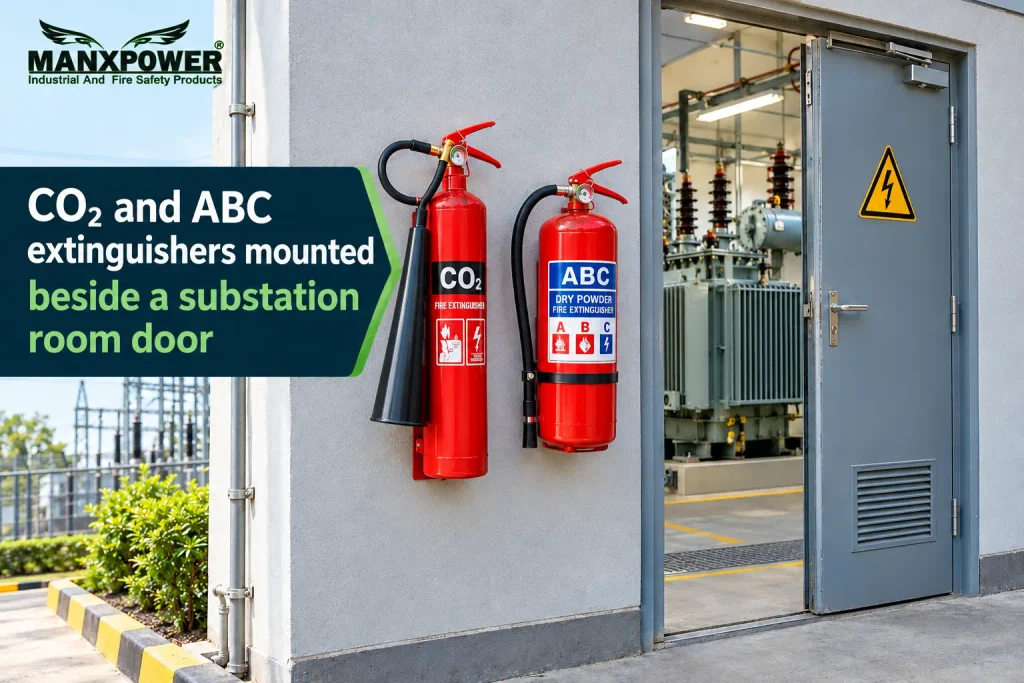
Mount the extinguishers outside the transformer enclosure or at the entry to the substation room, so a person can reach them without walking past the burning equipment. IS 2190 covers how many to keep and how to maintain them.
Need extinguishers for your transformer or substation room? Get CO2 and ABC fire extinguishers from Manx Impex. Call +91 11 4987 2937 or WhatsApp us.
Transformer Room Fire Protection System
A transformer room fire protection system combines fire detection, CO2 and ABC extinguishers at the door, and a fixed gas-based system where required. Indoor transformer and substation rooms are often locked and empty, so a fire can grow before anyone notices. The system usually has three parts:
- Detection. Heat or smoke detectors in the room, usually connected to a conventional fire alarm panel at the security desk.
- First-aid extinguishers. CO2 and ABC extinguishers at the door, outside the room.
- Fixed system, where required. For switchgear rooms, IS 3034 prefers automatic gas-based systems, such as CO2 or clean agent flooding, over water spray. For an indoor transformer, the fixed system must be designed by a specialist.
Substation fire protection requirements also cover the room itself: keep it free of stored material, keep the door clear, and keep cable openings sealed so fire cannot travel along cables to other floors.
Dry Type Transformer Fire Protection
Dry type transformers use no oil, so they carry a lower fire risk and are often installed inside buildings. Dry type transformer fire protection still needs detectors in the room, CO2 or ABC extinguishers at the door, good ventilation so the unit does not overheat, and regular checks of connections.
Transformer Fire Protection Checklist for Societies and Factories
These are common good-practice intervals, not fixed by IS 3034. If your electrical engineer or electricity company sets a different schedule, follow that.
Every Month
- Walk around the transformer. Look for oil stains, leaks, rust on the tank and damaged cables.
- Clear dry leaves, rubbish and stored material from the enclosure.
- Check that the enclosure is locked and the danger board is in place.
- Check the extinguisher gauges and seals.
Every Quarter
- Check the oil level and temperature readings.
- Look at bushings and cable terminations for dirt, cracks or heat marks.
- Test the fire alarm and the detectors in the substation room.
Every Year
- Get the oil tested for dielectric strength and moisture by a qualified agency.
- Have an electrician check the earthing, the Buchholz relay and the overload protection.
- Get a thermal scan of the connections if your load is high.
- Inspect the fire wall, the oil pit and the drain. Make sure the pit is not full of rainwater or rubbish.
Loose joints and overheating cause many electrical fires, not only transformer fires. Read more in our guide to electrical fire safety.
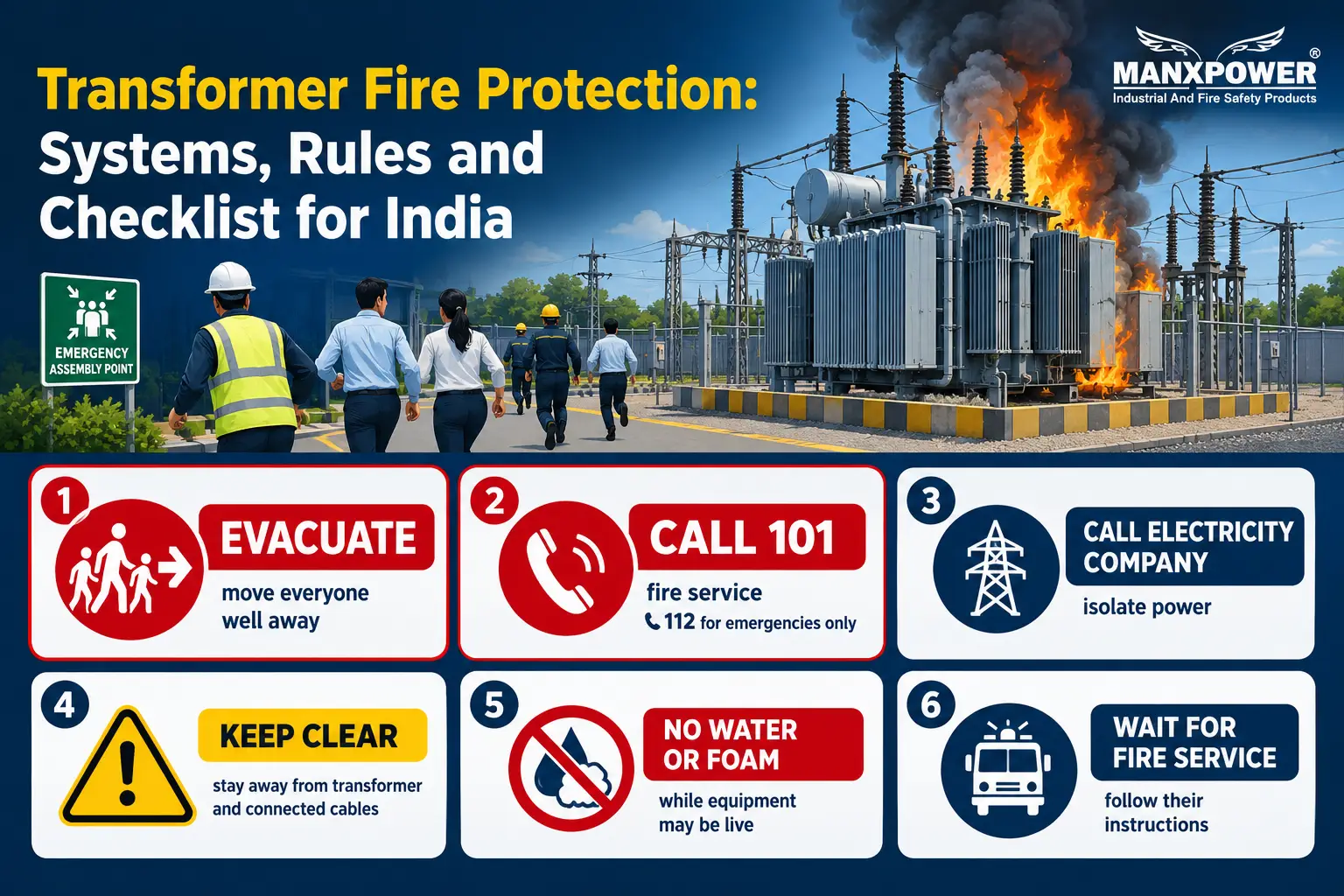
What Should You Do If a Transformer Catches Fire?
Your first job is to get people away and get help. Do not go near a burning transformer.
- Shout “Fire” and move everyone well away. Burning oil can spread, and the tank can burst.
- Call 101 for the fire service and 112 for emergencies.
- Call your electricity company’s emergency number, usually printed on your bill, so it can cut the supply.
- Keep everyone away from the transformer and from the cables and meter rooms connected to it.
- Never use water or foam while the transformer may still be live.
- Wait for the fire service and follow its instructions.
Extinguishers and sand are only for trained staff, only for a very small fire at its start, only after the supply is cut off, and only if their escape route is behind them. If the fire is on the transformer itself or is growing, leave it to the fire service.
Housing Societies and Factories: Who Is Responsible?
In some housing societies, the transformer belongs to the electricity company even though it sits inside the society’s boundary. The company maintains the transformer. The resident welfare association (RWA) or facility team should still keep the area clear, report leaks, and keep extinguishers and a working alarm near it. Fire risk around transformers rises during festivals with decorative lighting and fireworks. Read our Diwali fire safety checklist for housing societies.
Factories usually own their transformers, so the full checklist and any transformer fire fighting system are their responsibility. See how this fits with the rest of your plant in our page on fire safety for factories.
The Verdict: Transformer Fire Protection in One Line
Transformer fire protection means preventing the electrical faults that start fires, containing the oil with a pit and a fire wall, keeping CO2 and ABC extinguishers at the entry, never using water on live equipment, and fitting an automatic system on transformers of 10 MVA and above.
For CO2 and ABC fire extinguishers, heat detectors or a fire alarm panel for your substation room, call Manx Impex, an ISO 9001:2015 certified fire safety supplier in New Delhi, on +91 11 4987 2937 or WhatsApp us.
Frequently Asked Questions
Q1. What is transformer fire protection?
It is the set of measures that stop a transformer from catching fire and stop a fire from spreading: preventing electrical faults, containing the oil with a pit and a fire wall, keeping CO2 and ABC extinguishers nearby, and fitting an automatic system on transformers of 10 MVA and above.
Q2. What is the Indian standard for transformer fire protection?
IS 3034:1993, the BIS code of practice for fire safety of electrical generating and distributing stations. It covers fire walls, oil containment, water spray systems, protection relays and maintenance. The CEA (Measures relating to Safety and Electric Supply) Regulations, 2023 also make an automatic fire-fighting system mandatory for transformers of 10 MVA and above.
Q3. Which fire extinguisher is used for a transformer fire?
CO2 and ABC dry powder extinguishers. Both work on oil and electrical fires. CO2 works best indoors, and ABC works indoors and outdoors. Do not use water or foam while the transformer may be live. In a real fire, first move people away and call 101. Only trained staff should use an extinguisher, and only on a very small fire after the supply is cut off.
Q4. When is a fire wall needed between transformers?
IS 3034:1993 asks for a fire barrier between oil-filled transformers holding more than 2,000 litres of oil where the required clearance is not kept, and between transformers less than 15 metres apart. It also asks for a fire barrier of at least 2 hours’ fire resistance where an outdoor transformer is less than 15 metres from a building.
Q5. What is a nitrogen injection fire protection system for a transformer?
An automatic system that, on detecting an internal fault, cuts the power, drains some oil from the top of the tank and injects nitrogen at the bottom. This cools the oil and keeps air out, which stops the oil from burning.
Q6. Do dry type transformers need fire protection?
Yes. Dry type transformers use no oil, so the fire risk is lower than for oil-filled ones, but they still need detectors in the room, CO2 or ABC extinguishers at the door, good ventilation and regular checks of connections.
Q7. Can water be used on a transformer fire?
Not by hand while the transformer may be live, because water conducts electricity and can spread burning oil. Move people away, call 101 and leave it to the fire service. Large transformers use fixed high-velocity water spray systems designed for this, but those are engineered systems, not buckets or hoses.