
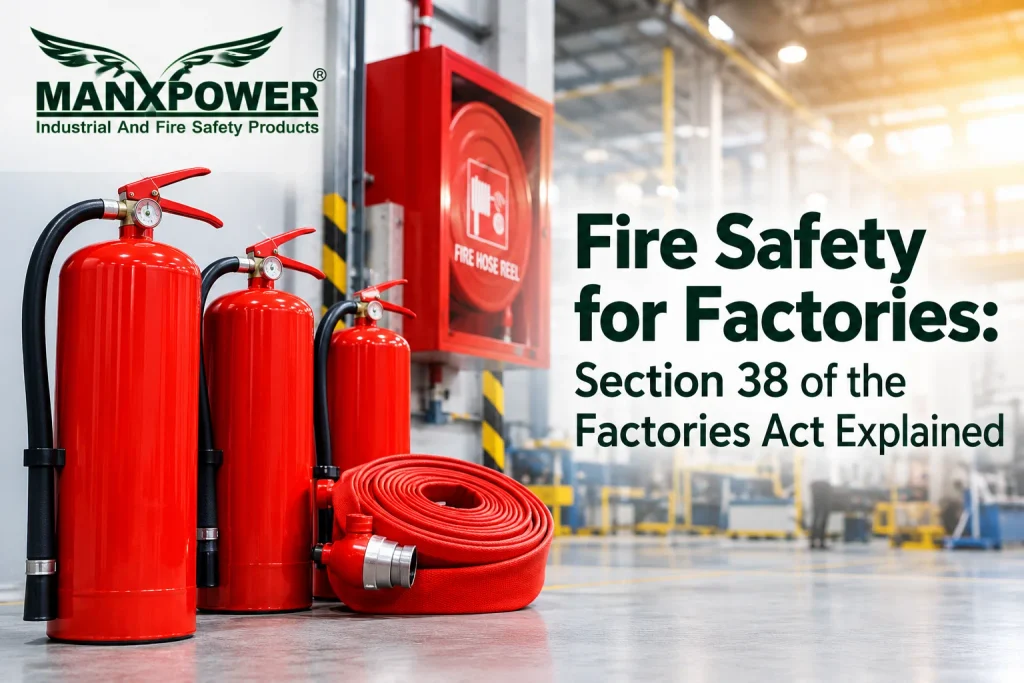
Factory fire safety in India rests on Section 38 of the Factories Act, 1948. It requires every factory to take all practicable measures to prevent fires and stop them spreading, to keep safe escape routes, to maintain firefighting equipment, and to train workers in what to do. For a broader overview of fire safety for factories, including the types of fire protection relevant to industrial facilities, see our dedicated factories industry page. This guide explains each part in plain language and shows what it means on the shop floor, including for factories in Delhi.
What Section 38 Says
The section has four parts:
| Sub-section | What it requires | What it means in practice |
| 38(1) | Take all practicable measures to prevent fire and its spread, inside and outside the factory. Provide and maintain safe escape routes and firefighting equipment | Fire prevention, clear exits, working extinguishers and water systems |
| 38(2) | Make sure workers know the escape routes and are trained in the routine to follow | Drills, briefings, refresher training |
| 38(3) | State governments may frame rules for factories or classes of factories | Local rules add detail, so state requirements matter |
| 38(4) | The Chief Inspector can order additional measures in writing if existing ones are inadequate | An inspector can raise the standard for a specific site |
What “All Practicable Measures” Means
The Act doesn’t list equipment. It sets a duty and leaves the detail to state rules and inspectors. In practice, a factory should match its protection to what it actually makes and stores. A garment unit with piles of fabric and a chemical plant with flammable liquids carry very different fire loads.
Section 38(4) is the part many occupiers overlook. Even a factory that meets its state rules can be told to add more if the Chief Inspector decides the risk calls for it. Reviewing hazards yearly, rather than waiting for an order, is the safer habit.
Factory Fire Protection: The Core Layers
Good factory fire protection works in layers:
- Prevention: controlled storage of flammables, tidy housekeeping, hot-work permits and checked wiring.
- Detection: smoke or heat detectors, manual call points and an alarm panel that people can hear across the plant.
- Suppression: extinguishers at hand, plus hydrants, hose reels or sprinklers for larger fires.
- Escape: unlocked, unobstructed exits with clear signage and enough lighting.
- People: trained workers who know the plan.
Factory Fire Safety Equipment Checklist
Factory fire safety equipment should match the hazard, not just fill a wall.
| Equipment | Where it is needed | What to check |
| Portable extinguishers | Work areas, store rooms, near exits | Right type for the fire class, gauge in green, seal intact |
| Hose and hydrant points | Large halls, yards, storage areas | Hose condition, couplings, water pressure |
| Sprinklers | Storage and high fire-load areas | Heads unobstructed, system tested |
| Detectors and call points | Production floors, stores, electrical rooms | Regular testing, no blocked sensors |
| Exit and direction signs | Corridors, doors, stairs | Visible, lit, route kept clear |
For portable protection, MANXPOWER lists ABC, CO2 and AFFF foam extinguishers, and the 9-litre foam model is described as suited to factories, warehouses and fuel stations. Factory fire safety equipments need servicing as much as installing, so keep a monthly check and a logbook.
Factory Fire Safety in Delhi
Under Section 38(3), the detailed requirements come from state rules, so factory fire safety in Delhi depends on Delhi’s own rules and its fire authority. Delhi Fire Service issues the Fire NOC. Under Rule 27 of the Delhi Fire Service Rules, 2010, industrial buildings with a covered area of more than 250 square metres on all floors need one. The factories inspectorate separately enforces the Factories Act. Confirm the current rules for your unit before you plan equipment.
Training and Drills Under Section 38(2)
Equipment alone doesn’t satisfy the Act. Workers must know the escape routes and the routine to follow. Run regular drills, brief new joiners on day one, and walk each shift through the nearest exit and assembly point. Record each drill with the date and attendance.
Gaps That Often Cause Trouble
Inspections tend to turn up the same few problems: extinguishers that are expired, empty or the wrong type for the area, exits blocked by stock, alarm points that haven’t been tested, and workers who can’t say where the assembly point is. Most are cheap to fix. They are also the easiest to avoid with a simple monthly walk-through and a logbook that records who checked what.
How to Choose a Factory Fire Safety Supplier in New Delhi
Whether you’re comparing top factory fire safety suppliers in New Delhi or a factory fire safety supplier in India, ask a few plain questions:
- Do the products carry the relevant Indian standard approvals, with documents to show it?
- Is the range wide enough to cover extinguishers, sprinklers, hose and spares from one source?
- Are spares available, so the equipment stays serviceable?
- Can the supplier deliver across India if you run more than one plant?
Manx Impex is an ISO 9001:2015 certified company based in New Delhi, supplying fire safety equipment and industrial hoses across India since 2015 under its MANXPOWER brand. To discuss your factory’s requirement, call +91 11 4987 2937.
The Verdict: What Does Factory Fire Safety Require?
Section 38 asks for four things: prevent fires, keep escape routes, keep working equipment, and train people. State rules and inspectors decide the detail. Start with a hazard review, match your equipment to it, service it on schedule, and drill your workers. For help with a factory fire safety equipment list, contact Manx Impex on +91 11 4987 2937.
Frequently Asked Questions
Q1. What does Section 38 of the Factories Act say?
It requires every factory to prevent fire and its spread, keep safe escape routes and firefighting equipment, and train workers in the escape routine.
Q2. Can an inspector demand more fire safety measures?
Yes. Under Section 38(4), the Chief Inspector can order additional measures in writing if the existing ones are inadequate.
Q3. What factory fire safety equipment does a factory need?
It depends on the hazard, but most need extinguishers, alarm and detection, escape signage, and hose or hydrant systems. Larger or high-risk sites may need sprinklers.
Q4. Who handles factory fire safety approvals in Delhi?
Delhi Fire Service issues the Fire NOC, and the factories inspectorate enforces the Factories Act. Confirm current requirements for your unit before applying.
Q5. Where can I buy fire safety equipment for a factory?
Buy from a supplier that gives product details, approvals and spares support. Manx Impex supplies fire safety equipment from New Delhi across India, so call +91 11 4987 2937 to discuss your list.
Q6. How do I pick a factory fire safety supplier in India?
Check approvals, range, spares availability and delivery coverage. You can visit Manx Impex or call +91 11 4987 2937 to ask about its MANXPOWER range.