Walk into any commercial building, shopping mall, factory, or warehouse and you’ll probably find a fire hose neatly rolled inside a fire hose cabinet. To most people, every hose looks the same. But if you’ve ever been responsible for specifying fire safety equipment or replacing an existing hose, you’ll know that’s far from the truth.
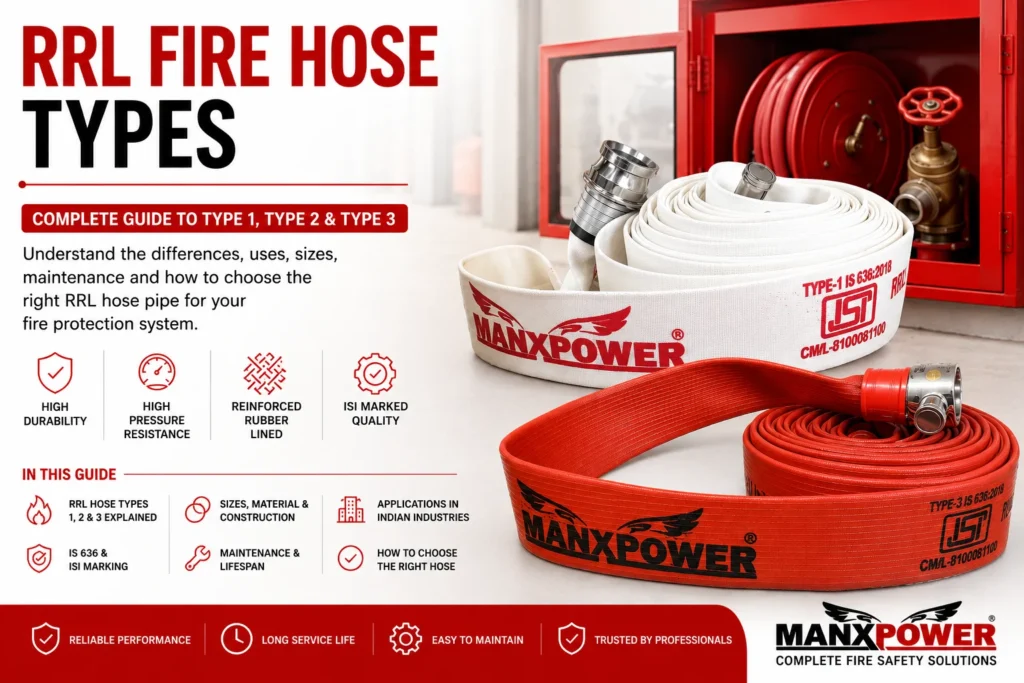
There are different RRL fire hose types, and each one is designed for a specific purpose.
Choosing the right hose isn’t just about ticking a box on a project checklist. The wrong choice can affect firefighting performance, increase maintenance costs, and reduce the overall reliability of your fire protection system.
If you’ve been searching for “What is an RRL hose pipe?”, trying to understand the difference between RRL Hose Pipe Type 1, Type 2, and Type 3, or wondering which hose is best for your building, you’re in the right place.
In this guide, we’ll explain everything in simple terms—from what RRL actually means to the different hose types, Indian standards, available sizes, maintenance tips, and how to choose the right hose for your application.
What is an RRL Hose Pipe?
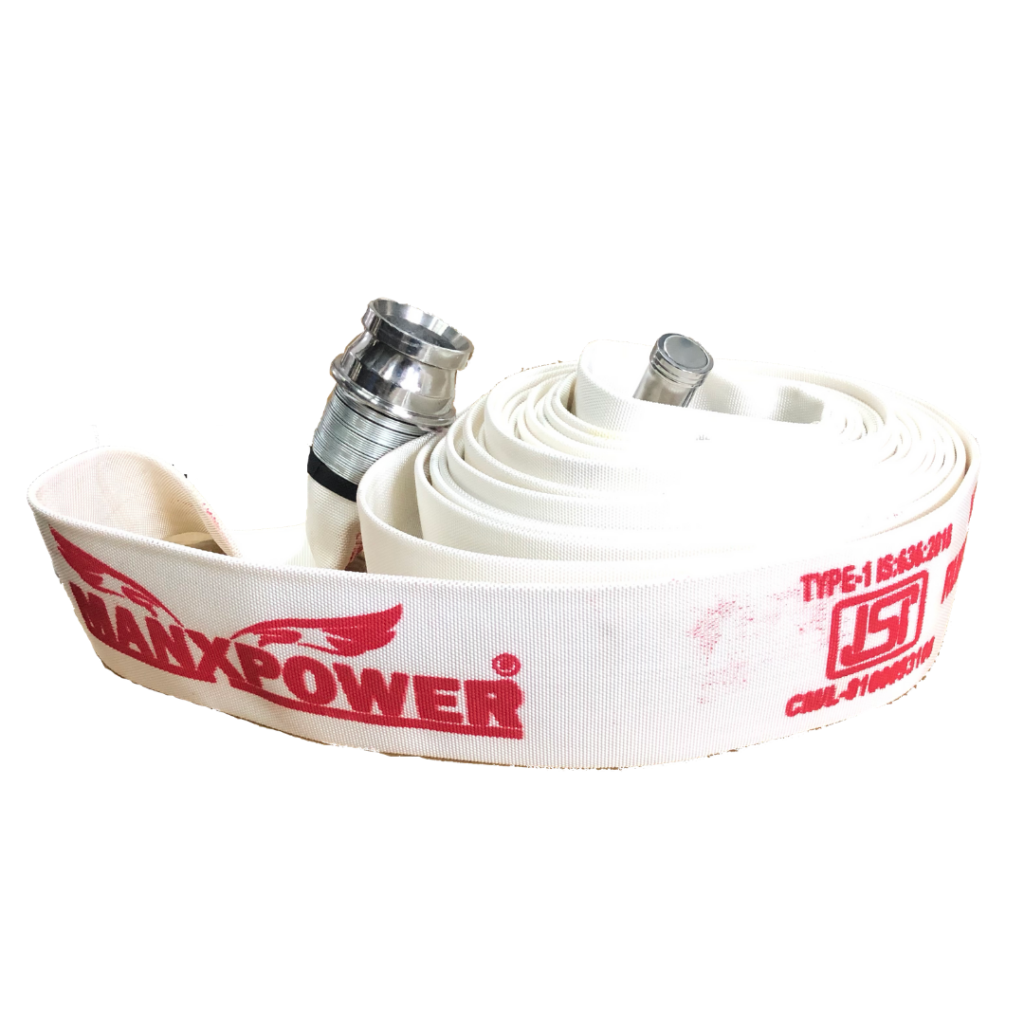
An RRL hose pipe is a Reinforced Rubber Lined firefighting hose designed to carry water from a hydrant or fire engine to the fire.
Unlike ordinary water hoses, an RRL fire hose is specifically built to handle high water pressure during firefighting operations while remaining flexible enough to be deployed quickly in an emergency.
An RRL hose has two main components:
- A smooth rubber lining on the inside that allows water to flow efficiently.
- A reinforced woven synthetic outer jacket that provides strength and protects the hose from wear and tear.
This combination makes RRL hoses suitable for both everyday fire protection systems and demanding firefighting operations.
Today, reinforced rubber lined hoses are widely used across India in:
- Commercial buildings
- Residential complexes
- Factories
- Warehouses
- Shopping malls
- Hotels
- Hospitals
- Educational institutions
- Airports
- Municipal fire services
- Industrial fire protection systems
Because of their durability and reliable performance, they’re considered one of the most widely used firefighting hoses in India.
What Does RRL Mean?
Many people assume RRL simply refers to the rubber lining inside the hose. In reality, it describes the hose’s overall construction.
The inner rubber lining helps water flow smoothly while reducing friction and leakage. Surrounding that lining is a high-strength woven synthetic jacket that gives the hose its flexibility and ability to withstand high operating pressures.
Some specialised hoses also include an additional protective coating to improve resistance against:
- Chemicals
- Oils
- Grease
- Moisture
- Abrasion
- Harsh weather conditions
This construction is one of the reasons RRL hoses have become the preferred choice for modern firefighting systems.
Understanding the Different RRL Fire Hose Types
Although they share the same basic construction, not every RRL hose is designed for the same environment.
Some are intended for standard building protection, while others are manufactured to withstand harsh industrial conditions where chemicals, oils, heat, and heavy abrasion are common.
Let’s look at each type individually.
RRL Hose Pipe Type 1
RRL Hose Pipe Type 1 is the most commonly installed hose in commercial and residential fire protection systems.
If you’ve opened a fire hose cabinet in an office building, school, apartment complex, or shopping mall, there’s a good chance you’ve seen a Type 1 hose.
Best suited for
- Commercial office buildings
- Residential apartments
- Shopping malls
- Hotels
- Schools and colleges
- Hospitals
- Fire hose cabinets
- Municipal firefighting
Standard sizes
- 40 mm
- 50 mm
- 63 mm
- 75 mm
Available lengths
- 15 metres
- 30 metres
The 15 Mtr RRL Fire Hose Type 1 is one of the most widely used firefighting hoses in India because it fits standard fire hose cabinets connected to landing valves.
Key features
- Reinforced woven synthetic jacket.
- Smooth rubber lining.
- Flexible and lightweight.
- Easy to deploy during emergencies.
- Suitable for everyday firefighting operations.
Advantages
- Cost-effective.
- Easy to roll and store.
- Requires minimal maintenance.
- Compatible with standard hydrant systems.
- Ideal for most commercial buildings.
Read More: RRL Hose Pipe Type 1
RRL Hose Pipe Type 2
RRL Hose Pipe Type 2 is designed for locations where the hose is likely to experience more frequent use or tougher operating conditions.
While it shares many characteristics with Type 1, it generally offers improved durability, making it suitable for larger commercial and industrial facilities.
Best suited for
- Warehouses
- Manufacturing plants
- Industrial buildings
- Commercial complexes
- Logistics centres
- Utility facilities
Standard sizes
- 40 mm
- 50 mm
- 63 mm
- 75 mm
Available lengths
- 15 metres
- 30 metres
Key features
- Reinforced synthetic construction.
- Higher resistance to wear.
- Better durability than Type 1.
- Suitable for repeated handling.
- Designed for more demanding environments.
Advantages
- Longer service life.
- Better abrasion resistance.
- Suitable for industrial firefighting.
- Performs well in high-usage installations.
Read More: RRL Hose Pipe Type 2
RRL Hose Pipe Type 3
Among all RRL fire hose types, RRL Hose Pipe Type 3 is designed for the toughest working environments.
Unlike standard hoses, Type 3 includes a special synthetic polymer or elastomeric outer coating that protects the woven jacket against chemicals, grease, oils, moisture, and severe abrasion.
This additional protection makes it the preferred choice for industries where ordinary hoses may deteriorate quickly.
Best suited for
- Oil and gas industries
- Refineries
- Chemical plants
- Steel plants
- Heavy engineering facilities
- Marine applications
- Ports
- Petrochemical industries
Standard sizes
- 40 mm
- 50 mm
- 63 mm
- 75 mm
Available lengths
- 15 metres
- 30 metres
Key features
- Rubber lined construction.
- Special polymer-coated outer jacket.
- Excellent abrasion resistance.
- Excellent chemical resistance.
- Excellent weather resistance.
Advantages
- Performs well in harsh industrial environments.
- Longer lifespan under demanding conditions.
- Better resistance to oils, grease, acids, and alkalis.
- Reduced maintenance compared to standard hoses.
Read More: RRL Hose Pipe Type 3
RRL Hose Type 1 vs Type 3
One of the most common questions customers ask is whether they should choose RRL Hose Type 1 or Type 3.
The answer depends entirely on where the hose will be used.
Choose RRL Hose Type 1 if:
- You’re protecting an office building.
- The hose is installed inside a fire hose cabinet.
- Normal firefighting conditions are expected.
- You need a reliable and economical solution.
- The environment isn’t exposed to aggressive chemicals.
Choose RRL Hose Type 3 if:
- The hose will be used in a refinery or chemical plant.
- Oils and chemicals are present.
- The hose will be exposed to severe abrasion.
- Long-term durability is the priority.
- The project demands higher resistance to harsh environments.
Neither hose is “better” than the other. They’re simply designed for different applications. Selecting the correct type ensures better performance, longer service life, and lower maintenance costs.
RRL Fire Hose Pipe with ISI Mark: Why It Matters
When you’re purchasing a fire hose, it’s natural to compare prices first. However, in fire protection, quality should always come before cost. A fire hose is expected to perform in an emergency, and that’s not the time to discover it doesn’t meet the required standards.
That’s why many consultants, contractors, and facility managers specifically ask for an RRL Fire Hose Pipe with ISI Mark.
An ISI-marked hose indicates that the product conforms to the applicable Indian Standard and has been manufactured under a certified quality system. It gives buyers greater confidence in the hose’s performance, reliability, and consistency.
For many commercial projects, government buildings, and industrial installations, specifying an ISI-marked fire hose is part of the project requirements rather than just a preference.
Before purchasing an RRL fire hose, it’s a good idea to check:
- The applicable Indian Standard.
- Manufacturer details.
- Hose size and length.
- Pressure rating.
- Coupling specifications.
- Manufacturing date (where applicable).
- Test certificates, if required for the project.
Investing in a quality hose today can help avoid expensive replacements and improve safety over the long term.
Indian Standards for Firefighting Hoses (IS 636)
If you’ve worked on fire protection projects in India, you’ve probably heard of IS 636.
IS 636 is the Indian Standard that specifies the requirements for reinforced rubber lined firefighting hoses. It helps ensure that hoses used across different buildings and industries meet consistent performance and quality requirements.
The standard covers important aspects such as:
- Hose construction.
- Dimensions.
- Performance requirements.
- Pressure testing.
- Materials.
- Workmanship.
- Acceptance criteria.
When selecting a fire hose, choosing one that complies with the applicable version of Indian standards for firefighting hoses (IS 636) helps ensure compatibility with modern fire protection systems.
Material & Construction of an RRL Fire Hose
Although an RRL fire hose may look simple from the outside, it’s carefully engineered to withstand demanding firefighting conditions.
A typical hose consists of several layers working together.
Inner Rubber Lining
The inner lining is responsible for carrying water through the hose.
Its smooth surface reduces friction, allowing water to flow efficiently while helping minimise leakage.
A quality rubber lining also improves flexibility, making the hose easier to handle during firefighting operations.
Reinforced Synthetic Jacket
The outer jacket gives the hose its strength.
It’s woven using high-strength synthetic yarns designed to withstand internal water pressure while protecting the hose against abrasion and repeated handling.
This reinforced construction allows the hose to be rolled, dragged, and deployed repeatedly without losing its structural integrity.
Protective Outer Coating (Type 3)
In RRL Hose Pipe Type 3, the woven jacket is protected by a special synthetic polymer or elastomeric coating.
This additional layer improves resistance to:
- Oils.
- Grease.
- Chemicals.
- Moisture.
- UV exposure.
- Abrasion.
- Harsh weather conditions.
That’s one of the main reasons Type 3 hoses are widely used in refineries, chemical plants, and heavy industrial facilities.
Standard RRL Fire Hose Sizes
RRL fire hoses are available in different diameters and lengths to suit various hydrant systems and firefighting applications.
Common hose sizes
- 40 mm
- 50 mm
- 63 mm
- 75 mm
The size selected depends on the hydrant system design, required water flow, and project specifications.
Standard hose lengths
- 15 metres
- 30 metres
The 15 Mtr RRL Fire Hose Type 1 remains one of the most widely used configurations across India because it’s ideal for standard fire hose cabinets installed alongside landing valves.
Before purchasing a hose, always confirm:
- Hose diameter.
- Hose length.
- Coupling type.
- Pressure rating.
- Compatibility with the hydrant system.
Choosing the correct size ensures firefighters can operate efficiently during an emergency without compatibility issues.
RRL Fire Hose vs Canvas Fire Hose
People often ask whether an RRL hose is better than a traditional canvas hose.
The answer depends on the application, but modern fire protection systems generally favour reinforced rubber lined hoses because they offer better durability and require less maintenance.
RRL Fire Hose
Advantages
- Smooth rubber lining improves water flow.
- Lightweight and flexible.
- Excellent pressure handling.
- Better abrasion resistance.
- Longer service life.
- Easier to maintain.
- Suitable for modern hydrant systems.
Best suited for
- Commercial buildings.
- Factories.
- Warehouses.
- Hospitals.
- Shopping malls.
- Municipal fire services.
Canvas Fire Hose
Advantages
- Traditional firefighting hose.
- Suitable for specific legacy installations.
Limitations
- Can absorb water depending on construction.
- May become heavier during prolonged use.
- Generally requires more maintenance.
- Lower resistance to abrasion compared with reinforced rubber lined hoses.
Today, RRL hoses are the preferred choice for most modern commercial and industrial fire protection systems.
Uses of Reinforced Rubber Lined Hose in Indian Industries
One of the biggest reasons RRL hoses are so widely used is their versatility.
They’re suitable for almost every sector where reliable firefighting equipment is required.
Some of the most common uses of reinforced rubber lined hose in Indian industries include:
- Commercial office buildings.
- Shopping malls.
- Hotels.
- Hospitals.
- Educational institutions.
- Residential complexes.
- Warehouses.
- Manufacturing plants.
- Food processing industries.
- Pharmaceutical facilities.
- Oil and gas industries.
- Chemical plants.
- Steel plants.
- Airports.
- Power plants.
- Municipal fire brigades.
Different industries have different requirements, which is why selecting the appropriate hose type is important.
For example:
- Type 1 is suitable for standard commercial firefighting.
- Type 2 offers improved durability for higher-usage environments.
- Type 3 is ideal where chemicals, oils, and heavy abrasion are present.
How to Choose the Right RRL Hose Pipe
If you’re buying an RRL hose for the first time, it’s easy to assume every hose performs the same way.
Instead of choosing based only on price, consider how and where the hose will actually be used.
Choose RRL Hose Pipe Type 1 if:
- You’re protecting offices or commercial buildings.
- The hose will be stored in a fire hose cabinet.
- Normal firefighting conditions are expected.
- You want a dependable and economical solution.
Choose RRL Hose Pipe Type 2 if:
- The hose will be used more frequently.
- The environment is moderately demanding.
- Better abrasion resistance is required.
- You’re protecting warehouses or industrial buildings.
Choose RRL Hose Pipe Type 3 if:
- The hose will be exposed to oils or chemicals.
- It’s being installed in refineries or petrochemical plants.
- Maximum durability is required.
- The hose will experience harsh operating conditions.
Taking a few extra minutes to match the hose to the application can improve performance, reduce maintenance, and increase the service life of your firefighting equipment.
At MANXPOWER, we regularly help contractors, consultants, and facility managers choose the right RRL fire hose based on the project requirements rather than simply recommending the most expensive option.
Maintenance Guide for RRL Fire Hoses
Buying a quality fire hose is only the beginning. Like every other piece of firefighting equipment, an RRL hose needs regular inspection and maintenance to ensure it performs when it’s needed most.
A fire hose may remain inside a cabinet for months or even years without being used. That doesn’t mean it should be forgotten. Environmental conditions, moisture, improper storage, or accidental damage can affect its condition over time.
A simple maintenance routine can significantly extend the hose’s life while ensuring it’s ready for use during an emergency.
Inspect the Hose Regularly
Carry out visual inspections at regular intervals.
Look for:
- Cuts or tears in the outer jacket.
- Cracks in the rubber lining.
- Bulges or soft spots.
- Loose or damaged couplings.
- Signs of abrasion.
- Chemical stains or oil contamination.
If any damage is found, the hose should be repaired or replaced immediately.
Check the Couplings
The hose itself isn’t the only component that needs attention.
Inspect the couplings for:
- Cracks.
- Corrosion.
- Damaged threads.
- Loose connections.
- Worn rubber washers.
A damaged coupling can lead to water leakage or make it difficult to connect the hose during an emergency.
Drain and Dry the Hose After Use
If a hose has been used during firefighting or testing, never roll it up immediately.
Always:
- Drain all remaining water.
- Allow the hose to dry completely.
- Store it in a cool, dry place.
- Avoid prolonged exposure to direct sunlight.
Proper drying helps prevent mould, mildew, and deterioration of the hose lining.
Store the Hose Correctly
Good storage is often overlooked.
To maximise service life:
- Keep the hose inside a fire hose cabinet.
- Avoid placing heavy objects on top of it.
- Roll it neatly without sharp bends.
- Protect it from chemicals and direct sunlight.
- Keep rodents and insects away from storage areas.
Proper storage helps maintain flexibility and prevents unnecessary wear.
Carry Out Pressure Testing
Visual inspections are important, but they shouldn’t replace periodic pressure testing.
Pressure testing helps identify hidden defects that may not be visible from the outside.
Testing should always be carried out using appropriate procedures and equipment by trained personnel.
Lifespan of a Standard Fire Hose
One of the questions we hear most often is: “How long does a fire hose last?”
The answer depends on several factors.
The lifespan of a standard fire hose isn’t fixed because it depends on:
- Frequency of use.
- Storage conditions.
- Environmental exposure.
- Maintenance practices.
- Quality of the hose.
- Operating conditions.
A well-maintained hose that’s stored correctly and inspected regularly can provide reliable service for many years.
On the other hand, hoses exposed to chemicals, heavy abrasion, or poor storage conditions may need replacement much sooner.
Rather than replacing hoses based only on age, it’s better to inspect them regularly and replace them whenever they no longer meet operational or safety requirements.
Why Choose MANXPOWER RRL Fire Hoses?
When specifying fire protection equipment, reliability should always come before price.
At MANXPOWER, we understand that firefighting equipment isn’t purchased for everyday use—it’s purchased for the one day when it matters most.
That’s why we focus on supplying dependable products that meet the expectations of consultants, contractors, facility managers, industries, and government organisations.
Our range of RRL fire hoses is suitable for a wide variety of applications, including commercial buildings, factories, warehouses, hospitals, hotels, educational institutions, municipal fire services, and industrial facilities.
Why customers choose MANXPOWER
- Manufactured to applicable Indian standards.
- Available in multiple sizes and lengths.
- High-quality reinforced rubber lined construction.
- Durable synthetic jackets.
- Reliable performance under demanding conditions.
- Suitable for hydrant systems and fire hose cabinets.
- Competitive pricing.
- Technical support for product selection.
- Trusted by contractors, consultants, and facility managers.
In addition to RRL fire hoses, MANXPOWER also supplies:
- Fire Hose Reels
- Landing Valves
- Branch Pipes
- Fire Hose Cabinets
- Fire Hydrant Valves
- Fire Extinguishers
- Fire Alarm Systems
- Smoke Detectors
- Heat Detectors
- Sprinkler System Components
- Manual Call Points
- Hooters & Strobes
This allows customers to source complete fire protection solutions from a single trusted supplier.
Choose the Right RRL Fire Hose for Your Fire Protection System
An RRL fire hose may look like a simple piece of equipment, but it plays a vital role in every fire hydrant system. During an emergency, firefighters rely on it to deliver water quickly and efficiently, which is why selecting the correct hose is so important.
Whether you’re installing a new fire protection system, replacing worn-out hoses, or specifying equipment for a commercial or industrial project, understanding the differences between RRL Fire Hose Pipe Type 1, Type 2, and Type 3 will help you make a more informed decision.
At MANXPOWER, we supply high-quality RRL fire hoses designed for commercial buildings, factories, warehouses, hospitals, educational institutions, municipal fire services, and industrial facilities across India.
If you’re unsure which hose is right for your project, our team is here to help. We’ll guide you through the available sizes, specifications, and applications so you can choose a solution that matches your fire protection requirements.
Looking for reliable RRL fire hoses? Contact MANXPOWER today for expert guidance, competitive pricing, and dependable fire safety solutions.
Frequently Asked Questions
What is an RRL hose pipe?
An RRL hose pipe is a Reinforced Rubber Lined firefighting hose used to carry water from a fire hydrant or fire engine to the fire. It consists of a rubber-lined inner tube and a reinforced woven synthetic outer jacket, making it suitable for high-pressure firefighting applications.
What is the difference between RRL Type 1, Type 2, and Type 3?
The main difference lies in their intended application and level of protection.u003cbru003eRRL Hose Pipe Type 1 is designed for standard commercial and municipal firefighting.u003cbru003eRRL Hose Pipe Type 2 offers improved durability for higher-usage environments.u003cbru003eRRL Hose Pipe Type 3 includes an additional protective coating, making it ideal for chemical plants, refineries, and heavy industrial applications.
What does an ISI marked fire hose mean?
An RRL Fire Hose Pipe with ISI Mark indicates that the hose complies with the applicable Indian Standard and has been manufactured under a certified quality system. It provides greater confidence in the hose’s quality and performance.
What is the working pressure of an RRL fire hose?
The working pressure varies depending on the hose type, size, manufacturer, and project specifications. Always refer to the manufacturer’s technical data sheet and ensure the selected hose meets the pressure requirements of your fire protection system.
Which RRL hose type is best for high-rise buildings?
There isn’t a single answer.u003cbru003eFor most commercial and residential high-rise buildings, RRL Hose Pipe Type 1 is commonly used as part of the building’s fire hydrant system.u003cbru003eWhere the environment is more demanding, such as industrial high-rise facilities, Type 2 or Type 3 may be more appropriate.u003cbru003eThe correct selection should always be based on the building’s fire protection design and operational requirements.
How long does an RRL fire hose last?
The lifespan depends on usage, maintenance, storage conditions, and environmental exposure.u003cbru003eA properly maintained hose that’s inspected regularly and stored correctly can provide many years of reliable service. Regular inspections are more important than relying on age alone when deciding whether a hose should be replaced.