
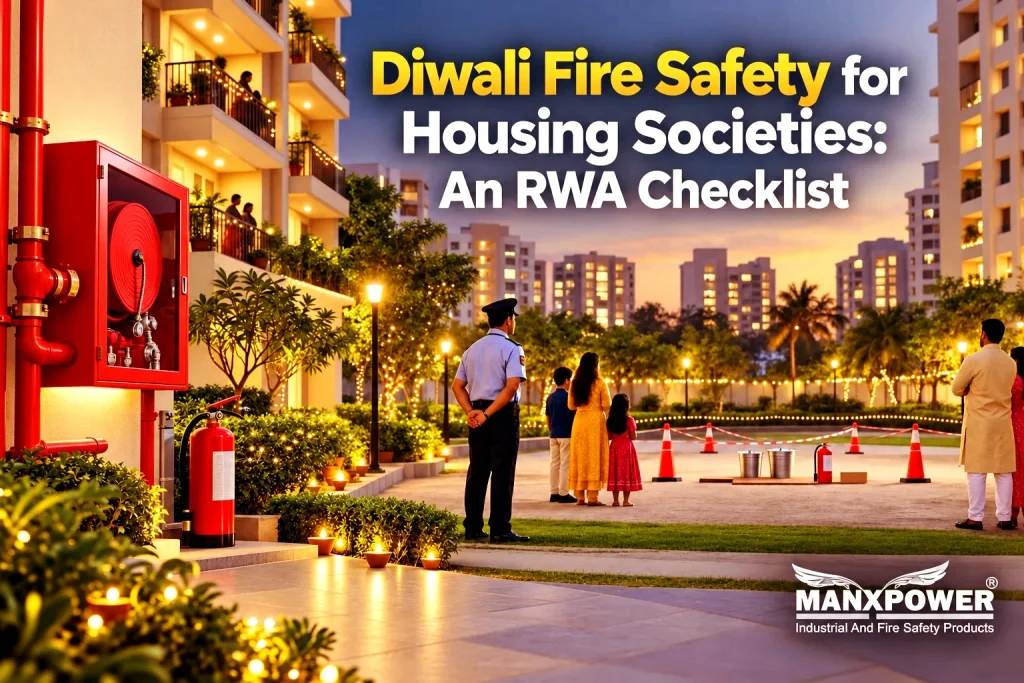
Society Diwali fire safety is a shared job. Before the festival, the RWA or facility team should do four things:
- Test the building’s fire systems.
- Mark a safe cracker zone away from towers and parking.
- Brief the guards.
- Keep working extinguishers at every floor, gate and common area.
A fire that starts on one balcony can reach many homes through stacked balconies, shafts and stairwells. That is why the checks have to happen at society level, not only inside each flat.
For tips families can follow inside their own homes, read our Diwali fire safety guide for homes. This checklist is for the people who manage the building.
Why Is Diwali Riskier for a Housing Society?
A society packs a lot of fuel and a lot of people into a small space. During Diwali, these risks add up:
- Balconies stacked one above another, often full of stored boxes, old furniture and dry plants.
- Rockets and sky shots that can land on upper-floor balconies, terraces and car covers.
- Cars parked close together in basements and open parking.
- Extra electrical load from decorative lights on every tower and gate.
- Common areas such as the clubhouse, lobby and terrace hosting gatherings.
- Fewer residents at home over the long weekend, so a small fire may go unseen.
None of this means a society should cancel celebrations. It means the shared fire systems need to be ready before the first evening of the festival.
What Should an RWA Check Before Diwali?
Walk through the building with the facility manager or maintenance contractor at least two weeks before Diwali. Use this checklist.
| Area | What to check | Status |
| Fire pump room | Pumps set to auto, diesel pump fuelled, test run done | Yes / No |
| Water tank | Fire water tank full, no leaks | Yes / No |
| Hydrant and landing valves | Valves open and close smoothly, outlets not jammed | Yes / No |
| Hose reels | Hose not cracked, drum turns, nozzle works | Yes / No |
| Fire alarm panel | No fault lights, detectors and call points tested | Yes / No |
| Extinguishers | Gauge in green, seal and pin intact, not expired | Yes / No |
| Staircases | Clear of stored items, fire doors close fully and are not wedged open | Yes / No |
| Electrical shafts and meter rooms | Locked, no stored junk, no exposed joints | Yes / No |
| Terrace | Free of dry waste, old mattresses and scrap | Yes / No |
| Fire tender access | Driveway and fire lane clear of parked cars | Yes / No |
If a hydrant valve is stiff or a hose reel is damaged, fix it now. Spare parts and replacements take time to arrive in festival week.
Check your alarm system too. A fire alarm panel showing a fault light is often ignored for weeks, and Diwali is not the week to ignore it. Read how fire alarm panels work to understand what each light means.
Need refills, hose reels or extinguishers before Diwali? Call Manx Impex on +91 11 4987 2937 or message us on WhatsApp.
Where Should the Society Set Up Its Cracker Zone?
A common cause of society fires during Diwali is crackers burst in the wrong place. The simplest fix is one marked cracker zone that everyone uses.
Choose a spot that is:
- Open ground, away from towers, balconies and windows.
- Away from parking, the gas bank, the DG set, transformers and dry trees.
- Not under power lines.
- Easy for a fire tender to reach.
Keep these at the zone every evening of the festival:
- Two or more drums of water and buckets of sand.
- At least two ABC fire extinguishers, checked and in the green zone.
- A first-aid box.
- One or two volunteers or guards on duty.
Follow the cracker timings and rules set by your local authority. In Delhi-NCR, the Supreme Court decides what is allowed each year, so check this year’s order before you put up the notice.
Which Extinguisher Suits Each Area of a Society?
Each area of a society has a different fire risk, so one type does not suit every spot. Our guide on ABC vs CO2 fire extinguishers explains the difference. Use this table as a starting point. Confirm numbers and sizes with your fire consultant or the local fire authority.
| Location | Main fire risk | Suggested equipment |
| Lobby and floor corridors | Paper, wood, cloth, electrics | ABC extinguisher |
| Main gate and guard room | Paper, electrics | ABC extinguisher |
| Electrical and meter rooms | Electrical | CO2 extinguisher |
| DG set and fuel store | Diesel and oil | ABC or foam extinguisher |
| Clubhouse kitchen | Cooking oil, gas | Wet chemical (Class K) extinguisher plus a fire blanket |
| Basement parking | Vehicles, fuel | ABC extinguishers near ramps and exits |
| Cracker zone | Paper, cardboard, clothing | ABC extinguisher, water and sand |
Not sure which extinguisher fits each area of your society? Call +91 11 4987 2937 and share your layout.
How Should Guards Be Briefed?
Guards are usually the first people to see a fire in a society, so a ten-minute briefing before Diwali makes a real difference. Cover these points:
- Emergency numbers: 101 for the fire service and 112 for emergencies.
- Where the main electrical switch is for each tower.
- How to open a hose reel and a hydrant valve.
- Where the extinguishers are kept, and how to use one.
- Who in the RWA to call first, and who guides the fire tender to the tower.
- Keeping the main gate and fire lane clear all night.
Ask each guard to show you, not just tell you. A real fire is too late to open a hydrant valve or run out a hose for the first time.
What Should Residents Be Told?
Send one short circular or WhatsApp note to all residents a week before Diwali. Keep it simple:
- Use only the marked cracker zone. No crackers from balconies, terraces or windows.
- Clear stored boxes, dry plants and old furniture from balconies.
- Close balcony doors and windows when you go out.
- Do not plug many light strings into one socket in common areas.
- Never block staircases or fire doors with decorations.
- Share the RWA emergency contact and the guard room number.
Does Your Society Need a Fire Safety Certificate?
Taller residential buildings in Delhi need a Fire Safety Certificate from Delhi Fire Service, often called a fire NOC. Under the Delhi Fire Service (Amendment) Rules, 2025, the certificate stays valid unless it is suspended or cancelled. The owner or RWA must still file a declaration in Form K every year.
Diwali is a good moment to check two things: that your certificate is valid, and that this year’s Form K is filed. Our post on fire NOC for commercial buildings explains how the process works for other building types. Confirm the current rule for your building with Delhi Fire Service.
Society Diwali Fire Safety Timeline
| When | What to do |
| Two weeks before | Building walk-through, order repairs and refills |
| One week before | Resident circular, guard briefing, mark cracker zone |
| Diwali evenings | Volunteers at cracker zone, guards on rounds, fire lane clear |
| Morning after | Check terraces, balconies, parking and gardens for debris |
What Should a Society Do After Diwali Night?
The morning after is often missed. Ask guards to walk the terraces, parking, gardens and the balconies they can see.
- Look for burnt-out rockets and smouldering paper.
- Collect cracker waste in metal bins with water, not plastic bins.
- Refill or replace any extinguisher that was used, even partly.
The Verdict: What Matters Most for Society Diwali Fire Safety?
Three things matter most: working systems, one safe cracker zone and trained guards. Test the hydrants, hose reels, alarms and extinguishers early. Keep the fire lane clear. Make sure every guard knows what to do in the first minute.
If your RWA needs help choosing or refilling equipment, call Manx Impex, an ISO 9001:2015 certified fire safety supplier in New Delhi, on +91 11 4987 2937 or use our contact page.
Frequently Asked Questions
What is the first step in society Diwali fire safety?
Test the fire pumps, hydrants, hose reels, alarms and extinguishers at least two weeks before Diwali, and mark one safe cracker zone away from towers and parking.
What should an RWA check before Diwali?
Check the fire pumps, water tank, hydrant valves, hose reels, alarm panel and extinguishers. Also clear the staircases, electrical shafts, terraces and the fire lane.
Where should a society set up its cracker zone?
In open ground away from towers, balconies, parking, the gas bank, the DG set, transformers, dry trees and power lines. Keep water, sand, ABC extinguishers and a first-aid box there.
Which extinguisher suits each area of a society?
ABC extinguishers suit lobbies, corridors, the main gate, parking and the cracker zone. CO2 suits electrical and meter rooms, and ABC or foam suits the DG set and fuel store. A wet chemical extinguisher with a fire blanket suits the clubhouse kitchen. Confirm numbers and sizes with your fire consultant or the local fire authority.
Should society guards be trained to use hose reels and hydrants?
Yes. Before Diwali, guards should know how to open a hose reel and a hydrant valve, where each tower’s main electrical switch is, and how to use an extinguisher.
What should a society do after Diwali night?
Check terraces, balconies, parking and gardens for burnt rockets and smouldering paper. Put cracker waste in metal bins with water, and refill or replace any extinguisher that was used, even partly.