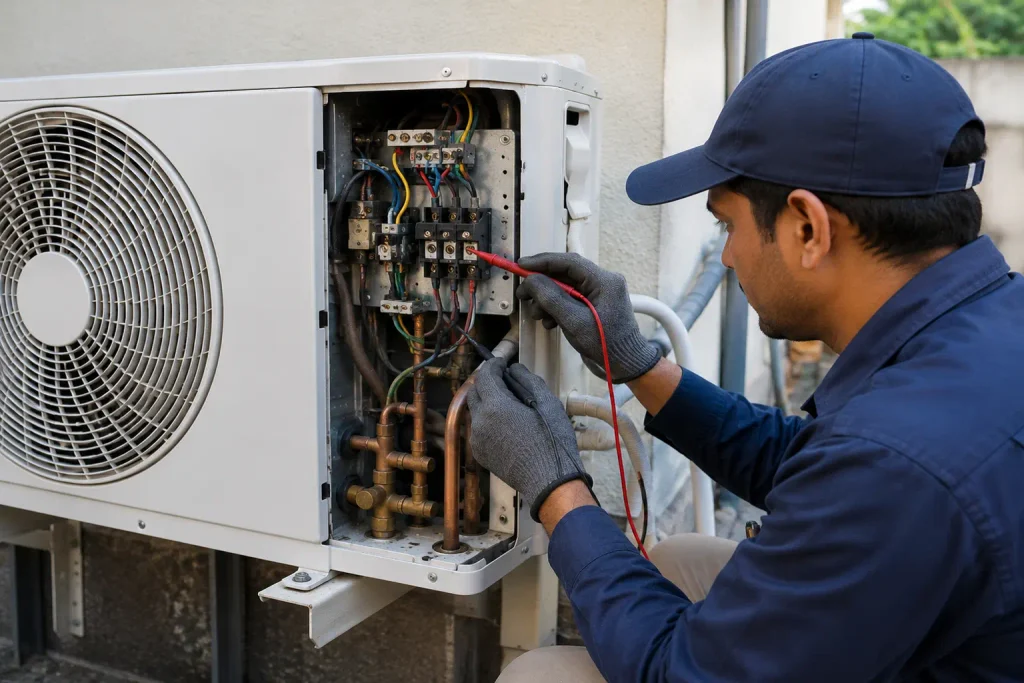
AC fires are usually caused by electrical faults, refrigerant leaks near live wiring, dust buildup, or a compressor forced to run under stress. Most cases build up slowly — poor maintenance, an overworked unit, or damaged wiring — before ending in a sudden blast or fire. AC fire safety comes down to catching these warning signs early and knowing exactly what to do if something goes wrong.
What Causes Air Conditioner Fires?
- Electrical short circuits — damaged or loose wiring inside the unit or in the wall socket
- Overloaded circuits — AC drawing more current than the circuit or extension board can handle
- Capacitor failure — a worn or swollen capacitor can spark or overheat
- Refrigerant gas leaks — some refrigerants are flammable and can ignite near sparks or heat
- Dust and debris buildup — clogs airflow, forcing the compressor to overheat
- Poor installation — incorrect wiring gauge, unearthed connections, or unstable mounting
- Voltage fluctuations — sudden power surges stressing internal components
- Lack of servicing — worn parts left unchecked for years increase AC fire hazards significantly
Which Part of the AC Is Most Likely to Cause a Fire?
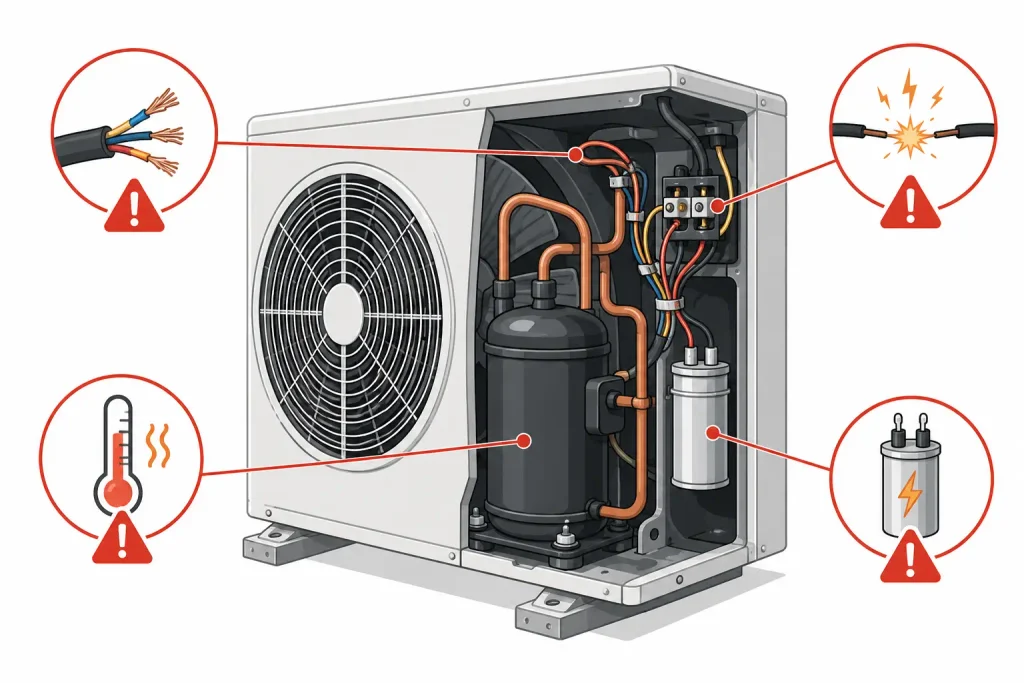
- The compressor is the single most common source of AC fire incidents
- Compressors run under high pressure and heat — any internal fault can trigger an AC compressor blast
- Capacitors are the second most common culprit — they can swell, leak, or short internally
- PCB (circuit board) faults are common in newer inverter-type split ACs
- Power cords and plug points — a weak or overheating connection here is an easy fire starter
- Outdoor unit wiring is more exposed to weather damage, making it a frequent failure point
Window AC vs Split AC — Which One Is More Fire-Prone?
Looking at fire risk only — not price or electricity use:
Window AC:
- Compressor sits inside the same unit as the room-facing side — a fault is closer to occupants
- Wiring is more compact and exposed to dust and moisture in one housing
- Less ventilation around the compressor can trap heat
Split AC:
- Compressor sits outdoors, away from occupants, reducing direct exposure if it fails
- Wiring runs a longer path between indoor and outdoor units — more joints, more potential failure points
- Outdoor unit is exposed to rain, direct sun, and dust, which can accelerate wear over time
Bottom line: Neither is inherently “safe” — both carry real AC fire hazards if poorly maintained. Split ACs isolate the highest-risk component (the compressor) away from living spaces, which is a meaningful safety advantage, but they introduce more wiring and joints that need regular inspection.
Warning Signs You Should Never Ignore
- Burning or plastic-like smell from the unit or vents
- Frequent tripping of the circuit breaker
- Buzzing, clicking, or grinding sounds from the compressor
- Sparks or visible smoke near the plug, socket, or unit
- AC shutting off and restarting on its own repeatedly
- Discoloration or scorch marks on the plug or wall socket
- Unit feels unusually hot to the touch on the outer casing
- Weak cooling combined with any of the above signs
- Water or refrigerant leaking near electrical connections
- A hissing sound, which can indicate a refrigerant leak near live wiring
- Visible fraying or exposed wiring on the power cord
- Remote or display panel behaving erratically for no clear reason
If you notice two or more of these together, treat it as an immediate AC fire hazard, not a “wait and see” issue.
How to Prevent AC Fires
Outdoor unit care:
- Keep the outdoor unit clear of dust, leaves, and debris
- Ensure at least 2 feet of clearance around it for airflow
- Check outdoor wiring and joints for weather damage every season
- Trim vegetation or remove stored items placed too close to the unit
Summer months:
- Schedule a professional service before peak summer usage begins
- Clean or replace filters monthly during heavy-use months
- Avoid running the AC continuously at maximum load for extended periods
- Monitor for unusual sounds or smells more closely during high-demand weeks
Nighttime use:
- Don’t leave the AC running unattended overnight without periodic checks
- Use a timer or smart plug to avoid extended, unmonitored operation
- Keep flammable items (curtains, bedding) away from the indoor unit
- Avoid placing the remote or thermostat near the unit where it could be knocked or trigger rapid on/off switching
Apartments & shared buildings:
- Confirm the electrical circuit is rated for your AC’s load before installation
- Avoid running the AC off an extension board or multi-plug adapter
- Report burning smells or breaker trips to building maintenance immediately, don’t wait
- Ask about the building’s last electrical safety inspection if you’re unsure of wiring age or condition
The “3-Minute Rule” for Air Conditioners — Explained
- The 3-minute rule means waiting at least three minutes after switching an AC off before turning it back on
- This gives internal refrigerant pressure time to equalize before the compressor restarts
- Restarting too soon forces the compressor to work against high pressure, drawing a heavy electrical current
- That extra current draw causes real electrical strain — overheating, hard starts, and stress on wiring and capacitors
- Repeated violations of this rule over time raise the risk of overheating-related electrical faults, which is directly relevant to AC fire safety
- Most modern ACs have a built-in delay (often 3–5 minutes) to enforce this automatically — but power cuts, breaker resets, or manual on/off switching can bypass it
- Simple habit: if your AC shuts off for any reason, wait a few minutes before switching it back on
What to Do If an AC Fire Starts (Emergency Steps)
- Turn off the power at the main switch or breaker — never at the unit itself if it’s already sparking
- Do not use water on an electrical fire — it conducts electricity and can worsen the situation
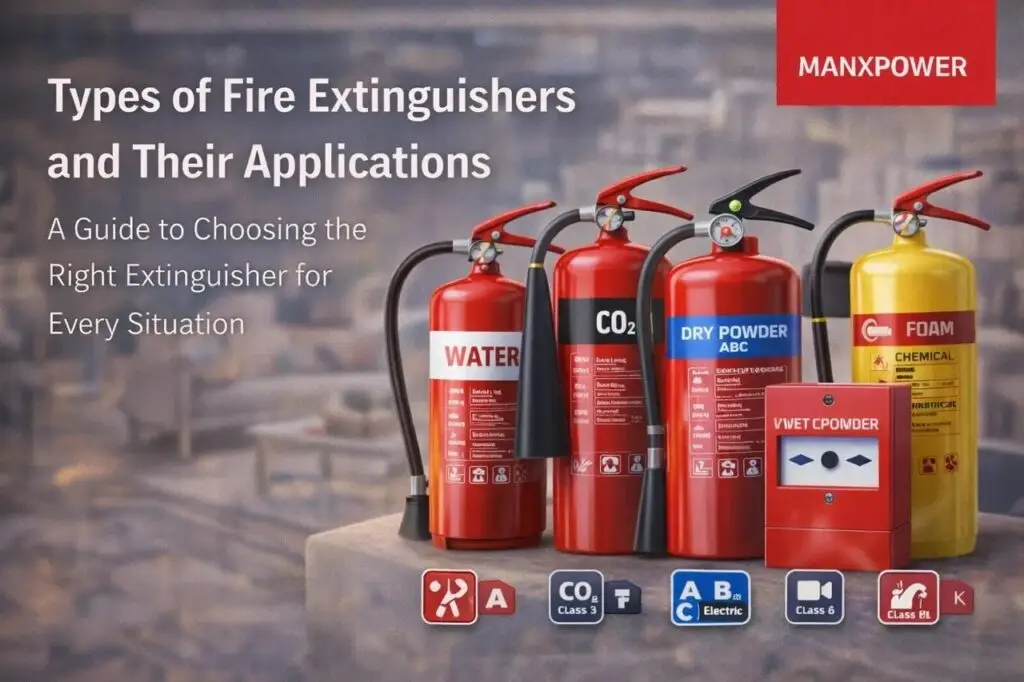
- Use a CO2 or ABC extinguisher if you can safely reach it and the fire is small and contained
- Evacuate immediately if the fire spreads or smoke fills the room quickly
- Call the fire department even if you think you’ve put it out — hidden embers can reignite
- Do not re-enter the room until it’s confirmed safe by professionals
Which Fire Safety Equipment to Use for an AC Fire
- AC fires are electrical fires — the extinguisher choice matters, and the wrong one can make things worse
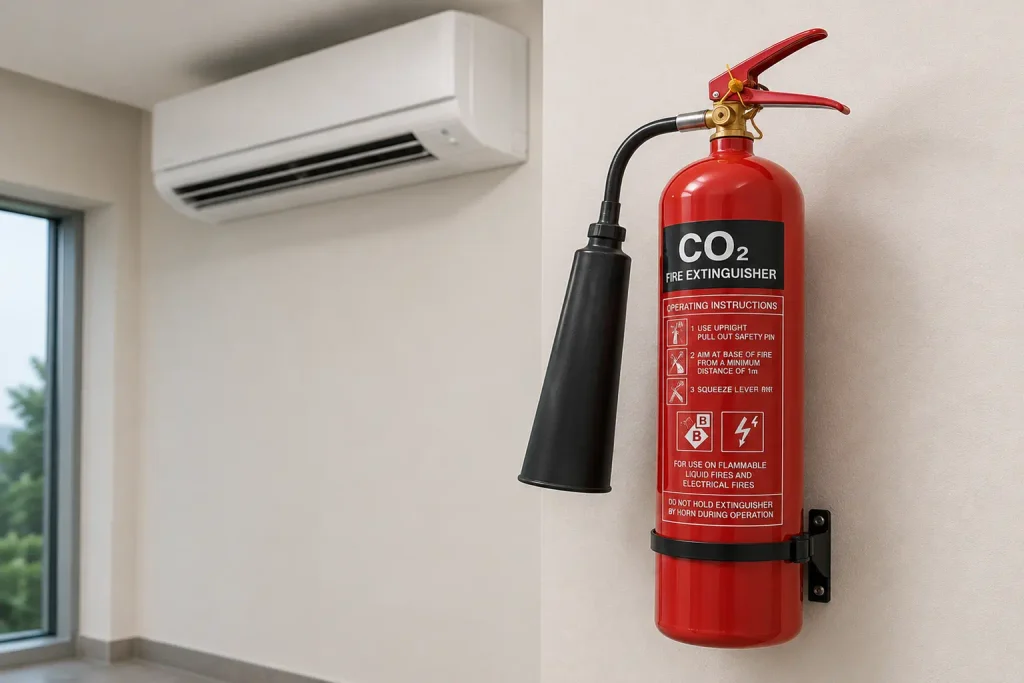
- CO2 extinguishers are ideal — they smother the fire without leaving residue and are safe on live electrical equipment
- ABC dry powder extinguishers are also effective for electrical fires and work well as a general-purpose backup
- Never use water or foam extinguishers on an AC or any electrical fire — both conduct electricity
- Keep an extinguisher accessible in rooms with heavy AC usage, especially server rooms, offices, and multi-AC households
Regulatory Fire Protection Requirements for AC Systems
- Commercial buildings with centralized or multiple AC units are typically required to follow electrical safety codes under local fire NOC and building regulations
- Circuit loads for AC systems must match approved wiring standards — undersized wiring is a common compliance failure
- Fire safety audits in commercial spaces often specifically check AC electrical connections and breaker ratings
- Buildings with server rooms or dense AC installations may be required to maintain CO2 or clean-agent fire suppression nearby
- Regular electrical inspection records are increasingly expected as part of fire safety compliance documentation, not just a one-time install check
- Multi-AC commercial installations often need dedicated circuit breakers per unit rather than shared circuits, to reduce overload risk
- Building fire safety audits typically flag AC units installed without proper earthing as a compliance gap
- Facility managers should treat AC fire protection as part of the broader fire safety compliance picture, not a separate concern
Why Choose MANXPOWER Fire Safety Equipment for AC-Related Fire Risks
- AC fires are electrical by nature, and having the right extinguisher on hand matters more than most people realize
- MANXPOWER supplies CO2 and ABC dry powder extinguishers built to BIS standards, suited for exactly this kind of electrical fire risk
- Equipment is designed to be simple enough for staff or family members to use quickly, without hesitation
- For offices, apartment complexes, and facilities with heavy AC usage, MANXPOWER also supports broader fire safety planning — not just a single extinguisher, but a system that fits the space
FAQs
What can cause an AC to catch fire?
Electrical short circuits, overloaded circuits, capacitor failure, refrigerant leaks, dust buildup, and poor installation are the most common causes of AC fires.
Which part of the AC is most likely to blast?
The compressor is most commonly involved in AC fire incidents, followed by capacitors and circuit board faults.
What is the 3-minute rule for air conditioners?
It means waiting at least three minutes after switching an AC off before restarting it, giving internal pressure time to equalize and reducing electrical strain on the compressor.
How to prevent AC from blasting?
Keep the outdoor unit clean and ventilated, schedule regular servicing, avoid overloading circuits with extension boards, and never ignore burning smells or repeated breaker trips.
Is it safe to keep AC running 24/7?
Continuous, unmonitored use increases wear and heat buildup over time. Periodic checks and scheduled breaks are safer than running an AC nonstop without supervision.
What should I do if my AC catches fire?
Cut power at the main switch, avoid water, use a CO2 or ABC extinguisher if it’s safe to do so, and evacuate immediately if the fire spreads.
Should I turn off the AC if it smells burnt?
Yes — a burning smell is a clear warning sign. Switch it off at the breaker and have it inspected before using it again.
Is a split AC or window AC safer from fire risk?
Split ACs keep the compressor outdoors, away from living spaces, which reduces direct exposure. Window ACs have more compact, exposed wiring. Both require regular maintenance to stay safe.