
Sidewall Sprinkler for Corridors, Hotels & Hospitals
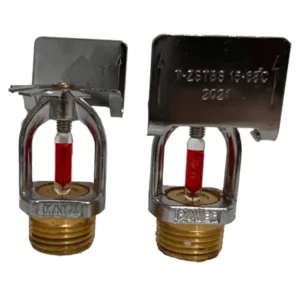
A sidewall sprinkler is a fire sprinkler that fits on a wall, close to the ceiling, instead of hanging from it. Its deflector throws water out across the room in a half-circle. It’s the answer when running pipe across the ceiling isn’t practical, which is common in corridors, hotel rooms and compact spaces.
This page covers how these sprinklers work, where they fit and how to choose the temperature rating. If you already know what you need, go straight to the MANXPOWER sidewall fire sprinkler (pack of 50).
How a sidewall sprinkler works
A sidewall sprinkler has the same three parts as any automatic sprinkler: a threaded body that screws onto the pipe, a glass bulb that holds the water back, and a deflector that spreads it. When the heat reaching the bulb hits its rating, the glass breaks, water flows and the deflector sprays it out.
What sets this type apart is the deflector. It’s shaped to push water away from the wall and across the room, so the spray covers a half-circle in front of the sprinkler instead of a full circle around it.
Only the heads that get hot enough open. The rest stay shut.
When a wall mounted fire sprinkler makes sense
Pendent and upright sprinklers on the ceiling are the usual choice. A wall mounted fire sprinkler earns its place when the ceiling gets in the way:
- Narrow corridors, where the pipe can run along the wall
- Small rooms, where one sprinkler on the wall covers the space
- Ceilings crowded with ducts, beams or other services
- Retrofit jobs where opening up the ceiling would be disruptive
The layout still comes from a fire design. Spacing and the distance from the ceiling depend on the sprinkler and the building, so don’t copy a layout from another site.
Where to use a horizontal sidewall sprinkler
A horizontal sidewall sprinkler connects to a branch pipe running along the wall and sprays out into the room. These are the places it can fit, where the fire design allows standard response heads:
- Hotel rooms and hallways. Guest rooms and long corridors, with the pipe kept along the wall. See our fire safety equipment for hotels.
- Hospital wards and corridors. Places where opening up the ceiling is disruptive. See hospitals.
- Offices and commercial complexes. Meeting rooms, passages and compact floors.
- Residential buildings. Common corridors and lobbies. See residential societies.
- Side entrances and lobbies. Short stretches where a ceiling run isn’t worth it.
Our sidewall sprinkler is standard response, so check it against your design first. NFPA 13, for example, asks for quick response heads in light hazard areas such as hotel guest rooms and hospital wards. Storage, workshops and anything riskier also need a design from your fire consultant.
How to choose between 57°C, 68°C and 79°C
The rating is the temperature at which the glass bulb breaks. It has to sit comfortably above the hottest the space ever gets, or the sprinkler can open with no fire. Set it too high and it reacts later than it should.
Rating | Bulb colour | Suits |
57°C | Orange | Cool, air-conditioned spaces |
68°C | Red | General indoor areas and corridors, with more headroom than 57°C |
79°C | Yellow | Warm spaces where the ceiling can pass 38°C |
Both 57°C and 68°C are ordinary temperature ratings, meant for ceilings up to about 38°C. If a space can get hotter, say a top-floor corridor in a Delhi summer or a spot near a heater, move up to 79°C. Sprinkler datasheets and NFPA 13 follow this rule. Your fire consultant makes the final call.
Sidewall vs pendent vs upright
Type | Where it sits | Spray pattern | Suits |
Sidewall | On a wall, near the ceiling | Half-circle away from the wall | Corridors, small rooms, limited ceiling access |
Pendent | Hangs down from the ceiling pipe | Full circle below | Rooms with a clear ceiling |
Upright | Sits on top of the pipe, pointing up | Full circle, water hits the deflector above | Exposed pipework, high or open ceilings |
Want the full comparison? Read pendent, upright and sidewall sprinklers compared. If you’re choosing for a ceiling instead, see our upright fire sprinkler.
What to check before you buy
- Thread. Our sidewall fire sprinkler has a 1/2″ BSPT thread. Check it matches your fittings.
- Temperature rating. Match it to the hottest the space gets (table above).
- Material. Brass for humid areas, zinc for standard indoor spaces.
- Response type. Ours is standard response. Check your design doesn’t call for quick response.
- Approved design. Confirm the sprinkler type and layout with your fire consultant or contractor.
- Pack size. They’re sold in packs of 50.
Ready to order? Go to the MANXPOWER sidewall fire sprinkler (pack of 50), or send us your requirement and we’ll quote.
You can also call us on +91 11 4987 2937, Monday to Saturday, 10:30 AM to 5:00 PM, or message us on WhatsApp.
FREQUENTLY ASKED QUESTIONS
Please reach us at info@manximpex.com if you cannot find an answer to your question.
It protects rooms and corridors where ceiling sprinklers are hard to fit. It’s fitted on the wall, close to the ceiling, and sprays water out into the room in a half-circle.
Yes. They’re two ways of writing the same product. You’ll also see it called a wall-mounted sprinkler or an HSW (horizontal sidewall) sprinkler.
Not necessarily. Where sprinklers go, and how many, comes from the building’s fire design, not a rule of thumb. Your fire consultant or contractor prepares it.
A qualified fire protection contractor, working to the approved design. The sprinkler is one part of a system that also needs pipework and a water supply.